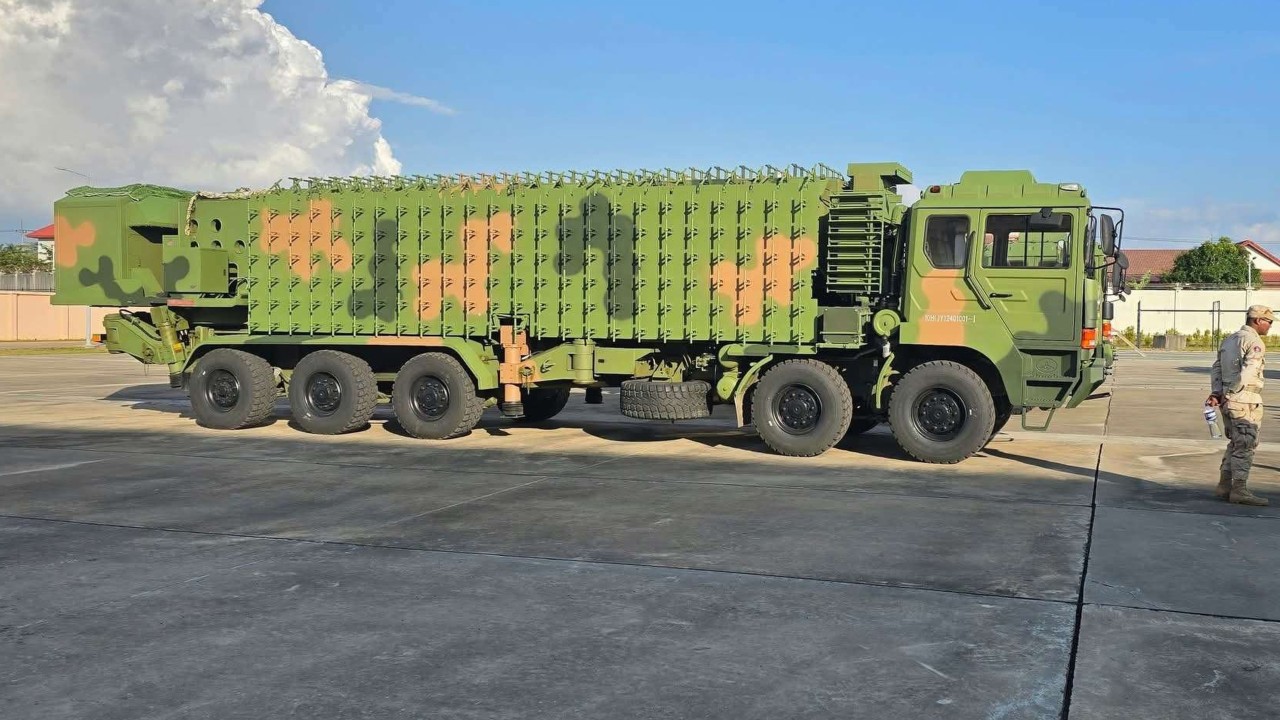
A long-range Chinese radar rolled onto Cambodia's Ream Naval Base during the Golden Dragon 2026 exercises, and suddenly everyone is arguing about permanent bases again.
Let's be honest. Most headlines treat every piece of Chinese hardware in Cambodia like a smoking gun. A truck shows up with an LCQ-776 air surveillance radar, and commentators immediately act as if the People's Liberation Army just planted a permanent air-defense dome on the Gulf of Thailand.
It's not quite that simple. Nor is it harmless "disaster relief" window dressing, despite what official press releases say.
When you look at what actually happened during Golden Dragon 2026 alongside years of satellite tracking and defense reporting, the real story isn't a binary yes-or-no over whether Ream is a "secret base". The real story is access, sensors, and hedging—and how Phnom Penh tries to play multiple sides while leaning heavily on Beijing for military hardware.
Why Ream Naval Base Keeps Drawing Scrutiny
Ream sits on Cambodia's southern coast along the Gulf of Thailand, within striking distance of key maritime routes linking the gulf to the South China Sea. Because it's the main sea-access hub for the Royal Cambodian Navy, any major construction or foreign deployment there carries weight far beyond Preah Sihanouk province.
For years, Western officials and defense analysts have watched China fund and build upgrades at Ream—including piers, support facilities, and a joint training center—while Chinese warships have made repeated, extended appearances. Cambodia has consistently pushed back. Phnom Penh insists its constitution bars foreign military bases, denies granting China exclusive control, and has pointed to openness toward visits by other foreign navies.
Think about how defense watchers read that gap between words and concrete. In security analysis, you don't just listen to diplomatic assurances. You watch pier lengths, vessel rotations, command buildings, and mobile sensors. Every time a new system appears on base grounds, analysts ask a sharper question: Is this a temporary drill prop, or is it a glimpse of how sensors and logistics could plug into regional surveillance?
What the LCQ-776 Radar Adds to the Picture
During Golden Dragon 2026—staged in late November across 15 days with nearly 3,000 troops, including around 1,300 Chinese personnel, making it the largest edition since the series began in 2016—images surfaced showing a Chinese-made LCQ-776 radar system at Ream.
The LCQ-776 is a mobile solid-state air surveillance and early warning radar, widely reported with an air detection reach extending up to around 500 kilometers. In plain English, that kind of sensor is built to track aircraft at long range rather than merely spot a rogue speedboat near the jetty.
Here's the catch if you're trying to read this photo like an intelligence brief: a photograph from a joint exercise proves presence during a drill, not permanent installation or Chinese command. Joint exercises routinely bring in headline hardware—tanks, artillery, communications gear, and radars—to showcase interoperability and political alignment. Official statements around Golden Dragon 2026 framed the drills around counterterrorism, anti-piracy, and humanitarian assistance and disaster relief.
Still, radar optics matter in Southeast Asia. Even temporary deployments give forces practice setting up emitters, linking data feeds, and operating along a coastal corridor near contested maritime waters. And when a long-range air radar shows up at the exact facility where China has invested heavily in infrastructure, skeptical neighbors and Washington aren't going to shrug it off just because the banner says "humanitarian relief".
Why Cambodia Leans on China While Hedging Elsewhere
If you only watch Beijing's moves, you miss half the equation. Cambodia's leadership has its own incentives—and its own limits.
Analysts at institutions like the Lowy Institute have pointed out that Cambodia's defense ties with China reflect converging interests rather than identical goals. Phnom Penh wants to modernize aging forces and strengthen its security posture vis-à-vis regional neighbors like Thailand and Vietnam, while Beijing wants deeper influence and operational reach in Southeast Asia.
At the same time, Cambodia isn't locking every door. Reporting in 2026 noted Cambodian Prime Minister Hun Manet's announcement that long-halted joint military exercises with the United States are slated to resume in 2027, years after Phnom Penh ended earlier drills with Washington in 2017.
That's classic small-state hedging—kinda messy, pragmatic, and rarely clean enough for bumper-sticker geopolitics. A country can accept Chinese funding, buy Chinese air-defense gear, host big PLA contingents for Golden Dragon, and still try to keep diplomatic and security channels open with the U.S. and other regional partners to avoid total dependency.
What Analysts Actually Get Wrong About Ream
I've seen two lazy mistakes repeated whenever Ream hits the news cycle:
- Mistake 1: Treating every upgrade as an instant PLA base. Not every foreign-built pier or visiting radar equals a sovereign overseas base like Djibouti. Sovereign control, legal status, and day-to-day operational authority are distinct questions.
- Mistake 2: Dismissing sensor deployments as "just a drill." Exercises aren't a vacuum. They test logistics, familiarize troops with local terrain and facilities, and normalize foreign hardware in sensitive locations.
Honestly, the truth usually sits in the gray zone between those two extremes. A base doesn't have to be a carbon-copy foreign enclave to shift regional calculations—preferential access, shared training, and familiar equipment already change how neighboring militaries plan.
Practical Next Steps If You're Tracking This Story
If you're following Ream Naval Base and Golden Dragon 2026 for work, research, or sharp situational awareness, don't rely on single-day headlines:
- Check what happens after the exercise window closes. Drills have start and end dates. Watch whether mobile radar and support units depart or linger once Golden Dragon wraps up.
- Cross-reference official claims with independent imagery and defense briefings. Compare press releases from defense ministries with open-source satellite analysis and regional think-tank assessments.
- Track diplomatic moves alongside military ones. Watch port calls by non-Chinese vessels and follow-through on planned U.S.–Cambodia exercise restarts to see how Phnom Penh balances its alignment.
Chinese radar spotted at Cambodia's Ream Naval Base during Golden Dragon drill
Watching the visual coverage of the exercise alongside the radar details helps put the scale of the Golden Dragon deployment and equipment on display into concrete perspective.