We generate massive amounts of waste every single day, and standard construction relies heavily on energy-intensive, resource-depleting materials. Thai architect Boonserm Premthada looked at an overlooked roadside nuisance in rural villages and saw a structural solution. Instead of ignoring mountains of discarded animal byproduct, he turned it into solid, hand-shaped building blocks.
This unusual material choice led directly to the construction of the Goya Tower in Phang Nga, southern Thailand. It is a sculptural public landmark built almost entirely from sun-cured elephant dung bricks. If you think building with animal waste sounds absurd, you are missing the point of modern sustainable design.
The Reality of Elephant Waste Management
Walk through Ta Klang Village or any elephant-dense region in Thailand, and you will notice an inescapable physical fact. There is dung everywhere. Elephants consume massive amounts of vegetation daily, digesting only a fraction of what they eat. The rest comes out as bulky organic waste.
Historically, this byproduct gets left behind or used in small amounts for paper and fertilizer. But when local elephant populations grow, the sheer volume of organic waste becomes a logistical problem for rural communities. Premthada didn't approach this from a sterile corporate sustainability standpoint. He looked at it as a raw local resource.
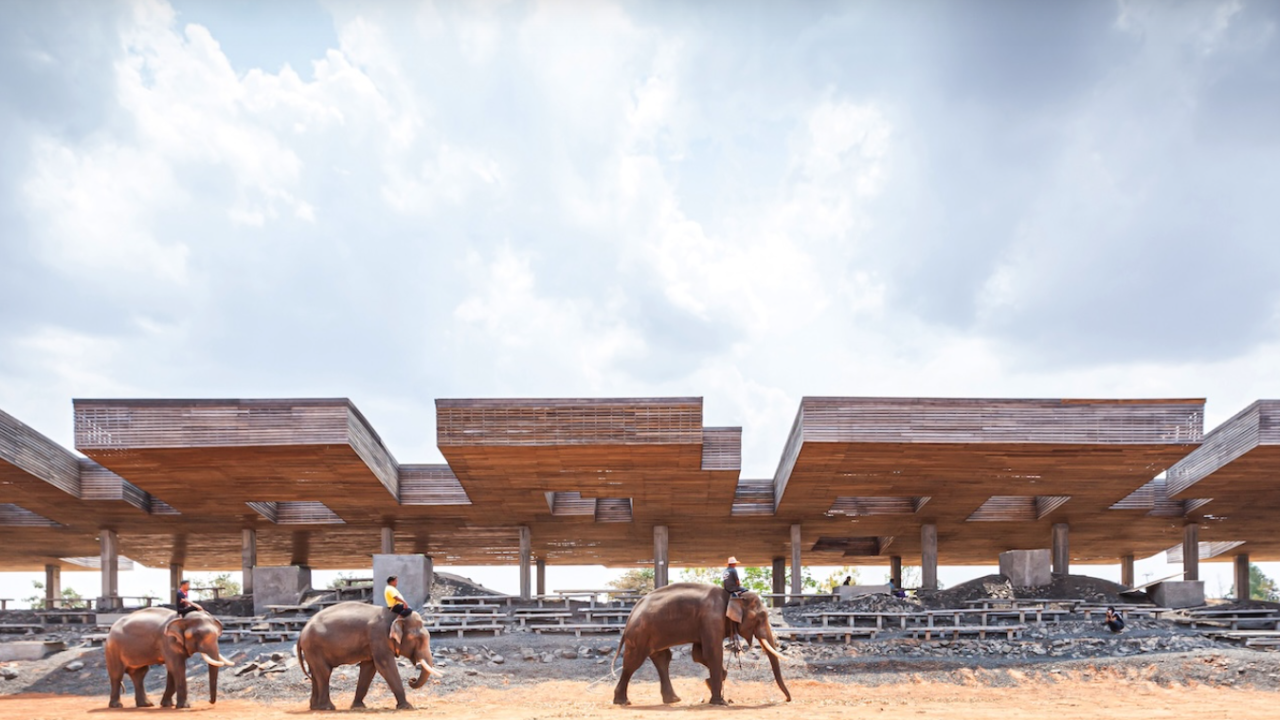
His experiments began after finishing the Elephant World project in northeastern Thailand in 2021. Instead of shipping in conventional concrete blocks that drain regional resources, he started mixing the raw dung with local soil, cement, stucco, tree bark, leaves, and natural plant-based pigments.
How to Make a Building Block Out of Dung
Forget industrial kilns and carbon-heavy firing processes. The production method for these bricks is low-tech, labor-intensive, and entirely reliant on natural resources.
Workers shape the mixture by hand into distinct modular units. For the Goya Tower, these circular bricks measure 33 centimeters across and 5 centimeters thick. They cure under the direct heat of the sun rather than going into a high-temperature factory oven.
This manual manufacturing process creates unique practical benefits:
- It eliminates the massive carbon footprint associated with traditional brick firing.
- It keeps manufacturing jobs local, directly engaging community labor.
- It utilizes materials that cost practically nothing and are locally abundant.
The bricks emerge in five distinct natural, sunset-inspired colors depending on the exact mix of soil and organic matter. These varied hues give the final structures their distinct visual texture without requiring artificial chemical dyes.
Inside the Goya Tower Design
The Goya Tower stands at the entrance of the Matalay resort development in Phang Nga, right near Khao Chang, known locally as Elephant Mountain. The limestone formation resembles a reclining elephant, anchoring the tower deeply into regional geography and folklore.
The structure itself is named after a local female elephant. Rather than acting as a solid, monolithic block, the tower consists of cylindrical columns. Builders thread individual hand-shaped dung bricks onto central steel rods, stacking them by color.
These columns form curved internal walkways where visitors can climb upward. As you move through the interior, the arrangement of the bricks creates shifting patterns of light and shadow, framing views of nearby roads, gardens, and the sea. The bricks serve a dual purpose, functioning simultaneously as the building's exterior surface and its structural core.
Moving Beyond a One-Off Architectural Gimmick
Skeptics often dismiss unusual building materials as short-lived media stunts. Premthada’s work with animal waste spans several years and international exhibitions, proving it is a scalable concept.
He showcased early public tests at the Île-de-France Architecture and Landscape Biennial in 2022, followed by exhibitions at London's Academy of Art using dung sourced from the Colchester Zoo. He also built the Elephant Chapel using sun-cured dung discs at the 2025 Venice Architecture Biennale.
These international tests proved the technique is not restricted to a single village in Thailand. Because the process relies on locally sourced organic material, builders can adapt the formula anywhere elephants or large herbivores produce manageable waste streams.
Architecture rarely questions its foundational materials. We default to concrete, steel, and kiln-fired clay because those supply chains are familiar, not because they are smart. When designers look at local ecosystems and treat organic waste as a structural asset instead of a disposal problem, the built environment changes for the better.