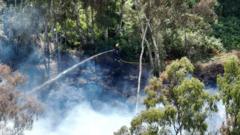
Fighting a wildfire on deep organic soil isn't like spraying water on a burning house. It's an exhausting, high-heat battle against an invisible underground enemy. When peatlands catch fire, they don't just flame on the surface. They smolder beneath the earth for weeks, turning protective firefighter gear into a personal steam chamber.
If you've ever wondered why crews describe tackling these incidents as feeling like they're "boiling in the bag," you need to understand the physics of peat. Peat is basically ancient, compacted plant matter packed with moisture and trapped carbon. When it dries out due to prolonged dry spells or climate pressures, it becomes an underground fuel source.
The Brutal Reality of Subsurface Heat
Surface fires move fast. You chase them, beat them down, and clear a break. Peat fires do the exact opposite. They burrow underground.
The fire eats away at layers of organic soil meters below the grass line. Crews walk over ground that looks stable, only to risk sinking into hot ash pits. When water hits the burning peat, it doesn't just put out the fire. It creates massive clouds of boiling steam and dense, acrid smoke trapped by protective layers of waterproof turnout gear.
That moisture has nowhere to go. It builds up inside the suits. Crews get cooked by their own sweat and trapped heat. It's a brutal micro-climate of humidity and radiant thermal energy.
Why Peatland Fires Are So Hard to Extinguish
Most people assume a heavy downpour solves the problem. It doesn't.
Water often beads off dry peat or channels around the burning pockets without reaching the seat of the fire. Crews have to use specialized equipment. They rely on heavy excavators to dig up the smoldering organic layers, turning and breaking up the earth so water and low-concentration foam can actually penetrate the mass.
Thermal imaging cameras are non-negotiable tools here. Without them, firefighters are operating blind in thick layers of yellow pall and soot, guessing where the underground fire is traveling next.
- Hidden voids: Burned-out roots leave hollow underground caves that collapse under a firefighter's weight.
- Toxic emissions: Smoldering organic matter releases high levels of carbon monoxide and sulfur, forcing crews to rotate constantly.
- Stubborn persistence: Without mechanical excavation, a peat fire can burn beneath the snow all winter and flare up again in spring.
What Needs to Change
We can't just treat these incidents as ordinary brush fires. Fire services dealing with upland ecosystems need heavy machinery on standby early. Waiting for a peat fire to surface means you've already lost the opening week of the fight. Land managers must also prioritize water table restoration to keep these bogs saturated before dry weather hits.
Protecting the crews means giving them the right tools to break the ground open fast, rather than letting them suffer in a suffocating steam bath while the earth burns from the inside out.