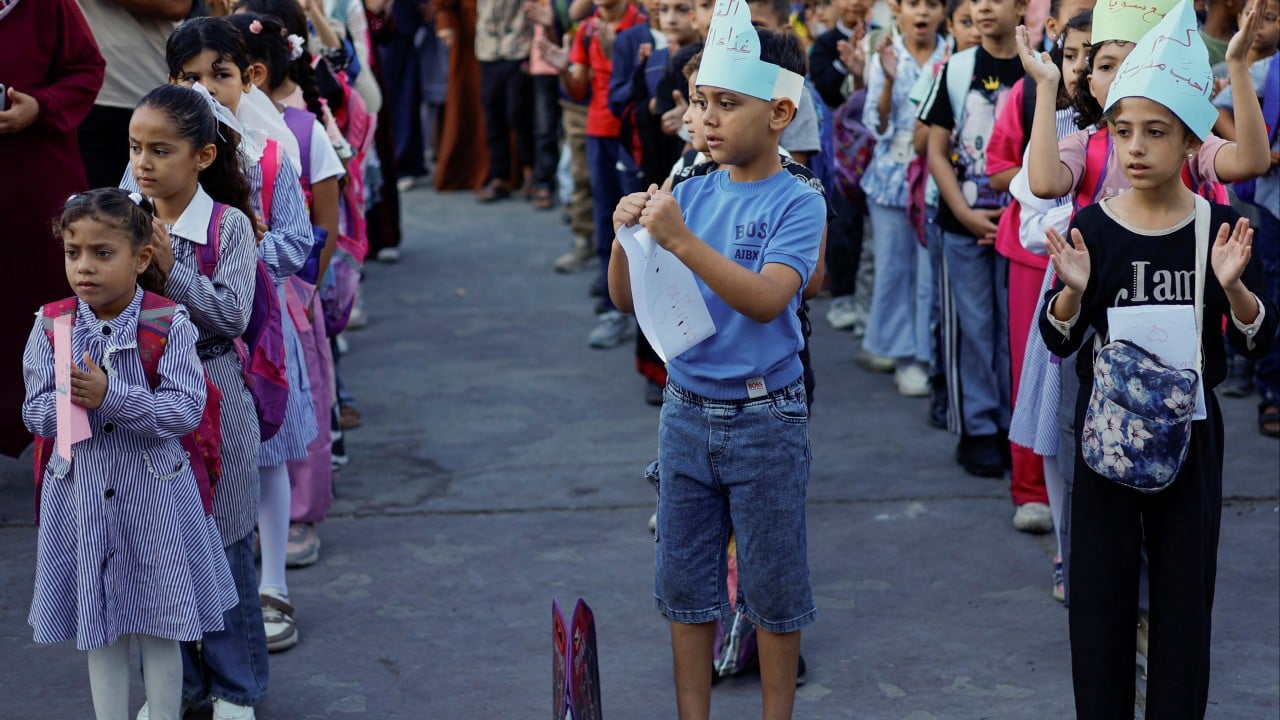
Desks are missing. Walls are gone. But the notebooks are open anyway.
Hundreds of thousands of children in Gaza walked back into classrooms on Saturday for the first time in nearly three years. You're looking at a milestone born out of absolute desperation. UNICEF data shows that 98 percent of schools in Gaza were either completely destroyed or severely damaged during the war. Normal buildings don't exist for these kids anymore. Instead, education happens under canvas tents, amid piles of concrete rubble, and on bare dirt floors.
If you want to understand the true cost of prolonged conflict, look no further than an entire generation locked out of learning. About 660,000 students have been deprived of consistent in-person education for a third consecutive year. The reopening isn't a polished institutional rollout. It's a fragile, desperate scramble by local education officials and international agencies to piece together a fragmented school year for roughly 540,000 to 541,000 students through a mix of physical tent schools and virtual lessons.
The Reality Behind Tent Classrooms and Missing Supplies
Walk through Khan Younis or Gaza City right now, and you won't see pristine hallways. You'll see improvised tarpaulins strung over metal poles. Education officials like Ibrahim Ramadan, director of education for East Khan Younis, call this a fragile milestone. It's hard to argue with that label when you look at the human toll. The conflict has claimed the lives of roughly 22,000 students and more than 770 education workers, including 532 teachers.
Supplies are another nightmare entirely. Basic items have become luxury goods due to severe import restrictions. Stationery trader Khaled Aliyan points out that notebook prices spiked from 3 shekels to a staggering 15 shekels. Families simply can't afford uniforms, pens, or proper paper. Yet, teenagers like 15-year-old Samar Abu Salmi show up anyway, determined to chase a future that others tried to erase.
How Aid Groups and Communities Are Fighting for a Classroom Routine
Organizations like UNICEF and UNRWA are stepping in to provide psychosocial support alongside basic instruction, trying to patch up minds as well as curricula. But the hurdles are massive.
- Schools destroyed or heavily damaged: 98%
- Estimated students out of school or displaced from normal routines: over 660,000
- Students participating in the newly opened academic year: ~540,000
Virtual learning remains a lifeline for the kids who can't physically reach a tent school due to ongoing displacement or security risks. It's clunky, it's unstable, but it's working. Teachers are holding classes wherever they can find a patch of shade.
What Comes Next for Gaza's Students
The reopening of these makeshift facilities isn't a magic fix. It's a statement of stubborn survival. If you're tracking humanitarian aid or international education efforts, watch how local communities sustain these temporary learning hubs through shifting security conditions and skyrocketing material costs. Support local educational funds directly if you want to make an actual dent in the stationery and supply shortages hitting these families.
Education is surviving in Gaza because refusal to quit is the only option left.
Gaza's children return to school after nearly three years of war
This video provides an on-the-ground look at how children in Gaza are adapting to makeshift tent schools and navigating the destruction of their neighborhoods to resume their education.
http://googleusercontent.com/youtube_content/1