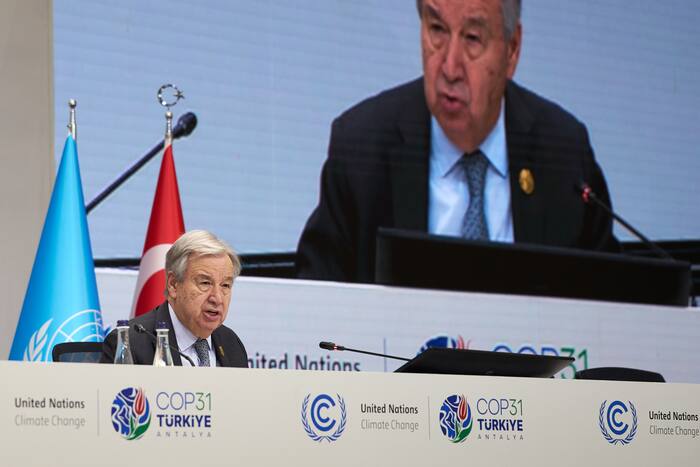
The brutal reality of global heating hit a hard wall at the COP31 summit in Antalya. United Nations Secretary-General António Guterres didn't mince words when he stepped up to the microphone. He called for immediate, drastic cuts to greenhouse gas emissions, warning that a temporary breach of the critical 1.5 degrees Celsius warming threshold is now locked in.
We aren't just talking about abstract numbers on a scientific chart anymore. Extreme weather events are rewriting the rules of daily life. From devastating floods in South Asia to catastrophic heatwaves killing tens of thousands across Europe, the cost of inaction is piling up in hospital wards and battered infrastructure. Yet political systems continue to drag their feet, treating an existential emergency like a routine bureaucratic debate.
The Math Behind the 6 Percent Rule
Science doesn't negotiate, and right now, the numbers are flashing red. Global emissions reached historic highs last year, pushing planetary systems into dangerous territory. To keep a warming overshoot as brief and shallow as possible, global emissions must fall by roughly 6 percent every single year.
Current national climate plans don't even come close. They deliver at best one-third of the required cuts. If every country fully implements its current promises without raising ambition, the world is heading toward a disastrous 2.5 degrees Celsius of warming by the end of this century. Crossing that line means triggering irreversible tipping points that will permanently alter sea levels, agricultural yields, and water supplies.
Guterres pointed out an uncomfortable truth that many world leaders prefer to ignore: the economic case for clinging to fossil fuels is entirely collapsing. Three-quarters of humanity live in countries that import fossil fuels, holding them hostage to volatile price shocks and geopolitical conflicts. Staying addicted to coal, oil, and gas isn't just an environmental suicide pact; it is a chronic security risk and a guaranteed cost-of-living crisis.
Where the Political Will Breaks Down
Why are we moving so slowly when the solutions are already sitting on the table? The answer comes down to entrenched interests and short-term political horizons. Fossil fuel companies continue to rake in massive profits while actively working to delay meaningful climate action.
Consider the stark financial asymmetry exposed at the summit. The world's top oil companies pulled in staggering billions in profit over a single quarter, while international funds dedicated to helping vulnerable developing nations recover from climate disasters received a tiny fraction of that amount. Guterres didn't hesitate to call out the imbalance, demanding that governments implement windfall profit taxes on polluters to fund adaptation and loss-and-damage initiatives.
Diplomats spend weeks arguing over text paragraphs and phase-out timelines while communities drown or burn. Brazil's President Lula da Silva highlighted that international attention has increasingly shifted toward weapons and trade tariffs rather than human survival. When global superpowers prioritize geopolitical posturing over ecological preservation, the entire multilateral framework begins to fracture.
What Real Action Actually Looks Like
Surrender is not an option. The explosion of cheap wind and solar power proves that a clean energy transition is entirely possible. But scaling renewables requires tearing down systemic roadblocks and shifting capital at an unprecedented velocity.
Real climate strategy rests on a few non-negotiable pillars:
- Stopping the expansion of new coal, oil, and gas infrastructure that locks in high emissions for decades.
- Slashing methane leaks, which provides the fastest brake on warming we can pull today.
- Building robust national grids and energy storage systems capable of handling massive electrification.
- Delivering financial and technological support to developing nations so they can bypass the fossil-fuel era entirely.
The technology to fix this crisis already exists. The economics favor clean energy over dirty combustion. What's missing is the political courage to enforce accountability and demand immediate structural change before the window closes completely.