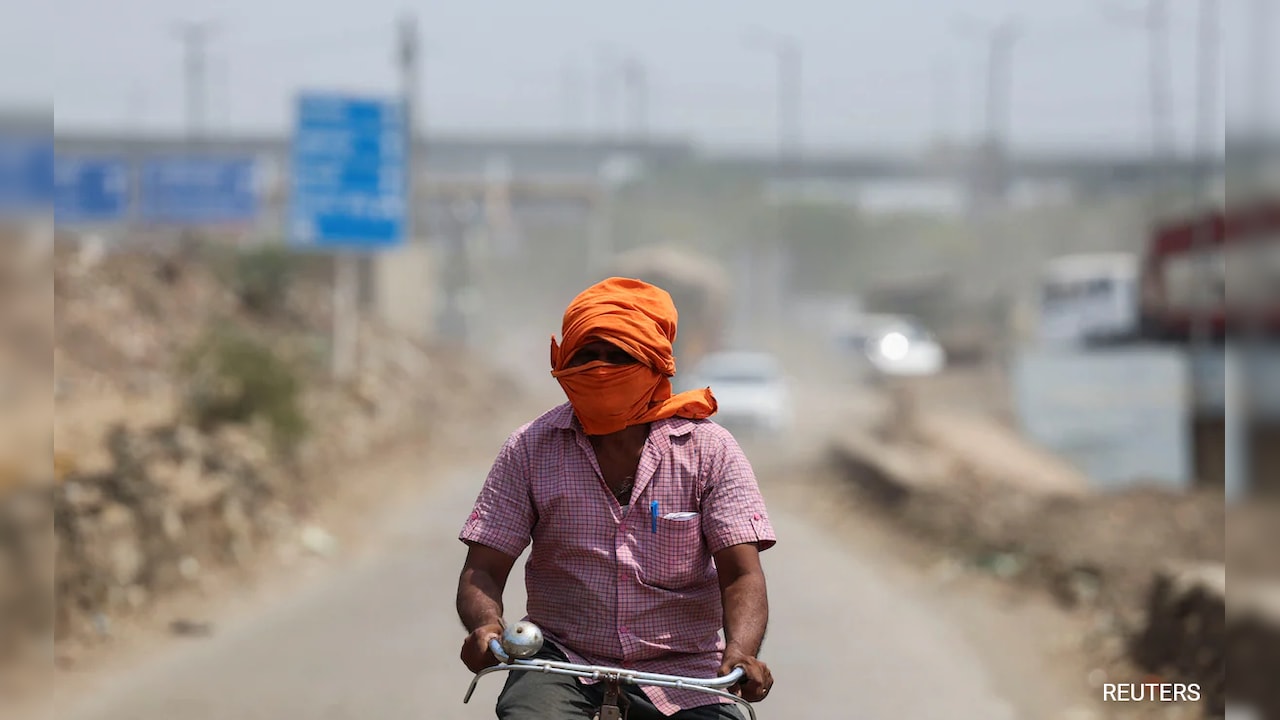
Look at a global temperature map from space, and you'll spot a weird anomaly over South Asia. While the rest of the planet bleeds deep red and orange with rising industrial fever, India sits as a stubborn pale patch. Climatologists call it a warming hole.
It sounds counterintuitive. Cities like Banda or Delhi regularly smash headlines with blistering mid-40s°C temperatures. Yet, long-term tracking tells a different story. India's overall average temperature has crept up by less than 0.9°C since 1900. Compare that to a global spike of 1.4°C since 1980, and you realize something strange is shielding the subcontinent.
The Groundwater Shield
You can trace part of this cooling effect straight to the soil. India pumps massive amounts of underground water to keep its vast agricultural plains green year-round.
Think of it on a continental scale. When billions of gallons of groundwater get slathered across millions of farms, the sun spends its energy evaporating that moisture instead of baking the air directly. It’s basic physics. Evaporation cools things down.
Researchers at Harvard and Columbia point out that this mimics what happens in the American Midwest. Heavy irrigation acts as a natural air conditioner. But there is a dark catch. Farmers are draining aquifers faster than monsoon rains can refill them. Once that groundwater runs dry, the cooling buffer disappears with it.
The Aerosol Trap
Pollution plays a heavy hand here too. You can't talk about India's climate anomaly without looking at its skies.
A thick soup of industrial aerosols, dust, and black carbon hangs over the region. These particles don't just dirty the air; they act as a planetary sunshade. Sulfate aerosols bounce incoming solar radiation right back out into space before it can hit the ground and warm the surface.
Harvard researchers note this creates a brutal paradox. The very pollution choking millions of citizens and claiming thousands of lives each year is simultaneously putting a temporary brake on runaway local warming. Cleaner air policies, vital for public health, might inadvertently unleash pent-up heat.
Monsoon Dynamics and Cloud Cover
Recent atmospheric models suggest another player in this mystery. Scientists at the Chinese Academy of Sciences argue that rising carbon dioxide levels are altering the land-sea temperature gradient.
That shift strengthens monsoon winds and kicks up massive cloud formations over the subcontinent. Clouds reflect sunlight away from the earth. Nature finds a way to balance the ledger, at least temporarily, by throwing up an umbrella of clouds during crucial months.
Yet, veteran climatologists remain skeptical that cloud cover alone can cancel out the relentless math of greenhouse gases. It is a temporary shield, not a permanent fix.
What Happens When the Shield Fails?
The warming hole won't stay open forever.
As India modernizes, two major things will shift. Groundwater reserves are hitting critical lows, and clean-air regulations will eventually clear out the reflective aerosols. When those two protective factors fade, the suppression effect dies.
Experts warn that India's temperature trajectory will likely accelerate to catch up with—or even outpace—global averages. For the millions of construction workers, farmers, and outdoor laborers who already endure brutal summer extremes without air conditioning, the illusion of safety is wearing thin. Stop treating the warming hole as a permanent blessing and start planning for the heat spike waiting around the corner.
Why India's Summer Isn't as Hot as Expected | Complex Weather Systems Explained | DTE News
This video explores the complex weather systems and atmospheric anomalies keeping parts of India cooler during peak summer months.
http://googleusercontent.com/youtube_content/1