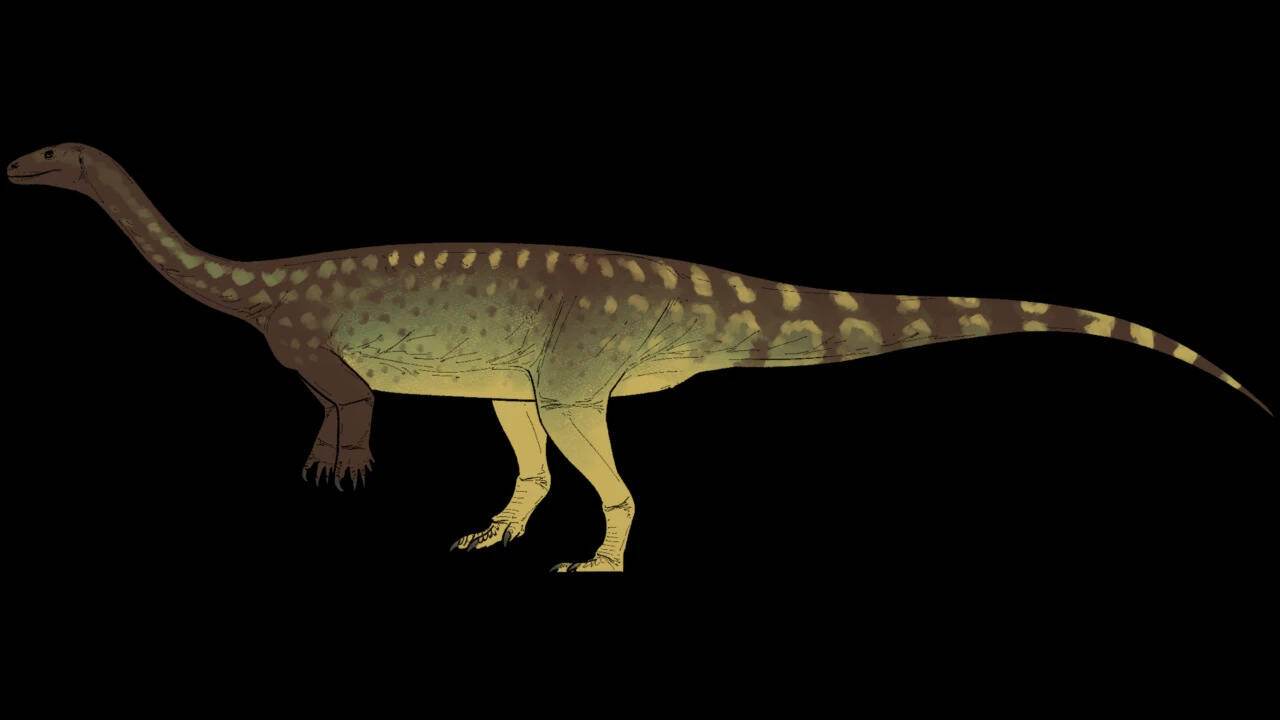
Imagine a toddler tipping the scales at 400 kilograms, and then realize it wasn't even close to being fully grown. That is the reality behind Nyana rooiwalensis, a newly named dinosaur species that just completely upended what we thought we knew about early sauropodomorph growth rates.
Unearthed from the rich fossil beds of South Africa's Eastern Cape province, this prehistoric youngster lived over 200 million years ago during the Late Triassic or Early Jurassic. While most people picture tiny, fragile beginnings for lineages that eventually produced multi-tonne giants like Brachiosaurus, Nyana tore up that script. At barely three years old, it was already built like a tank.
The Skull Hiding in Plain Sight
The discovery started with a remarkably preserved skull found near Qhemegha village back in 2018. Measuring roughly 21.3 centimeters long, the cranium included critical elements like the braincase, palate, and hyoid bone. Well-preserved skulls from this group of early plant-eaters are exceptionally rare in southern Africa.
Researchers at the University of the Witwatersrand, led by Atashni Moopen, didn't just look at the bone with the naked eye. They used high-powered X-rays at the European Synchrotron Radiation Facility to scan the specimen internally. This non-destructive imaging let the team build a precise three-dimensional digital model without risking damage to the fragile ancient fossil.
That digital reconstruction proved the specimen belonged to an entirely new species. But the real surprise waited inside the animal's limbs.
Microscopic Bone Rings Reveal a Giant in the Making
If you slice open a fossilized dinosaur bone and put it under a microscope, you get a front-row seat to its life history. Tree rings tell a story of seasons, and dinosaur bones do something remarkably similar through lines of arrested growth.
When researchers examined thin sections of Nyana's limb bones, they found at most two growth arrest lines. That meant the animal was roughly three years old when it died. More importantly, the porous, unremodeled outer surface of the bone shouted one clear message: this creature was still actively growing.
By measuring the circumference of the thigh bone and plotting it against known growth curves of related early dinosaurs, scientists calculated that the juvenile weighed about 400 kg. For comparison, that is more than four times the mass of similarly aged Massospondylus or Mussaurus specimens.
If a three-year-old weighed as much as a grand piano, imagine what an adult looked like. While researchers haven't found a fully grown specimen yet, extending these growth curves suggests adults easily scaled up to multiple tonnes.
Where Nyana Fits on the Family Tree
Nyana belongs to the sauropodomorph group, the evolutionary precursors to the colossal, long-necked sauropods that dominated later prehistoric ecosystems. Unlike those later four-legged titans, Nyana likely walked on two legs.
Analyses suggest interesting geographical links. The team found that Nyana might share a close evolutionary kinship with Sarahsaurus from North America or Ngwevu from South Africa. This hints at complex migration patterns and distribution routes across ancient supercontinents before continental drift rearranged the globe.
Finding out that rapid growth happened this early in sauropodomorph history changes how paleontologists view the evolutionary arms race toward gigantism. Size wasn't just an afterthought for later species. The biological machinery for massive weight gain was already shifting into high gear over 200 million years ago.
Stop thinking of early dinosaurs as slow-growing underdogs. Nyana proves that some prehistoric youngsters were already heavyweights long before hitting adulthood.