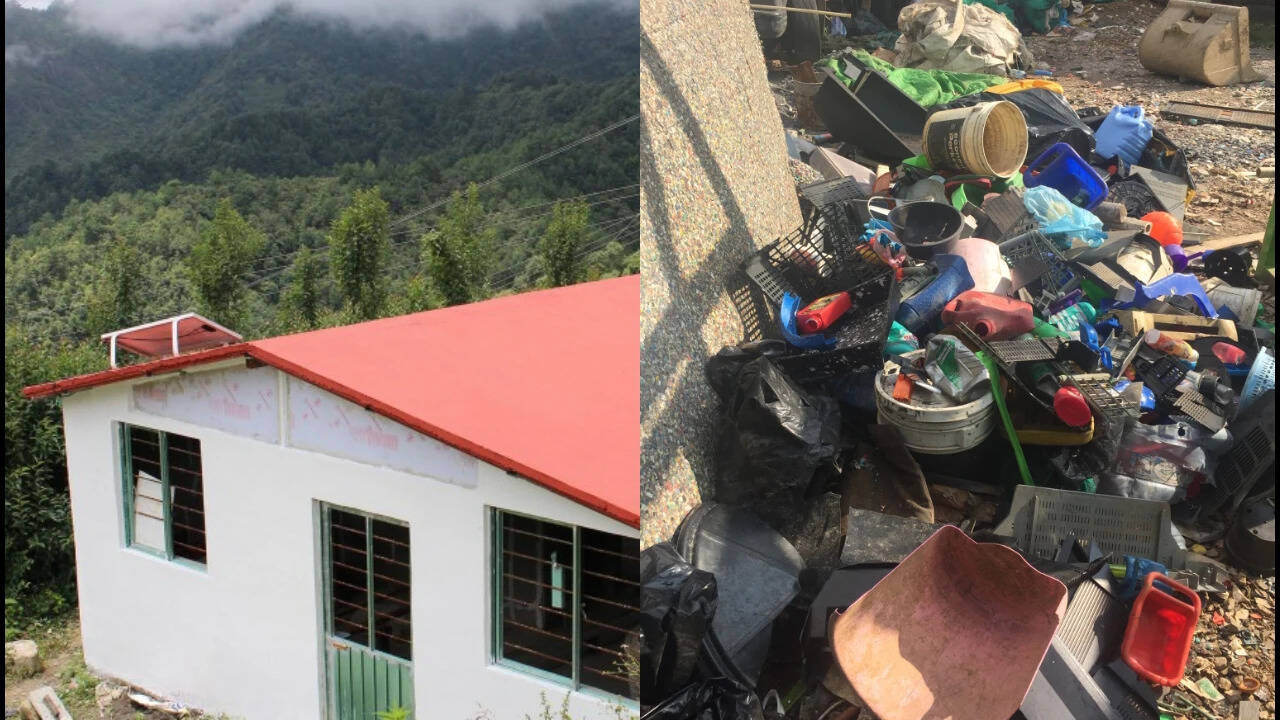
You see mountains of plastic bottles everywhere, and nobody seems to have a real plan to fix it. Landfills overflow. Oceans choke. Meanwhile, families live in shacks with dirt floors because proper housing costs way too much.
Carlos González figured out how to solve both problems at once.
Raised in the mountainous region of Puebla, Mexico, González watched families struggle with deep poverty and poor living conditions. Instead of waiting for a massive government grant or a miracle, he started experimenting in 2013 with a simple idea. Discarded plastic isn't garbage. It's building blocks.
His company, EcoDom, takes PET bottles, high-density polyethylene, polypropylene, and various consumer plastics, then turns them into structural housing panels. Each house uses about two metric tons of waste plastic. They take just a week to build. And the cost to low-income families sits at roughly 5,000 Mexican pesos, which translates to about $280.
How Plastic Trash Becomes a 450 Square Foot House
Building with waste sounds easy on paper, but the engineering has to hold up. You can't just glue old shampoo bottles together and expect people to live safely inside.
The process requires strict collection and sorting. EcoDom gathers plastic from local businesses, independent collectors, and community recycling drives. Workers grind down the materials into fine flakes. Next, they load those flakes into custom molds, heat them up, and press them hard into durable construction components.
The factory outputs modular panels for structural walls, slabs, mezzanines, and thermal roofing systems. Each wall panel consumes around six kilograms of processed plastic.
Traditional concrete and masonry take weeks to cure, require heavy machinery, and cost a fortune in freight and materials. EcoDom's system bypasses those headaches. Because the panels lock together easily, a standard 430 to 460 square foot home goes up in just seven days.
Let's look at the operational breakdown:
- Waste consumption: Roughly 2 tonnes of plastic per house.
- Build time: About 7 days.
- Family cost: Around $280 (5,000 pesos) for subsidized units.
- Material strength: Often more resistant to certain structural loads than standard cinder block masonry.
The Business Model Behind Cheap Housing
Charity sounds nice, but pure charity rarely scales. Nonprofits run out of donations, and grant money dries up. González built a hybrid model instead.
EcoDom operates as a commercial enterprise that sells building materials and construction services at market rates. That revenue keeps the lights on, pays the workforce, and funds research and development. When the company makes a profit on standard construction, a portion of that cash gets funneled into social subsidies.
That is why impoverished families can acquire a decent roof over their heads for $280.
Poor families can also contribute their own labor during construction. Sweat equity cuts costs even further and gives people actual ownership over their living space. It transforms a hand-out into a community project.
The social impact keeps growing. EcoDom has already sold two houses, donated five complete homes, and built three separate bedroom additions for families in desperate need. Now, the team is scaling up with plans to help construct 250 houses in Puebla, partnering with academic institutions like the Universidad Cuauhtémoc de Puebla to refine their methods.
Scaling Up Beyond Mexico
Word travels fast when you solve two global crises simultaneously. International organizations and private entities from India, Canada, France, Brazil, South Africa, Guatemala, and the Dominican Republic have already reached out to study the technology.
With over 8 million Mexican pesos invested in developing the business over the years, González is preparing to franchise the EcoDom concept. Franchising means local entrepreneurs in other countries can set up their own recycling and molding plants using local waste streams.
You don't need a massive petrochemical plant to build affordable housing. You just need to stop throwing away materials that can protect human lives.
If you want to support or replicate initiatives like this in your own community, start by looking at local plastic waste streams. Connect with local recycling centers, push for municipal sorting programs, and support modular construction startups that prioritize human dignity over profit margins.