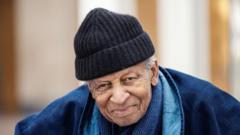
You don't just listen to Abdullah Ibrahim. You feel the weight of history shifting under his left hand on the piano.
The news of his passing in Germany at 91 hits hard, not because it was unexpected for a man who lived nearly a century, but because he felt like a permanent piece of South Africa's soul. When his family confirmed he died peacefully after a short illness, it closed a monolithic chapter of global music. He wasn't just a jazz musician. He was the sonic architect of a revolution, the guy who gave a broken nation its definitive anthem when politicians had nothing left but bullets.
If you only know him from a headline or a streaming playlist, you're missing the real story. His life wasn't a neat series of career milestones. It was a chaotic, beautiful, and deeply spiritual battle against a regime that tried to erase his very identity.
From Dollar Brand to the Voice of a Movement
Long before he was Abdullah Ibrahim, he was Adolph Johannes Brand, born in Cape Town in 1934. The streets of District Six and Kensington weren't easy, but they were loud. His mother and grandmother played piano in the local African Methodist Episcopalian church, anchoring his childhood in gospel tunes and traditional Khoi-san songs. Down at the Cape Town docks, he'd hustle for records from visiting American GIs, soaking up bebop like a sponge.
Friends nicknamed him "Dollar" because he was obsessed with imported US records. By 15, he was playing professionally. By 1959, he was leading the Jazz Epistles alongside legendary trumpeter Hugh Masekela and saxophonist Kippie Moeketsi. They recorded the first-ever jazz album by an all-Black South African ensemble.
Then the state cracked down.
Following the Sharpeville massacre in 1960, the apartheid government turned its crosshairs on jazz clubs. The regime hated jazz because it did something illegal: it brought people together across racial lines. Mixed-race bands were banned. Audience segregation was enforced with brutal violence.
Ibrahim chose exile, moving to Europe in 1962. It was a desperate move, but it led to a legendary stroke of luck. In 1963, his future wife, the brilliant vocalist Sathima Bea Benjamin, cornered Duke Ellington in Zurich and practically dragged him to a club to hear Ibrahim’s trio. Ellington was so blown away he immediately produced their first international record, Duke Ellington presents The Dollar Brand Trio.
The Blueprint of a Cultural Revolution
In 1968, searching for grounding in an increasingly fractured life, he converted to Islam and became Abdullah Ibrahim. His music changed. It got deeper, more hypnotic, and intensely spiritual.
When he temporarily slipped back into South Africa in 1974, he walked into a studio and recorded a track called Mannenberg.
It’s an optical illusion of a song. On the surface, it’s a breezy, rolling melody built on a township jive rhythm called marabi. But beneath that accessible groove lay pure defiance. The track was named after a township where the regime dumped non-white families after tearing down their homes in District Six.
Mannenberg exploded across the country. It was blasted from taxis, played at underground rallies, and hummed in prison cells. It became the unofficial national anthem of the anti-apartheid movement. When Nelson Mandela was locked away on Robben Island, he heard the tape. Mandela later remarked that the track was proof that "freedom was in the air."
What made Ibrahim a genius was his refusal to let his music become a rigid political lecture. He didn't need angry lyrics or ideological rants. He used the rhythm of the soil, the phrasing of church hymns, and the harmonic freedom of American jazz to create a counter-world where apartheid simply couldn't exist.
The Lessons from an Uncompromising Life
Ibrahim was notoriously difficult, unpredictable, and entirely uncompromising when it came to his art. He didn't care about commercial radio formatting or easy-listening trends. He believed music was medicine.
If you want to understand what made his style work, look at his daily discipline. He was a martial arts black belt and deeply invested in Zen philosophy. He regularly traveled to Japan to study with his master. That discipline bled onto the stage. His solo concerts were legendary for their intense silences. He would let notes hang in the air for what felt like minutes, forcing the audience to sit with the space between the sounds.
Even in his final years, long after receiving South Africa’s Order of Ikhamanga and being named an NEA Jazz Master in the United States, he didn't stop. He divided his time between Cape Town and New York, recording reflective, quiet albums like Solotude during the pandemic.
His absolute final public performance in South Africa happened just months ago, in March 2026, at the Cape Town International Jazz Festival. He sat at the grand piano, fragile but completely commanding, playing those same chords that once shook a dictatorship. His partner, Dr. Marina Umari, said it best: he passed away with South Africa and its people in his heart.
Dig Into His Catalog Right Now
Don't let his story end with an obituary. If you want to understand why his loss leaves such a massive void, stop reading about him and actually listen to the evolution of his sound. Skip the generic greatest hits playlists and cue up these specific tracks to hear his genius:
- Mannenberg (1974): The undisputed starting point. Listen to how the main sax melody loops effortlessly over his rolling piano chords. It’s the sound of resilience disguised as a party groove.
- Water from an Ancient Well (1985): A masterclass in mood. It’s slow, melancholic, and deeply rooted in the physical landscape of South Africa.
- The Wedding (From African Space Program): A gorgeous, sweeping melody that shows how he could blend European orchestral sensibilities with African choral traditions.
- Solotude (2020): Just Ibrahim and a piano in an empty hall. It’s stark, deeply spiritual, and shows the absolute control he maintained over his instrument even in his late 80s.
He will be buried in the Bavarian region of Germany where he lived out his final days, but his music belongs to the streets of Cape Town and every bedroom where a listener needs a reminder that some things are too beautiful to be crushed. Turn the volume up.