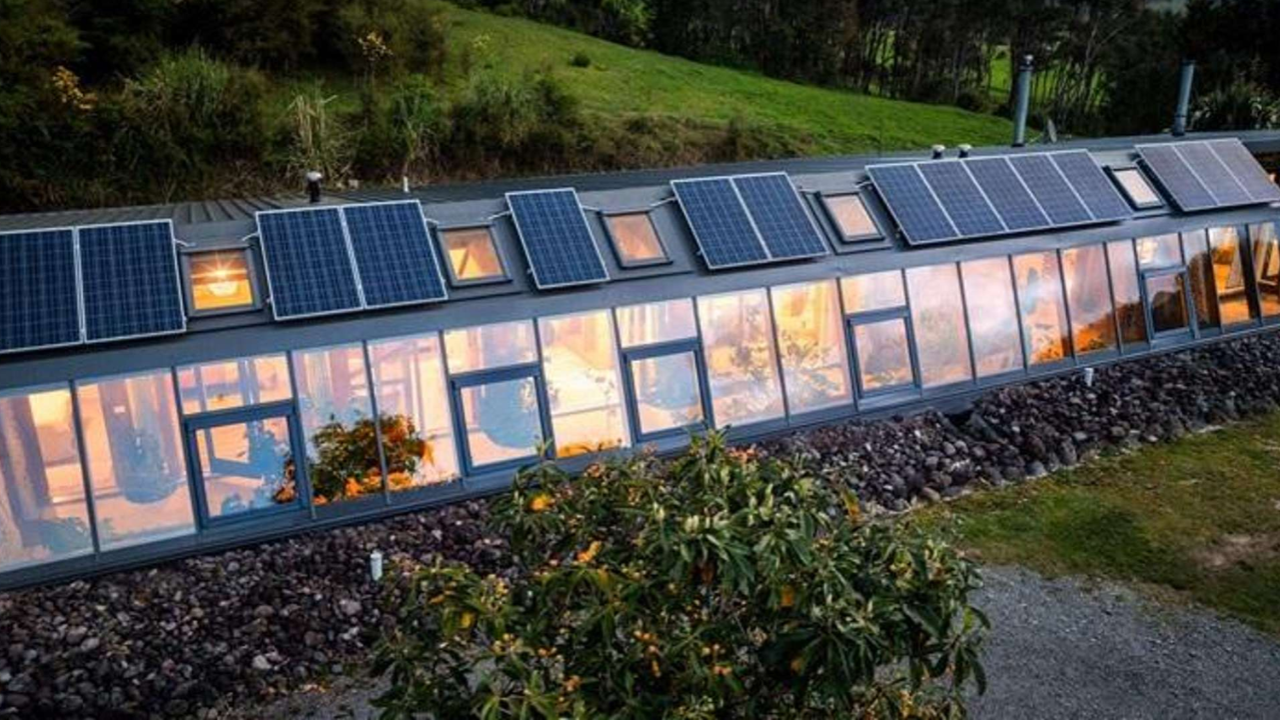
You don't usually see a home built from trash hit the open market with a celebrity television pedigree. But that is exactly what happened in New Zealand's Coromandel region, where the famous Earthship Te Timatanga in rural Hikuai has officially been listed for sale. Built by Gus Anning and Sarah Rowe after a life-changing spark from the documentary Garbage Warrior, this four-bedroom architectural marvel relies on 1,300 recycled tyres and 7,000 glass bottles instead of standard concrete blocks and timber framing.
If you watched the property debut during the inaugural season of Grand Designs New Zealand, you know this wasn't just a quirky weekend DIY project. It was a rigorous, back-breaking architectural statement that took shape in less than a year with the help of international experts, local designers like Graeme North and Young and Richards, and a dedicated family crew. Now that the property is seeking its next owner, it is worth looking past the television fame to examine how an unconventional tyre-and-bottle build actually performs in the real world.
The Reality of Building with Tyres and Bottles
Most people assume an experimental house constructed from waste materials feels damp, drafty, or makeshift. The reality is quite the opposite. Anning and Rowe engineered a structure that maintains a stable internal temperature hovering around twenty degrees Celsius all year round.
The secret lies in thermal mass. The rear walls consist of thousands of rammed-earth tyres packed tightly together, acting as massive thermal batteries. During winter, low-angled sunlight pours through seventy-degree conservatory glazing, warming the heavy structural mass behind the living spaces. When summer arrives, an ingenious passive ventilation loop kicks in: upper Velux windows open up, letting trapped heat escape through vertical vent tubes without needing a drop of electricity for air conditioning.
The seven thousand glass bottles do more than just catch the light. Placed strategically throughout interior partition walls—including striking blue Bombay Sapphire glass—they form translucent insulators that diffuse natural light while structurally reinforcing the walls. It is an exercise in functional beauty that challenges standard construction assumptions.
Living Off-Grid Without Sacrificing Comfort
Building an Earthship forces you to rethink basic utilities. You stop taking municipal supply for granted. Te Timatanga captures every drop of drinking water via extensive rainwater harvesting systems, routing greywater directly into a lush, indoor conservatory botanical bed. The plants filter and utilize wastewater naturally before it ever touches a standard drain field.
Electricity is handled via robust solar arrays capable of feeding surplus energy back into the local grid. Sarah Rowe described the property as living inside a breathing organism, noting how the indoor climate naturally regulates its own humidity through the combination of earthen materials, concrete floors, and internal greenery.
Building a home like this isn't for the faint-hearted. It demands patience, physical endurance, and a willingness to reject standard mortgage and contractor formulas. Anning and Rowe stayed on-site every single day during construction, managing volunteers, cooking meals for international specialists, and keeping their three children involved in the process.
What the Sale Signals for Alternative Architecture
When properties built from unconventional materials transition from owner-builder experiments to high-value real estate listings, the mainstream conversation shifts. For years, municipal councils and conservative lenders viewed homes built from waste rubber and glass bottles with deep suspicion.
Listings handled by major agencies like Bayleys prove that high-performance, off-grid architecture holds genuine market appeal. Five million views on Trade Me Property show an intense public appetite for homes that step away from fossil-fuel-dependent climate control systems. People are tired of sky-high power bills and generic suburban cookie-cutter builds. They want spaces with narrative, resilience, and a lighter footprint.
As Anning and Rowe prepare to move north to the Bay of Islands for a fresh chapter, Earthship Te Timatanga stands as proof that sustainable architecture can endure the test of time, television fame, and real-world family life.
If you are looking to step into sustainable living, start by auditing your own domestic resource consumption. Look at how your current home manages passive solar gain, where your water goes, and what materials surround you. You don't need a valley in Hikuai to start building a lighter footprint.