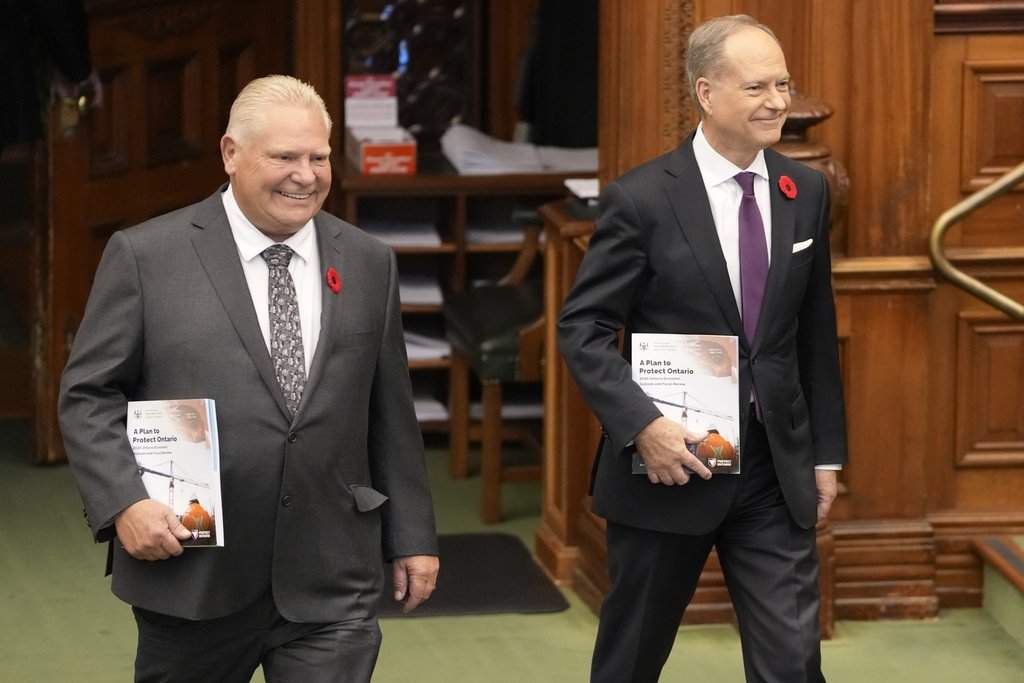
When S&P Global slapped a negative outlook on Ontario’s credit rating, Finance Minister Peter Bethlenfalvy basically shrugged and called it normal business. He’s got a point on paper. Bethlenfalvy spent years running a credit rating agency before entering politics, so he knows better than most how rating committees talk. Still, brushing off a warning with a one-in-three chance of a downgrade over the next two years feels a little breezy when the province’s debt is marching toward $520 billion.
Here’s the real story behind the warning. A negative outlook isn’t a downgrade yet, and Ontario still holds an AA- rating from S&P Global. You don’t panic in the street over a warning shot. Yet ignoring what triggered it—wider deficits, heavy spending tied to U.S. tariffs, and a $210 billion ten-year capital build—misses how credit math actually works.
What S&P Global Actually Warned About
Rating agencies rarely move out of nowhere. In November 2026, S&P Global revised Ontario’s outlook to negative after the province’s fall economic statement pushed the 2026–27 deficit up to $16.9 billion, doubled the projected deficit for 2027–28, and pushed the hoped-for return to a small $200 million surplus out to 2029–2030. According to S&P Global Ratings, there’s at least a one-in-three probability of a downgrade over the next one to two years if operating deficits stay stubbornly high and the government doesn’t show a credible plan to bring the books back into balance.
Look at the mechanics S&P flagged. The agency pointed out that tariff-related spending came in higher than expected while U.S. trade friction weighed on revenues. Add in support for hard-hit sectors like steel and autos, plus elevated energy costs and interest rates, and the fiscal cushion gets thinner. S&P specifically noted that rising debt and higher debt service costs could press on Ontario’s liquidity assessment. Under a downgrade scenario, debt service coverage could slip below 80 percent, while avoiding a cut likely requires slower borrowing and pulling debt down below 240 percent of operating revenues.
A negative outlook is a clock starting, not a gavel dropping. It tells bond buyers and taxpayers that the margin for error is shrinking.
👉 See also: ace hardware new middletown ohio
Why Peter Bethlenfalvy Calls It Routine
From Bethlenfalvy’s seat, calling the warning "not at all a hinge moment" is a deliberate political and market posture. Having led a credit rating agency for about five years, he’s seen plenty of outlooks shift without turning into permanent rating cuts. In his remarks covered by Global News, he pointed to Ontario’s economic scale—citing a GDP around $1.2 trillion, roughly $350 billion above 2018 levels—and more than $30 billion flowing toward tariff-affected businesses.
In my experience watching provincial budgets, finance ministers almost always try to separate economic growth from fiscal discipline. A big economy gives a government a wider tax base over time, sure. It doesn’t automatically pay down debt when spending climbs faster than revenue or when trade shocks knock tax receipts off track. Bethlenfalvy has promised he won’t hike taxes to close the gap and won’t cut health care spending, leaning instead on agency reviews and value-for-money audits to find savings inside existing envelopes.
That sounds neat in a press conference. Honestly, finding billions in quiet efficiencies without touching big-ticket programs is tough when health care, education, and interest costs already eat up most of the budget.
The Debt Bill Behind the Headlines
Even if Ontario holds onto its current rating, the baseline numbers are already heavy. Ontario’s debt sits around $483.8 billion and is projected to climb to $519.6 billion in 2027–28. Annual interest on that debt already runs about $17.3 billion, making debt interest the fourth-largest line item in the province’s budget.
Critics haven’t missed the optics. Liberal MPP Stephanie Bowman, a former Bank of Canada director, has hammered the government over the mounting tab, pointing to roughly $47 million a day in interest costs and framing the burden as a hefty per-taxpayer bill at a time when households are already squeezed on groceries and housing. You don’t have to agree with every political jab to see why people feel uneasy when interest payments compete directly with hospitals and classrooms.
At the same time, Ontario isn’t borrowing for nothing. The province has mapped out roughly $210 billion over ten years for major capital projects—including Highway 413, the Ontario Line, light-rail transit, Ring of Fire access roads, uploading the Gardiner Expressway and Don Valley Parkway, along with hospitals, long-term care homes, and schools. Capital assets can pay off over decades if they boost productivity and trade capacity. The catch is timing and cost overruns: mega-projects rarely get cheaper mid-build, and borrowing costs bite every single year regardless of when a transit line or highway opens.
Does a Credit Rating Downgrade Actually Hurt Everyday People?
People ask this all the time because credit ratings sound like Wall Street insider jargon. Here’s the straight answer: a downgrade doesn’t send a separate "rating penalty" invoice to your house tomorrow morning, yet it still matters.
When a province’s rating drops—or faces rising odds of dropping—investors typically demand a slightly higher interest rate (a wider spread) to lend money over 10, 20, or 30 years. Because Ontario borrows tens of billions of dollars every year to refinance maturing bonds and fund deficits and capital projects, even a small bump in borrowing costs compounds over time. More money going to bondholders means less fiscal breathing room later for tax cuts, infrastructure, or public services.
There’s also a nuance worth being honest about. Rating agencies aren’t infallible oracles. Sometimes they turn cautious right near the bottom of an economic cycle, and sometimes a government surprises markets by curbing spending or seeing stronger-than-expected revenue recovery. Still, treating a negative outlook as pure background noise is a mistake. Markets watch credibility closely, especially when a deficit target keeps getting pushed out.
What to Watch Next If You Care About Ontario’s Finances
If you’re a taxpayer, business owner, or bond watcher trying to figure out whether this warning turns into a real downgrade, don’t get lost in daily soundbites. Focus on a few concrete signals over the next 12 to 24 months:
- Whether deficits narrow or widen in future budgets: Watch if Ontario sticks to its trajectory toward that projected $200 million surplus in 2029–2030 or delays balance yet again.
- Real numbers from agency reviews and audits: Look past broad promises of "efficiencies" and check whether spending growth actually slows relative to revenue.
- U.S. trade and tariff developments: Trade policy with the United States remains a major wildcard for Ontario’s manufacturing base, business confidence, and tax revenues.
- Capital project pacing and borrowing forecasts: Pay attention to updates on the $210 billion capital plan and total debt issuance as debt heads toward $519.6 billion.
Bethlenfalvy has a one-to-two-year window to convince S&P Global that Ontario has a believable road back to fiscal balance. Calling it routine doesn’t change the math—the next two budgets will show whether confidence is backed by hard choices.