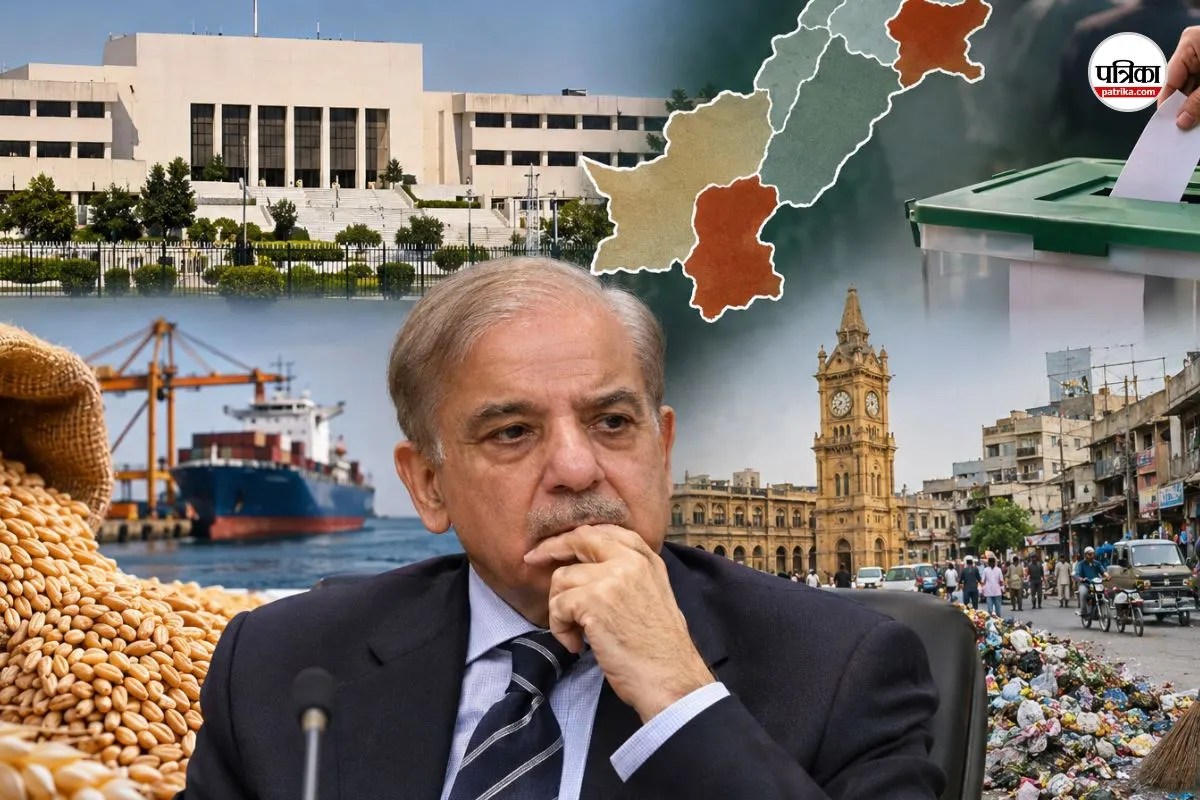
Redrawing a map won't fix a broken kitchen. Right now, Islamabad is buzzing with talk of carving out new administrative units and even holding a national referendum to make it happen. On paper, smaller units sound like an easy fix for sluggish administration. In reality, critics and independent analysts point out that Pakistan's ruling elite are pushing this debate to dodge accountability for massive governance failures, a $1 billion wheat import scandal, and the steady decay of Karachi.
If you've followed South Asian politics for any length of time, you've seen this playbook before. Whenever basic service delivery collapses or financial audits get too uncomfortable, politicians reach for structural distractions. A recent hard-hitting analysis in The Friday Times laid bare the core contradiction in Islamabad's latest push. Rulers who refuse to answer basic questions about missing public funds and stalled local elections suddenly want to ask citizens for permission to redraw provincial borders.
Why The Map Isn't Pakistan's Real Problem
Let's be honest about how power actually operates in Pakistan. The country doesn't suffer from having too few provinces. It suffers from hoarding power at the top.
For decades, the federal center refused to share authority with the four existing provinces. After constitutional reforms shifted certain powers downward, the provincial capitals simply copied the exact same habit. Lahore, Karachi, Peshawar, and Quetta kept tight control over money and decision-making instead of passing them down to cities and districts.
Look at Article 140A of Pakistan's Constitution. It explicitly requires every province to establish a local government system and devolve political, administrative, and financial responsibility to elected representatives. That's the law. Yet across the country, provincial governments have treated local bodies like an inconvenience:
- Punjab hasn't had an elected mayor since 2015. Every incoming administration rewrites the local government laws to suit its own political survival, leaving the country's most populous province without grassroots accountability for over a decade.
- Local spending has been gutted. Independent economic reporting highlights that local governments' share of total public expenditure dropped from roughly 10 percent in 2005 to under 5 percent by 2024.
- Four capitals simply become eight. As political analysts have warned, splitting existing territories without genuine fiscal devolution just creates more provincial bureaucracies bargaining with Islamabad while ordinary citizens still can't get a broken sewer fixed in their neighborhood.
Creating new provinces without empowering local mayors is like buying a bigger wallet when you're already bankrupt.
The $1 Billion Wheat Import Scandal Nobody Answered For
Before asking voters to approve a constitutional overhaul, Pakistan's leadership has an unresolved ledger sitting right in front of them. During the caretaker government's tenure, Pakistan imported roughly 3.5 million tons of wheat—a volume that blew past approved quotas.
Think about the timing. Pakistan was scrambling to secure bailouts and emergency loans from friendly nations just to keep its foreign reserves afloat. Yet authorities spent more than $1 billion in scarce foreign exchange bringing in foreign grain.
Government audits later questioned why those imports were even approved and how demand was calculated in the first place. According to investigative reporting, state-owned wheat reserves were deliberately held back to create an artificial impression of scarcity in the domestic market. While public grain sat in silos, private importers rushed their shipments to market first.
Then came harvest season. Domestic farmers brought their fresh crops to market right as massive foreign shipments flooded supply, crashing local prices and wiping out growers' livelihoods for the year.
What happened next tells you everything you need to know about accountability in Islamabad:
- A formal inquiry pinned blame on a handful of mid-level officials.
- Senior decision-makers above them received clean chits.
- Suspensions were quietly reversed, audit queries went unanswered, and nobody faced criminal prosecution.
When the people who profited from a billion-dollar policy disaster face zero consequences, sudden enthusiasm for "consulting the public" on provincial maps looks deeply suspect.
Karachi's Decay And The Hypocrisy Of Assembly Sanctity
The debate over Pakistan's new provinces gets even sharper when you look at Sindh and its capital, Karachi. Interior Minister Mohsin Naqvi recently floated the new provinces proposal at an economic forum, instantly sparking fierce pushback across Sindh and Balochistan. Meanwhile, Pakistan Peoples Party (PPP) figures like Nadeem Afzal Chan have insisted that any consensus on new provinces can only happen inside Parliament—specifically through the National Assembly and Senate—rather than via a referendum.
Legally, Chan has a point. Under Article 239 of the Constitution, altering provincial boundaries requires a two-thirds majority in both houses of Parliament plus a two-thirds vote in the affected provincial assembly. A referendum can't bypass that threshold. Historically, referendums in Pakistan—like those staged under military rulers Zia-ul-Haq and Pervez Musharraf—were used to rubber-stamp predetermined agendas rather than host genuine democratic debate.
Still, watching the PPP lecture the federal government on constitutional sanctity rings hollow to anyone walking the streets of Karachi.
The PPP has ruled Sindh continuously since 2008. Karachi remains Pakistan's undisputed financial engine, generating the largest share of national tax revenue. Yet one walk through its commercial districts shows uncollected garbage, crumbling roads, water shortages, and failing municipal infrastructure.
If provincial rulers want to defend the integrity of Sindh's borders, they owe citizens a transparent accounting first. Where did nearly two decades of Karachi's tax revenue go? How much of the wealth generated by Pakistan's richest city actually went back into maintaining its basic civic systems? You can't starve a metropolis of municipal funds for eighteen years and then act surprised when residents feel alienated from provincial rule.
What Actually Needs To Happen Before Any Referendum
Genuine democracy runs from the bottom up. Citizens ask questions, officials provide receipts, and elections serve as the final audit every five years. Right now, Pakistan's political establishment wants to flip that order—asking voters to endorse speculative constitutional experiments while keeping basic governance ledgers locked in a drawer.
If policymakers and civic observers want to test whether the new provinces debate is serious or just political theater, look for three concrete benchmarks before entertaining any talk of redrawn maps:
- Publish and prosecute the wheat audit: Release the full findings on who inflated import quotas beyond 3.5 million tons, why state stocks were withheld, and bring formal charges against senior decision-makers rather than scapegoating junior clerks.
- Enforce Article 140A immediately: Hold direct, party-based local body elections across Punjab, Sindh, Khyber Pakhtunkhwa, and Balochistan, and lock in guaranteed municipal funding formulas so mayors don't have to beg provincial chief ministers for garbage trucks.
- Audit urban revenue retention: Require provincial finance departments to publish transparent, city-by-city breakdowns showing how much revenue hubs like Karachi contribute versus how much is reinvested into their local infrastructure.
Until those three steps happen, any push for new provinces isn't a reform plan. It's just a distraction.