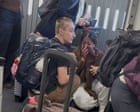
Imagine standing in a crowded jet bridge with a cup of coffee in your hand, ten minutes from boarding a flight to Los Angeles, when masked agents move in without warning. That exact scenario played out on Saturday morning, November 21, 2026, at Seattle-Tacoma International Airport. Bystander video caught federal immigration agents detaining a father and daughter—identified in reporting as Ricardo Larrondo Mendoza and Sofia Hernandez Mejia—right as passengers were boarding Alaska Airlines Flight 1306. Within hours, the clips went viral, angry protesters gathered with bullhorns and signs at the airport, and Washington state leaders erupted in condemnation.
What makes this clash so volatile isn't just a single viral clip. It's the collision between federal immigration enforcement, state-level limits on law enforcement masks, airline security protocols, and two wildly different accounts of what happened on that narrow walkway. Honestly, if you only read a quick headline, you miss the deeper questions this arrest raises for anyone flying domestically right now. If you found value in this piece, you should read: this related article.
How a Routine Flight Boarding Turned Into Protests in Seattle
Around 8 a.m. on November 21, travelers were lining up to board Alaska Airlines Flight 1306 bound for Los Angeles ahead of the busy Thanksgiving holiday rush. Instead of a smooth boarding process, passengers witnessed federal agents in dark clothing and face coverings moving in on the jet bridge. Footage shared by travelers and outlets like The Seattle Times showed scuffles on the walkway, a spilled cup of coffee, and bystanders shouting and asking for Mejia's name while someone yelled about a work permit.
Both Mendoza and Mejia were taken into custody and transferred to the Northwest ICE Processing Center in Tacoma. Mejia's husband, who was traveling with them, was not detained. Meanwhile, the boarding disruption pushed the Los Angeles flight back by roughly three hours—with Alaska Airlines reporting the aircraft eventually departed around 11 a.m. after rebooking many passengers onto alternative flights. For another look on this story, check out the recent coverage from The Guardian.
By later that day, demonstrators with bullhorns and signs reading "ICE out of Washington" and "Abolish ICE" were marching inside and around the terminal. Washington Governor Bob Ferguson called the operation "deeply un-American" and said ICE was "beyond reform," while labor leaders with the Washington State Labor Council pointed out that union members—including flight attendants and ground crew—were caught up in the chaos.
Two Conflicting Stories About Who They Are
Whenever high-profile immigration arrests hit social media, the facts on the ground get messy fast. In this case, federal officials and the family's legal team and community advocates tell starkly different stories.
U.S. Immigration and Customs Enforcement stated that Mendoza, a Mexican national, had overstayed his visa, and that Mejia had also overstayed her visa. ICE further alleged that Mejia threw hot coffee at officers during the confrontation and stated she would face a charge of assaulting a federal officer, while accusing bystanders of obstructing law enforcement.
On the other side, legal representation—including attorney Catala, cited in reports from PBS News and the Associated Press—pushed back hard. According to the lawyer, the father and daughter were heading to a family baptism, had no criminal record, and had "done everything correctly". Catala noted that Mejia had married a U.S. citizen and filed paperwork to adjust her immigration status, adding that when someone charges at you, dropping a cup of coffee is a natural reaction rather than an attack.
Friends and local outlets like KING 5 and Cascadia Daily News painted a detailed picture of Mejia's life in Washington. She graduated from Western Washington University, served as a student senator and co-chair of the university's Latine Student Union, and worked for the Seattle-based nonprofit Girls on the Run Puget Sound. By Sunday, a GoFundMe campaign started to cover legal expenses had passed $40,000.
Because criminal charges and immigration proceedings are only beginning to unfold, neither side's claims should be treated as the final word before court records and evidence are tested. That tension between alleged civil visa overstays, pending adjustment applications, and on-the-spot arrest claims sits right at the heart of the public outrage.
Why State Leaders Are Questioning Airport Access and Masks
Beyond the human drama on the jet bridge, this incident exposed a major friction point between federal enforcement and state-level authority. Alaska Airlines stated it received no advance notice from ICE before the operation took place, and the Port of Seattle noted that the scene distressed both the family and fellow travelers while pledging to engage federal officials for answers.
Governor Ferguson raised two sharp compliance questions during his response:
- How agents reached the jet bridge: State officials are looking into how federal officers accessed a secure boarding area without prior coordination or notice to the airline or airport operators.
- Use of facial coverings: Ferguson stated he believed agents may have violated a state law limiting facial coverings on law enforcement officers—a restriction enacted in Washington following state legislative pushback earlier in 2026.
Port of Seattle commissioners, including Hamdi Mohamed and Sam Cho, echoed concerns about alignment with Washington's Keep Washington Working Act, which restricts state and local entanglement with federal immigration enforcement. At the same time, legal and constitutional reality check: federal supremacy and federal facility rules often complicate how state laws apply to federal agents, even when state officials vow investigations or press Congress for oversight. Expect legal arguments over jurisdiction and officer identification to drag on long after the holiday travel rush ends.
What This Means for Travelers and Families
If you're flying domestically—especially with mixed-status family members or people who have pending visa or adjustment applications—it's smart to think practically rather than panicking. A civil visa overstay or pending paperwork doesn't automatically erase enforcement risk during travel, and tense encounters in tight spaces like jet bridges can escalate in seconds.
Here are concrete steps you can take right now if you or someone you know is traveling:
- Carry copies of key immigration and identity documents. If a traveler has a valid work permit, pending adjustment receipt notice, marriage certificate to a U.S. citizen, or legal counsel contact info, keep clear copies accessible—without assuming paperwork alone prevents detention on the spot.
- Know your rights and keep interactions calm. If federal agents approach you or a travel companion, state clearly that you wish to remain silent and want to speak with an attorney, and avoid physical resistance or sudden movements that could be misread as assault or obstruction.
- Save an immigration attorney's number offline. Don't rely solely on cloud notes or social media messages when cell service drops or phones get tied up; write down your lawyer's direct number and a trusted family contact's number.
- Document calmly from a safe distance if you're a bystander. If you witness an enforcement action in a public or boarding area, keep space so you aren't accused of obstructing officers, and share clips with credible journalists or legal aid groups rather than jumping to conclusions online.
In my view, the biggest takeaway from the Seattle airport clash isn't that one side wins a PR battle on social media. It's that when masked enforcement hits a crowded boarding gate with zero notice, nobody—not travelers, not airline crews, not local officials—feels safe or in control.