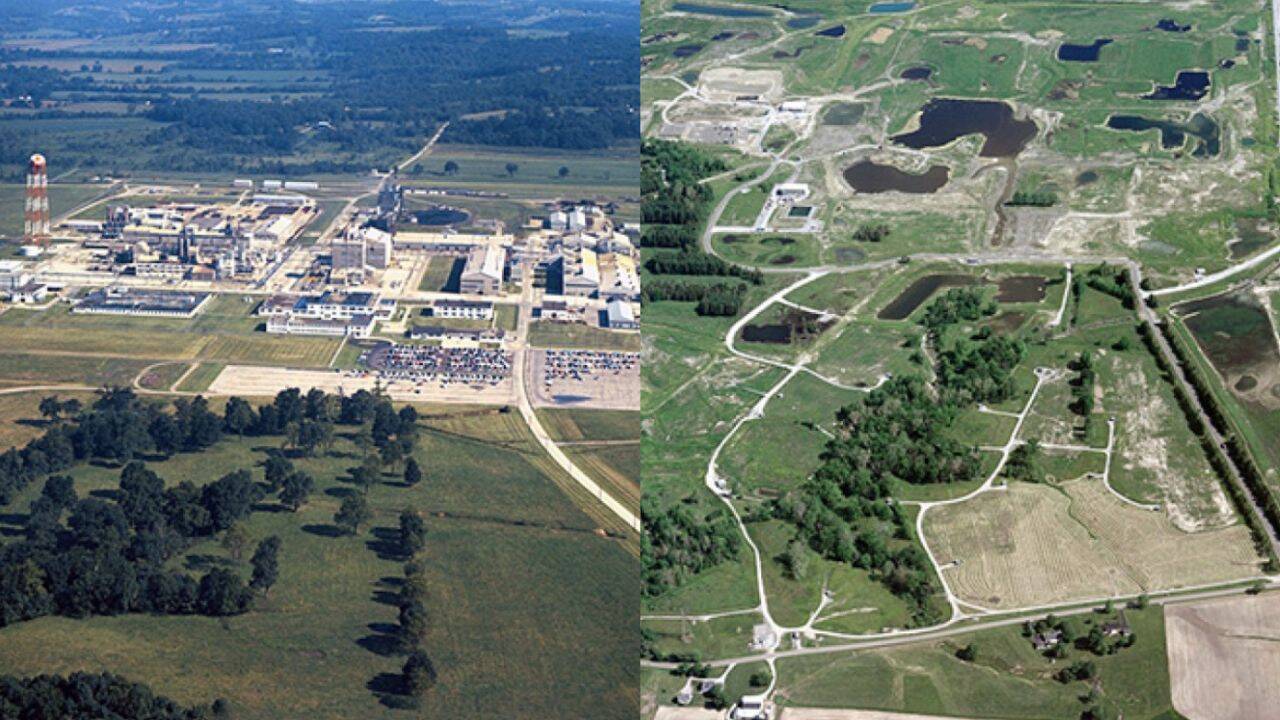
Walk the quiet trails of the Fernald Preserve today, and you will see sweeping tallgrass prairies, dense upland forests, and sprawling wetlands buzzing with wildlife. You'd never guess that this 1,050-acre plot northwest of Cincinnati was once a heavily guarded nuclear production facility.
For nearly four decades, the Feed Materials Production Center manufactured high-grade uranium metal products for America's nuclear weapons arsenal. When production stopped abruptly in 1989, the site wasn't just outdated—it was heavily contaminated, sparking decades of anxiety for local residents. What followed was a historic $4.4 billion cleanup that completely erased the industrial footprint and turned a radioactive scar into a thriving public nature park.
The Heavy Industrial Legacy of Fernald
The facility broke ground in May 1951 under the Atomic Energy Commission. Its core job was simple yet hazardous: process uranium metal to feed the United States Cold War military machine.
For years, operations ran behind closed doors with little public oversight. By the time production halted in 1989, the environmental toll was staggering. The property held 31 million pounds of nuclear product, hundreds of thousands of drums of waste, massive concrete silos filled with radioactive sludge, and millions of cubic feet of low-level radioactive debris. Worst of all, a massive plume of uranium contamination had seeped into the underlying Great Miami Aquifer.
Locals didn't stay quiet. Lawsuits, protests, and intense public pressure forced the government to acknowledge the mess. The mission shifted entirely from manufacturing weapons to environmental remediation.
Executing One of the Largest Cleanups in US History
Remediating a nuclear production site sounds like a project that should take half a century and cost tens of billions of dollars. Initially, some government projections estimated the job would stretch until 2020 with a $7 billion price tag.
Instead, the Department of Energy partnered with contractors and local stakeholders to push an accelerated cleanup plan. Workers demolished 323 buildings, including 10 massive uranium production complexes. They excavated more than a million tons of low-level waste from open pits and shipped it out by rail.
Crews also tackled the concrete silos, which held some of the largest sources of radon gas in the world at the time. Spending over $300 million on specialized treatment infrastructure alone, workers processed and stabilized the hazardous sludge before dismantling the temporary facilities.
By October 2006, the physical cleanup was officially declared complete. It finished 12 years ahead of initial schedules and saved billions of taxpayer dollars compared to early forecasts.
From Industrial Waste Pits to Ecological Restoration
Cleaning up the dirt was only half the battle. Transforming an industrial wasteland into a functioning ecosystem required intensive ecological engineering.
Workers graded the land, planted native trees, shrubs, and wildflowers, and established extensive tallgrass prairies. They constructed massive man-made wetlands that now act as natural filtration systems and vital habitats.
Today, over 250 species of birds use the preserve as a nesting ground or a migratory stopover. Deer, coyotes, and countless amphibians roam freely across acres of restored savanna and open water.
Of course, not everything vanished overnight. One vital cleanup effort remains active today: the groundwater extraction and treatment system. Pumping stations continue to clean the underground aquifer to ensure the water meets Safe Drinking Water Act standards, serving as a reminder that underground remediation requires long-term vigilance.
Visiting the Fernald Preserve Today
You can visit the site today without signing security clearances or wearing protective gear. The Fernald Preserve features a dedicated Visitors Center with exhibits detailing the land's evolution—from Indigenous settlements and early farming days to its secretive Cold War chapter and modern ecological rebirth.
A seven-mile network of walking trails winds through the prairies, forests, and wetlands. It stands as an unusual monument to industrial remediation, proving that even the most damaged landscapes can heal when communities demand accountability and science delivers solutions.
If you plan to visit, check the official Department of Energy Office of Legacy Management schedule for visitor center hours and guided tour availability. Walk the trails, explore the exhibits, and see firsthand how a Cold War nuclear facility quietly turned back into the wild.