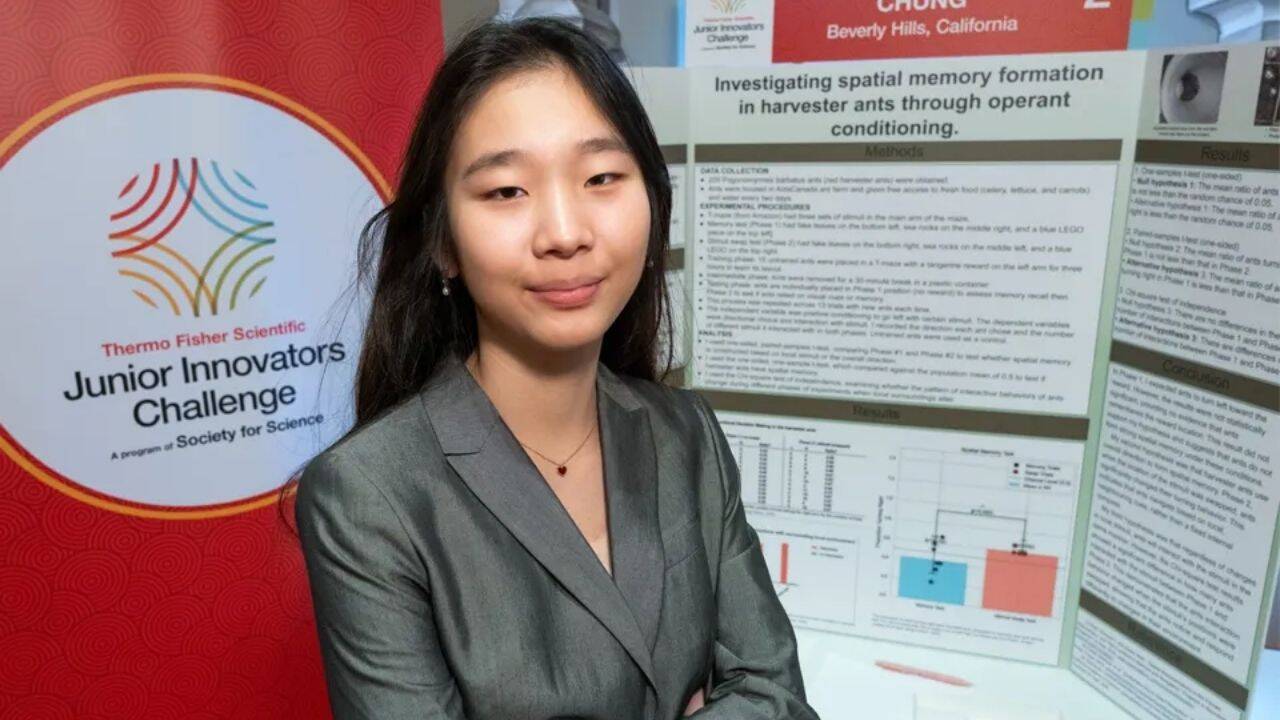
Most people watch ants march across a kitchen floor or a patch of dirt and think nothing of it. They are just tiny insects moving in a mindless line. Seungah Chung looked at that exact same scene and saw an unsolved puzzle.
How do creatures with brains no larger than a pinhead consistently find their way home without getting lost? That single question pushed an eighth-grader from Beverly Vista Middle School in California to build a custom maze, round up 200 red harvester ants, and put their spatial memory to the test.
Her findings did more than just win her a spot as a finalist in the prestigious 2025 Thermo Fisher Scientific Junior Innovators Challenge. They changed how we look at insect navigation and proved that breakthrough science doesn't require a million-dollar laboratory. It just requires genuine curiosity.
Beyond Chemical Trails
Scientists have spent decades studying how ants get around. We've known for a long time that pheromone trails play a massive role. An ant finds food, walks back to the colony, and leaves a scented chemical map for others to follow.
Seungah wanted to know if pheromones told the whole story. She suspected there was a visual component to how these insects map their environment. Could an ant look at its surroundings, recognize objects, and use them as physical guides?
To find out, she stopped reading textbooks and started building.
Inside the T-Shaped Ant Maze
Working with 200 red harvester ants (Pogonomyrmex barbatus), Seungah designed a controlled experiment. She placed groups of 15 ants at a time into a T-shaped maze. At the end of the correct path, a small piece of tangerine waited as a food reward.
She didn't leave the maze blank. Along the corridors, she placed a variety of artificial landmarks. Think tiny fake leaves, miniature sea rocks, and colourful building blocks. These weren't just decorations. They served as distinct visual markers positioned along the route while the ants learned the path to the tangerine.
She let the ants explore and learn the layout. Then, she changed the rules.
Shifting the Landmarks
If the ants were strictly relying on internal step-counting or simple muscle memory—like turning left at a specific interval—moving the objects wouldn't bother them. The food was still right where it had always been.
Seungah tested what happened when she rearranged the visual landmarks inside the maze.
The results were immediate and striking. Once the landmarks shifted, many of the ants became completely disoriented. Even though the food hadn't moved an inch, the misplaced objects sent the insects heading down the wrong paths.
Her data revealed a clear conclusion. Red harvester ants rely heavily on visual landmarks to orient themselves and navigate space. They aren't just following invisible chemical lines. They are building a mental map of their physical world using objects as reference points.
Why This Research Actually Matters
It is easy to write off middle school science projects as cute hobbies. That is a mistake.
Understanding how an organism with a microscopic brain solves complex navigational problems has massive real-world applications. Robotics engineers struggle constantly with how to build autonomous machines that can navigate unfamiliar environments without heavy GPS signals or massive computing power.
By looking at how biological systems process visual cues with minimal neural hardware, researchers can find blueprints for building smarter, lighter autonomous tech. Seungah's experiment shows that behavioral biology still holds answers we haven't unlocked yet.
More Than a Science Project
Seungah's story goes beyond a single experiment in a California classroom. Outside of her STEM interests, she spends her time working with art. She collaborates with a community service group called Ariari21, painting murals at senior living communities and homeless shelters to brighten up shared spaces. She plans to study microbiology in the future.
Her success highlights a vital lesson for anyone interested in science or problem-solving. You don't need a corporate budget or an advanced degree to ask a smart question. You just need to pay close attention to the world right in front of you, build a test, and let the data talk.
Take a closer look at the next routine thing you see today and ask yourself what everyone else is missing.