Putting a Pakistani astronaut aboard China's Tiangong space station isn't a charity stunt or a routine diplomatic photo op. It's a calculated geopolitical move with real orbital hardware behind it.
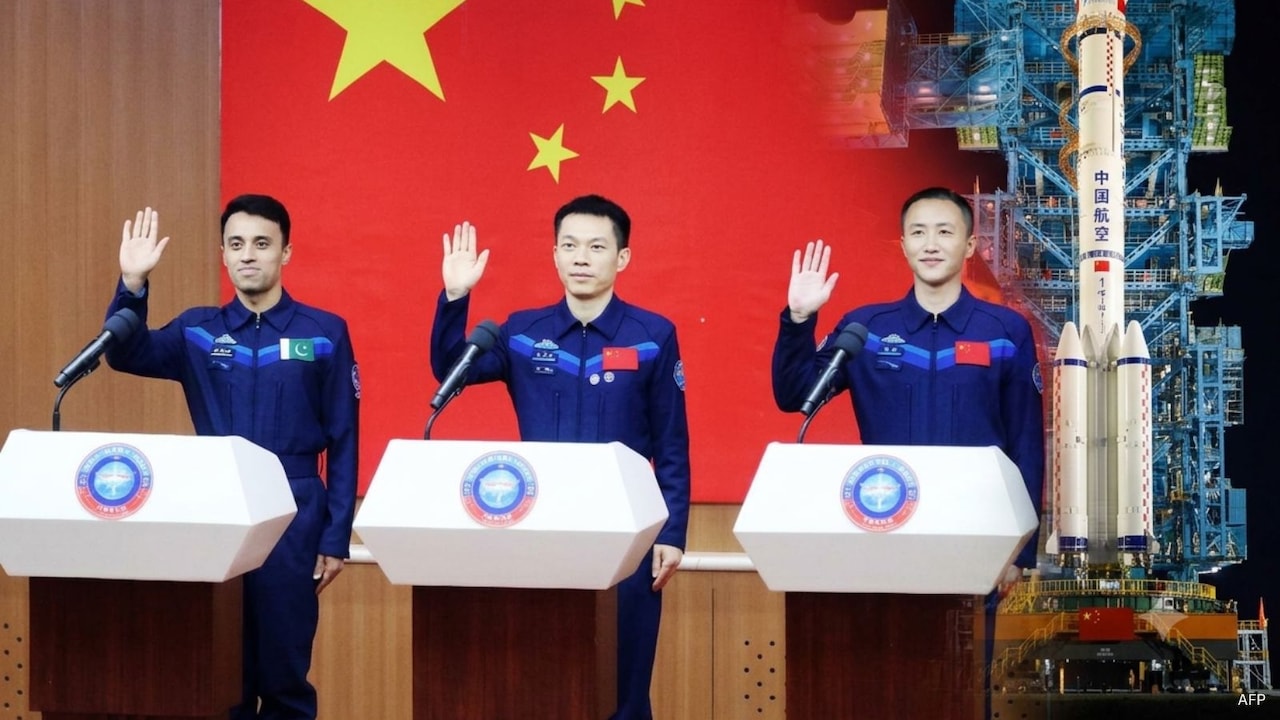
On November 25, 2026, Pakistan Air Force pilot Muhammad Zeeshan Ali is scheduled to lift off aboard the Shenzhou-24 mission from the Jiuquan Satellite Launch Center, flying as a payload specialist alongside Chinese crewmates Tang Hongbo and Wu Yi. That makes him the first Pakistani in space and the first foreign astronaut to visit China's Tiangong station, following the February 2025 astronaut agreement signed by SUPARCO and the China Manned Space Agency (CMSA). Brigadier Anshuman Narang (Retd), speaking to NDTV, framed this moment as Beijing projecting its long-standing strategic ties with Islamabad straight into low Earth orbit. Don't miss our earlier post on this related article.
He's right about the symbolism. Frankly, though, you miss half the story if you treat the flight purely as a diplomatic greeting card.
http://googleusercontent.com/lmdx_content/PqlQADaWVdNmPrdNkQbIjlJRrorzCqVfuJHbGaPBIiGXbzSTXdGiaxmLqxAMEXOAYATezRFjFNkuNxCGWtGPJgHDIXcGJZwNdLyapoQwdYCnlWJTEKQpijOJhgZLseYMCwIuUhgTJVnVdKqnQmkBuw61487 If you want more about the context here, BBC News provides an informative summary.
Why Shenzhou-24 Matters Beyond Diplomatic Headlines
For years, Beijing and Islamabad have leaned on grand phrases about friendship higher than mountains or deeper than oceans. Put a flight suit on a 40-year-old air force pilot and send him to a station China built on its own, and that rhetoric suddenly has a zip code in orbit.
As CMSA spokesperson Zhang Jingbo noted ahead of the flight, per AP News and International Business Times, Ali becomes the first foreign visitor to Tiangong and the first international crew member in China's human spaceflight program. Even the mission patch nods to the partnership by featuring jasmine, Pakistan's national flower.
Still, look closely at the mechanics. Ali isn't flying to Tiangong for a six-month tour. His stay is slated for roughly a week, while his Chinese crewmates handle longer-duration station work. That's a classic "guest researcher" window. It gives Islamabad an unmistakable national milestone without handing over flight control or turning the station into a joint command center.
- Symbolic first: First Pakistani national in orbit and first foreign crew member on Tiangong.
- Short orbital window: Around a week aboard the station, keeping operational complexity contained.
- Institutional bridge: Builds on the February 2025 SUPARCO–CMSA agreement after months of training at the Astronaut Centre of China.
Payload Specialist vs. Mission Pilot in Real Terms
People hear "astronaut" and picture someone gripping a stick through fiery reentry or running orbital maneuvers. That's not what a payload specialist does.
Brigadier Narang drew a sharp line between riding as a payload specialist and flying as a mission pilot, pointing to how different those roles are in training and authority. A payload specialist focuses on setting up experiments, monitoring hardware behavior in microgravity, and logging scientific observations. A mission pilot or commander carries direct operational responsibility for spacecraft systems, flight profiles, and crew safety protocols.
In fact, Ali explained during pre-launch media remarks reported by Al Jazeera that his roughly week-long stay is aimed at initiating and installing experiments and confirming the gear survived launch loads and vibrations before transitioning into microgravity operations—work that continues over six to 12 months. That distinction matters. Flying to orbit as a guest scientist earns genuine prestige, yet it doesn't magically hand Pakistan an indigenous launch vehicle, a domestic crew capsule, or independent mission control.
What SUPARCO Actually Gets From the Flight
Let's be honest about expectations here. A one-week stay aboard Tiangong won't turn Pakistan into a standalone crewed spaceflight power overnight.
What it can do is give SUPARCO and Pakistani researchers practical operational familiarity. Four experiments were shortlisted from more than 300 proposals submitted by Pakistani universities and institutions. Taking a concept from a university lab bench, qualifying it for launch loads, handing it off to orbit, and analyzing microgravity data over months builds real technical muscle—even if China owns the rocket, the capsule, and the station.
There's also a broader lunar thread worth watching. Pakistan previously flew the iCube-Qamar satellite into lunar orbit aboard China's Chang'e-6 mission in 2024, and SUPARCO has pointed to cooperation on a rover slated for Chang'e-8 around 2028 alongside lunar ambitions extending toward the 2030s. If Islamabad wants durable value from Shenzhou-24, converting a high-profile flight into repeatable science pipelines and robotic lunar work beats chasing one-off publicity every single time.
Regional Ripple Effects and What's Still Debatable
Whenever China and Pakistan pair up on anything involving aerospace, neighboring capitals pay attention. Brigadier Narang put it plainly: India sits behind China in overall space capability, well ahead of Pakistan's non-existent indigenous human spaceflight base, and closely watching how Beijing uses Tiangong to anchor regional partners.
At the same time, two big questions remain open for debate. First, how far is Beijing willing to open Tiangong to other non-Western partners after breaking the ice with Pakistan? Second, how much tangible engineering know-how transfers to smaller partner agencies versus staying tightly ring-fenced inside Chinese systems? For now, public details on follow-on crewed slots and deeper lunar hardware timelines remain limited, so anyone claiming this single flight reshapes the balance of power in orbit is getting ahead of the facts.
Practical Next Steps If You're Tracking This Mission
- Verify official launch and crew updates: Check primary statements from the China Manned Space Agency and SUPARCO around the scheduled November 25, 2026 Jiuquan liftoff rather than relying on recycled social clips.
- Track the post-flight science phase: Watch how the four shortlisted Pakistani experiments progress over the six-to-12-month window after Ali's return—that's where real scientific return shows up.
- Compare capabilities, not just headlines: Separate "first national in space" milestones from end-to-end indigenous capabilities like domestic launchers, life-support engineering, and autonomous mission control.