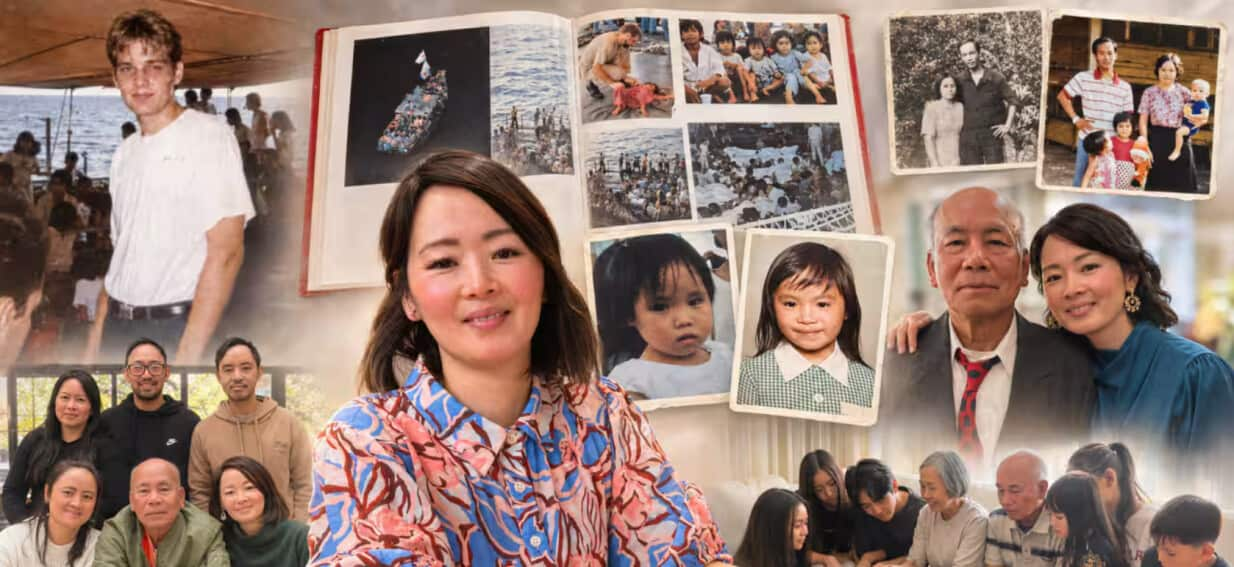
Forty-four years is a long time to carry a thank-you note in your head. When Julii Trinh finally saw Jeff Carlson on a video link at SBS Melbourne after four decades of separation following a 1982 South China Sea rescue aboard the USS Brewton, her reaction was plain and unpolished: "Sorry, I'm lost for words."
That kind of moment cuts straight through history textbooks. A viral reunion headline gives you the emotional spark, sure, yet the real weight of the story sits in what happened before and after the cameras rolled. In 1982, fleeing Vietnam by small boat wasn't a quick getaway. It was a gamble against storms, mechanical failure, dehydration, piracy, and turning-back policies across neighboring ports.
When a US Navy sailor like Carlson helped pull a family out of those waters, the rescue didn't end at the ship's rail. It started a chain of survival, camp processing, resettlement, and decades of unspoken gratitude that only surfaced when messages turned into a face-to-face call.
What Reconnecting After Forty-Four Years Actually Means
People love a neat full-circle ending. Honestly, real reunions rarely feel tidy. After forty-four years, neither the rescuer nor the child or young person who survived the crossing is the same person who stepped onto that deck in 1982.
From reporting and interviewing displaced families and veterans over the years, I've noticed a common trap in how media covers these reunions. Outlets treat the reunion itself as the finish line. For the people involved, seeing a face after messages is often just the opening of a heavy conversation about memory, guilt, luck, and what survived.
Julii had only exchanged messages with Carlson before their video connection through SBS Melbourne. Moving from text on a screen to seeing the human being who helped pull your family out of danger hits differently. You aren't just looking at a former sailor. You're looking at a living hinge between a night of terror and the entire life that followed.
Why does a story from 1982 hit so hard now? Because displaced people still cross open water in overcrowded vessels, and the moral question of who stops to help hasn't gotten any simpler.
The Reality of Fleeing Vietnam in the 1980s
If you think the mass flight from Vietnam ended the day Saigon fell in April 1975, you're missing the longest stretch of the crisis. Hundreds of thousands of people kept leaving by sea well into the 1980s and early 1990s.
According to figures cited by the United Nations High Commissioner for Refugees and historians such as Nghia M. Vo, roughly 839,228 Vietnamese arrived in UNHCR refugee camps across Southeast Asia and Hong Kong between 1975 and 1997, with the vast majority coming by boat. Roughly 749,929 were resettled abroad, while estimates from UNHCR and author Nghia M. Vo indicate that between 200,000 and 250,000 boat people died at sea.
Let those numbers sink in for a second. Not everyone who pushed off from shore made it to a camp, let alone a new country.
Families spent months—sometimes years—saving money, buying fuel or timber, and waiting for a window when coastal patrols looked the other way. Many had false starts that wiped out their savings before they ever cleared the coast. Once at sea, small wooden boats faced rough swells, engine trouble, dwindling fresh water, and violent attacks by pirates in the Gulf of Thailand and South China Sea.
Even reaching land didn't guarantee safety. Neighboring countries worried about bearing an endless burden and sometimes pushed boats back out to sea or held arrivals in crowded camps where water could be rationed to a gallon a day per person.
How Navy Rescues Worked on the Water
When a small boat drifted into the path of a warship like the USS Brewton in 1982, a rescue wasn't automatic movie drama. It was seamanship, split-second judgment, and humanitarian duty under international maritime norms.
Look at how rescues played out across other documented South China Sea cases from that era. On October 11, 1981, lookout Dale Joliffe aboard the USS Ingersoll spotted a small boat carrying the Huynh family and around 40 others fleeing Vietnam, after six other ships had already passed them by. In another case documented by TODAY, sea captain Georg Pedersen took 51 Vietnamese refugees—33 adults and 18 children—aboard in 1978 after other vessels passed them.
In my experience talking with veterans and historians who study maritime search and rescue, a few practical realities shaped every single pickup:
- Spotters and timing: A small wooden hull sitting low in choppy water is easy to miss at dusk, in rain, or during routine patrols. Sharp eyes on watch often made the difference between life and a missed signal.
- Shipboard care: Bringing dozens of exhausted, dehydrated, or terrified civilians onto a naval vessel meant immediate triage, clean water, warm food, and space on crowded decks.
- Transfer to camps: A Navy ship wasn't a permanent home. Rescued passengers still had to be transferred to asylum ports or UNHCR camps, where paperwork, interviews, and long waits decided their fate.
That's why sailors who served in the region often remember the faces of the kids on deck decades later. For a young crew member, handing a cup of water or a comic book to a child who just survived open ocean felt miles away from Cold War politics.
Misconceptions That Blur This History
Whenever a rescue story goes viral, a few myths tend to tag along. Getting them straight keeps the history honest.
First, people often assume every boat refugee was airlifted out in 1975 or resettled within weeks. In reality, the exodus stretched across more than a decade, and camp stays could drag on for years while resettlement quotas and screening played out. Programs like the Orderly Departure Program and the Comprehensive Plan of Action later helped organize pathways, yet tens of thousands were eventually repatriated voluntarily or involuntarily.
Second, some readers picture merchant and naval ships as a steady conveyor belt picking up everyone in distress. They weren't. Many boats went unassisted, and some crews hesitated out of fear of delays, piracy risks, or unclear port rules. That's precisely why the ships and sailors that did stop stand out so sharply in family memory.
Third, there's a tendency to flatten all refugees into one single motive or background. People fled for different reasons—former military or government ties, economic collapse, family reunification, persecution, or simply wanting a future their children didn't have at home. Treating every family's story as identical erases what they actually went through.
What Historians and Refugees Still Debate
Even among people who care deeply about this era, not every detail is settled with neat consensus.
Historians and policy analysts debate how effectively international agreements—especially the 1989 Comprehensive Plan of Action—balanced humanitarian protection against camp fatigue in countries like Thailand, Malaysia, Indonesia, Hong Kong, and the Philippines. Critics point out that stricter screening meant many late arrivals were denied refugee status and returned to Vietnam. Defenders argue the framework prevented countries from shutting their doors completely and helped close out long-running camps.
There is also no single exact body count for deaths at sea. Because boats sank without witnesses, vanished in storms, or went unreported, scholars and agencies rely on ranges—such as the 200,000 to 250,000 figure cited from UNHCR and Nghia M. Vo—rather than a neat ledger. Acknowledging that uncertainty is part of respecting the dead.
Practical Next Steps If You Are Researching or Reconnecting
If a story like Julii Trinh and Jeff Carlson's reunion makes you want to dig into family history or track down people from a past rescue, don't start with vague guesses. Start with concrete records.
- Gather exact dates, ship names, and locations: Write down everything your family remembers about the departure month or year, the approximate area at sea, the name of the vessel if known, and the first refugee camp or port of entry. Even rough details narrow searches dramatically.
- Search official naval and archival collections: Check the Naval History and Heritage Command for ship histories, cruise books, and humanitarian rescue records, and explore DVIDS for official military imagery and unit stories.
- Check UNHCR and resettlement archives: Look into records and historical accounts tied to the UNHCR and refugee resettlement archives to trace camp timelines, sponsorship programs, and regional history.
- Verify details carefully before publishing or sharing: Cross-check names, dates, and ship assignments across multiple sources so family memories and historical records back each other up.
If you're reaching out to a veteran or a family from a past crossing, keep your first message simple and patient. Share what you remember without demanding instant answers—forty-four years of silence takes a little time to unpack.
A reunion 44 years after a rescue in the South China Sea captures Julii Trinh's emotional first video call with former US Navy sailor Jeff Carlson and gives direct context on their 1982 rescue aboard the USS Brewton.