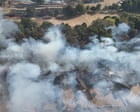
Extreme weather hit the UK hard on Thursday, August 13, 2026, as the country marked its hottest day of the year. While millions sought shade, emergency crews faced a baptism of fire. A massive 16-hectare grassfire tore through residential neighborhoods near a Stourbridge golf course, forcing evacuations and sending four people to the hospital.
When temperatures peak, the ground turns into a tinderbox. That is exactly what happened across the West Midlands.
The Stourbridge Blazes and the Toll on Residents
The alarm went off just before 1:30 pm on Thursday. Within minutes, West Midlands Fire Service found itself grappling with a fast-moving, multi-front wildfire. Twelve fire engines and roughly 60 personnel rushed to the scene as thick, black smoke choked local roads and disrupted rail services.
Flames jumped across streets, threatening properties and trapping residents. By the time crews gained the upper hand, six houses had suffered structural damage.
The human cost mounted quickly. Three firefighters and a child required hospital treatment, while six other individuals were treated on-site for severe smoke inhalation. Stourbridge town hall transformed into an emergency sanctuary. Local authorities opened its doors to shelter families forced to flee their homes with minutes to spare. Care home residents also faced emergency evacuation as the perimeter of the fire expanded.
A Regional Crisis Beyond Stourbridge
Stourbridge wasn't an isolated incident. The entire region felt the strain of the record-breaking heat, which saw provisional temperatures touch 38.1C at Kew Gardens and exceed 36C across dozens of locations in central and southern England.
In Stoke-on-Trent, fires destroyed homes in the Sandyford area. Meanwhile, a severe blaze in Castle Vale near Birmingham left a woman seriously injured. Commuters experienced gridlock when smoke from a fierce roadside blaze forced National Highways to temporarily close the northbound M6 near Birmingham, resulting in delays stretching past two hours.
Down in Worcestershire, a separate fire in Pershore forced 30 properties to evacuate, leaving 200 homes without power. Across the border in Warwickshire, the local fire service declared a major incident to tackle an aggressive blaze in Salford Priors.
Why UK Wildfires Are Changing
Urban and suburban wildfires used to be rare spectacles in Britain. Dr Thomas Smith, an environmental geography expert at the London School of Economics, noted that seeing fires destroy residential homes at this scale remains highly unusual for the UK.
However, climate patterns are shifting. Prolonged dry spells followed by sudden, sharp heatwaves strip moisture from vegetation entirely. Once a spark hits dry grass next to a suburban neighborhood, the fire doesn't just crawl—it sprints. Embers travel on dry winds, igniting fences, sheds, and roofs before ground crews have time to deploy hoses.
What You Can Do Now
If you live in an area prone to dry brush or near open fields, you need to change how you approach hot summer days. Do not wait for a local emergency alert to take precautions.
Clear dry leaves, pine needles, and overgrown brush away from your property line and wooden fencing. Keep garden hoses accessible and check that outdoor water taps work reliably. If authorities issue warnings about extreme heat and high fire risk, cancel any outdoor burning immediately and avoid using disposable barbecues in dry public spaces.
Emergency services are stretched thin during these peak heat events. Protecting your home starts long before a fire truck ever has to roll down your street.