When international agencies start using terms like forcible transfer and ethnic cleansing, it's worth paying attention to the exact documentation behind the headlines. Recent findings released by the United Nations Human Rights Office (OHCHR) regarding the occupied West Bank aren't just diplomatic rhetoric. They point to a calculated, systematic push that has upended thousands of lives, particularly across northern refugee camps like Jenin, Nur Shams, and Tulkarm.
If you've been following the broader Middle East conflict, you might wonder why focus is shifting toward the West Bank now. While attention has heavily concentrated on Gaza over recent years, the reality on the ground in the West Bank has transformed dramatically through institutional land seizures, escalating settler violence, and sweeping military operations. Let's break down what actually happened, what the data shows, and why legal experts view these developments as a major turning point.
The Anatomy of Displacement in the West Bank Camps
The core of the recent UN findings focuses heavily on operations conducted during early 2025, specifically Operation Iron Wall. During this period, Israeli security forces carried out extensive raids across several northern refugee camps. According to the OHCHR report, the actions went far beyond standard security measures.
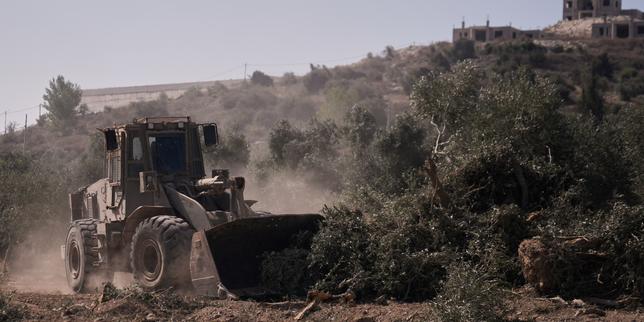
Troops deployed armored bulldozers, airstrikes, and controlled detonations that rendered entire neighborhoods uninhabitable. In Jenin, Nur Shams, and Tulkarm, over 33,000 Palestinians were forced out of their homes. Months after these operations concluded, thousands remain displaced because military orders explicitly prohibit them from returning.
Destruction statistics illustrate the scale of the devastation:
- Over half of all structures in the Jenin refugee camp were damaged or completely destroyed.
- Nearly half of the infrastructure in Nur Shams suffered a similar fate.
- Over a third of buildings in Tulkarm were left in ruins.
When an entire population is forced out under threat of military fire, and infrastructure is systematically dismantled to prevent any possibility of return, international humanitarian law has a very specific name for it. Volker Türk, the UN High Commissioner for Human Rights, pointed directly to these factors when noting that the pattern of displacement raises grave concerns regarding crimes against humanity and forcible transfer.
Shifting Geographies and Settlement Expansion
You can't understand the current wave of displacement without looking at the bigger demographic picture. The expansion of Israeli settlements in the West Bank has accelerated at an unprecedented pace. Over the past decade and a half, the settler population has surged past 540,000 people, spread across numerous official settlements and unauthorized outposts.
Government policies have actively facilitated this growth. Millions in state funding have gone toward road infrastructure designed exclusively for settlers, while vast tracts of unregistered land in Area C have been reclassified as state property.
Local residents and human rights monitors have repeatedly documented how this environment functions day-to-day. Herding communities and rural families face regular harassment, restricted access to water sources, and agricultural sabotage. The objective is straightforward: make daily life untenable so that communities abandon their ancestral lands voluntarily or under duress.
International Repercussions and Diplomatic Shift
For years, international responses to West Bank settlement expansion consisted primarily of routine condemnations and stalled resolutions. However, the sheer volume of documented displacement and the severity of the UN's findings have forced a shift in diplomatic circles.
Several Western nations, including the United Kingdom and Canada, have begun implementing targeted sanctions against radical settler groups and specific political figures associated with the violence. Foreign ministers have started labeling the ongoing forced expulsions with unvarnished language, signaling that passive acceptance of territorial annexation is no longer tenable for many international allies.
Despite these diplomatic warnings, ground realities continue to deteriorate. The legal battles fought in courts—such as challenges regarding the right of displaced families to return to villages like Zanuta—often result in protracted legal hurdles that rarely reverse the facts created on the ground by military orders and settlement growth.
What Happens Next
The implications of these reports extend far beyond immediate humanitarian concerns. They challenge the foundational frameworks of international accountability. When independent bodies document systematic violations on this scale, the pressure shifts to global legal institutions to determine individual and state liability.
If you want to track where this situation heads next, keep an eye on international trade policies regarding goods produced in illegal settlements, as well as ongoing investigations by international tribunals. The era of treating West Bank expansion as a minor diplomatic footnote is officially over, and the legal battle over accountability has only just begun.
Israël annonce 1 000 nouvelles habitations • FRANCE 24
This video provides additional context regarding recent announcements and regional developments surrounding Israeli settlements and policy decisions in the West Bank.