Death in Varanasi doesn't hide behind closed doors or sterile hospital corridors. It blazes openly on the stone steps known as ghats, where the sacred waters of the Ganges lap against relentless pyres of wood. Millions of pilgrims travel to this ancient Indian city to secure moksha, the ultimate liberation from the endless cycle of rebirth. Yet, the entire machinery of salvation relies on a group of people whom orthodox society historically deemed too polluting to touch: the Doms.
You won't hear many travel guides talk about them in depth. Mainstream itineraries focus on the evening Ganga Aarti ceremony, the chanting priests, and the floating oil lamps. They tend to gloss over the heavy logs of sandalwood and mango wood stacked high along Manikarnika and Harishchandra ghats. Day and night, the Doms keep these fires burning. Without them, the sacred transition from life to death simply wouldn't happen.
The Heavy Price of Managing Eternity
The social paradox defining the Dom community cuts deep. According to rigid traditional hierarchies, handling corpses, bodily fluids, and cremation ash renders a person permanently impure. Hindus revere Varanasi as a holy ground gifted by Lord Shiva, and dying here breaks the wheel of karma. But the very people who facilitate this sacred passage are pushed to the absolute margins of the social structure.
Society needs them desperately, yet shuns them in everyday life. This dynamic creates a bizarre economic and social reality. For generations, the leaders of the Dom community—historically centered around figures like the self-styled "Dom Raja"—wielded immense financial power. Controlling the monopoly on funeral pyres in a city where thousands are cremated weekly generates massive revenues. The business of death is lucrative, even if the laborers doing the actual heavy lifting see only a fraction of that wealth.
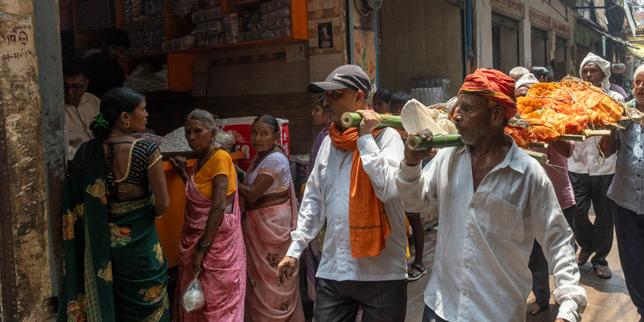
Negotiations over the cost of wood can get intensely raw. Grieving families arrive carrying bodies wrapped in bright shrouds, chanting "Ram naam satya hai" (the name of God is truth). Before the flames can touch the flesh, transactions must occur. The price fluctuates depending on the quality of the wood and the financial standing of the family. Municipal authorities have occasionally tried to regulate or standardize these fees, but challenging the traditional authority of the Doms on the ghats rarely succeeds. Everyone knows who holds the ultimate leverage.
Living on the Margins of Sacred Smoke
Working right next to burning human flesh requires a level of psychological and physical resilience that most people cannot fathom. The heat is punishing, often intensified by the humid subcontinental climate. Acrid smoke fills the air around the clock, coating lungs and skin in soot.
Despite performing a service viewed as essential for spiritual liberation, Doms face systemic exclusion. They live outside the mainstream social fabric, often relegated to specific neighborhoods with limited access to resources. While modern education and legal protections have slowly opened doors for some younger members of the community to seek alternative employment, the gravitational pull of the ghats remains strong. For many, it is the only generational inheritance they possess.
You might wonder how a community facing such intense prejudice maintains its role without a total collapse of labor. The answer lies in strict traditional duties, economic survival, and a distinct subculture anchored entirely to the rhythm of the cremation grounds. They are the keepers of the ultimate threshold, standing between the physical world and the absolute void.
What the Tourism Industry Misses
Visitors stepping off boats onto the stone steps often pull out cameras, captivated by the raw theater of mortality. Guides warn tourists not to take photographs of the burning pyres, noting that grief demands privacy. But beyond the etiquette of photography lies a deeper ignorance. Tourists rarely grasp the complex web of caste dynamics playing out right in front of them.
The Doms are not passive actors in this theater. They are shrewd operators of an ancient ritual economy. They manage a constant supply chain of firewood hauled in from regional forests, negotiate with grieving relatives under immense emotional pressure, and supervise the precise mechanics of reduction until only ash and bone remain to be swept into the river.
It is a harsh existence stripped of romantic illusions. There is no poetic comfort in the daily grind of shifting burning logs or breathing in the particulate matter of a thousand lifetimes coming to an end. Yet, Varanasi cannot exist without them.
Next time you see images of the eternal flames flickering along the riverbanks, look past the mystical haze. Recognize the human cost behind the spiritual facade. The true guardians of salvation aren't the wandering ascetics meditating in the lanes; they are the soot-stained laborers shoveling embers into the dark water.