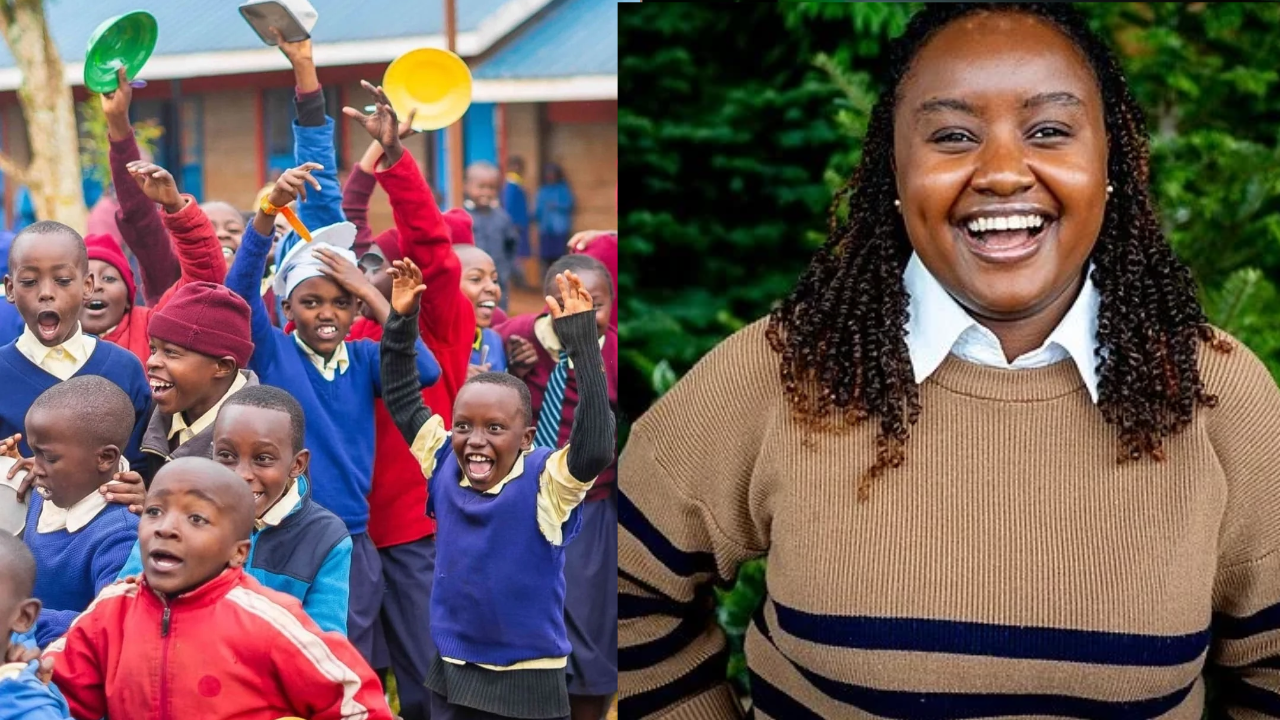
Hunger doesn't care about homework. When a child sits at a desk with an empty stomach, math equations and reading exercises become impossible. That stark reality is what drove Wawira Njiru to act back in 2010. While studying nutrition in Australia, she kept thinking about kids back in Kenya who went to school with nothing to eat all day.
Instead of writing another complaint or waiting for a massive government grant to appear, she started small. She rallied friends who had spare cash, pooled donations, and set up a modest kitchen in Ruiru, Kenya, by 2012. That first initiative fed exactly 25 schoolchildren.
Fast forward to today, and that grassroots effort has exploded into Food4Education, an organization employing over 6,000 people and serving more than 730,000 meals every single day.
If you want to understand how a tiny community project scales into a continental movement without losing its soul, look closely at how Wawira Njiru built her model.
The Shift From Charity to Infrastructure
Most charitable feeding programs fail because they rely entirely on endless fundraising cycles. When donations dip, children go hungry again. Njiru recognized this flaw early on. Good intentions alone can't scale to feed hundreds of thousands of kids.
By 2016, the operation outgrew makeshift setups. The team built their first central kitchen capable of pumping out 10,000 meals. But volume creates logistical nightmares. Transporting hot food across rugged terrain before it spoils requires industrial precision, not just volunteers in aprons.
They restructured the economics. They didn't make lunches entirely free or entirely dependent on charity. Instead, they designed a sustainable hybrid model combining parental contributions, government partnerships, and donor backing. Parents pay a small, affordable fraction of the meal's cost. That small financial buy-in preserves dignity and builds local ownership while stabilizing the supply chain.
Solving Logistics With the Tap2Eat Wristband
Serving 730,000 meals daily creates a massive tracking and payment bottleneck. Cash handling in primary schools is slow, chaotic, and prone to leakage.
In 2019, Food4Education deployed Tap2Eat, a digital wristband system. Children wear a simple band embedded with NFC technology. When they walk up for lunch, a handler scans the band, and the meal is logged instantly. Parents top up funds onto the wristband digitally using mobile money services.
This technology slashed lines, eliminated cash handling errors inside schools, and gave leadership real-time data on exactly how many meals were served, where supplies were needed, and how operations were performing. Technology actually solved a human problem instead of just adding corporate buzzwords to a pitch deck.
Supporting Local Farmers Instead of Importing Food
A massive school-feeding program can easily wreck local agricultural markets if it buys cheap, imported food from multinational conglomerates. Njiru avoided that trap entirely.
Today, Food4Education sources roughly 80% of its ingredients directly from small-scale local farmers in Kenya. This choice accomplishes two massive goals at once. First, it guarantees fresh, culturally appropriate ingredients for the kids. Second, it gives local farmers a guaranteed, stable market for their crops, boosting rural economies from the bottom up.
When you buy from the farmer down the road, money stays in the community. Schools become economic engines rather than charity sinks.
What Most People Get Wrong About Scaling Social Impact
People love the romantic narrative of an overnight success story. They look at 6,000 employees and 730,000 daily meals and assume it happened through sheer passion.
It didn't. It happened because Njiru treated social work like an engineering problem. She obsessed over unit economics, logistics bottlenecks, payment friction, and supply chain integrity. Passion gets you through day one. Systems get you to year ten.
Her work recently earned her the prestigious German Africa Prize, and the organization's eyes are now set on feeding one million children every single day.
Real change doesn't wait for permission. It starts with twenty-five plates of food, a clear-eyed strategy, and the stubborn refusal to accept that childhood hunger is just "the way things are." Take inventory of the broken system right in front of you, stop waiting for someone else to fix it, and build a better process today.