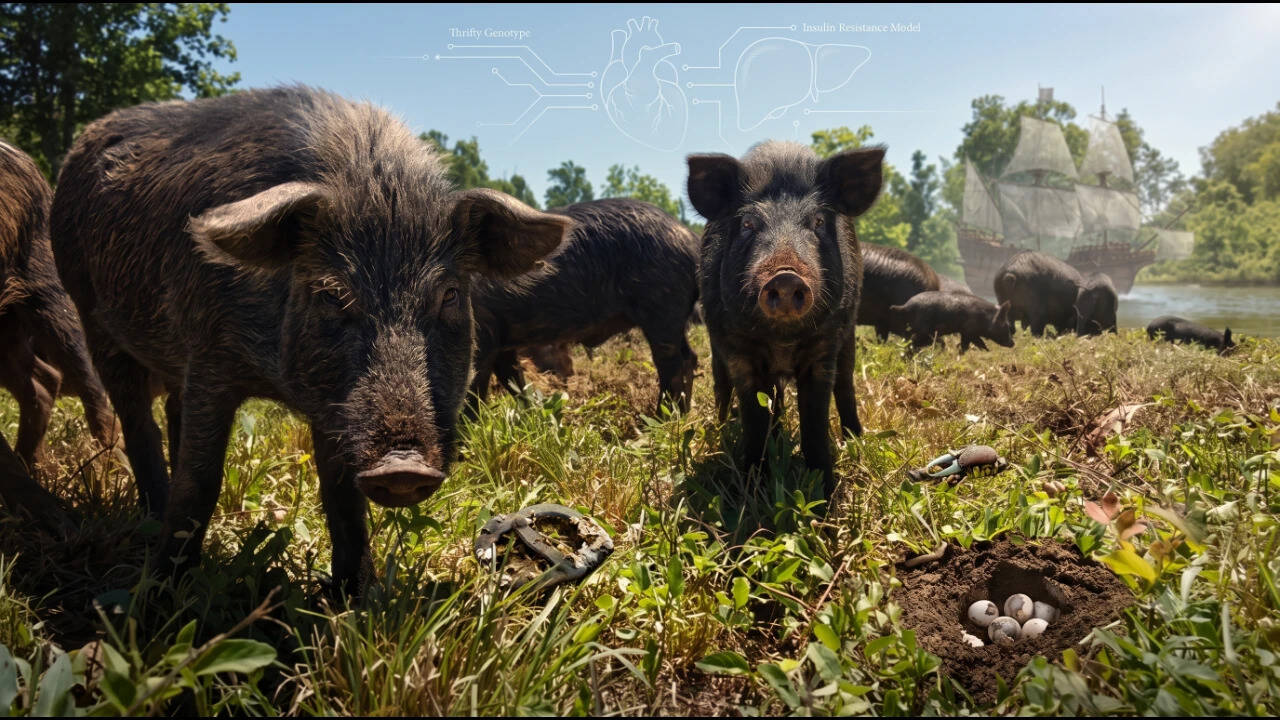
If you drop a domestic pig onto an isolated barrier island and let nature handle the menu for five hundred years, you get something remarkable. You get an animal engineered by survival to store fat at lightning speed.
Back in the 1500s, Spanish explorers dropped livestock onto Ossabaw Island off the coast of Georgia as a living pantry for future voyages. Some pigs wandered off, others were left intentionally, and all of them faced a brutal ecological reality. Ossabaw Island doesn't offer a steady buffet. Summer brings roots, insects, and fiddler crabs, while winter forces these animals into severe scarcity.
Generations of feast and famine molded the Ossabaw hog into a master of energy retention. When food was plentiful, their bodies packed away every available calorie. That evolutionary trick kept them alive through centuries of starvation. Today, that exact survival mechanism has turned these feral descendants into one of the most valuable animal models for studying human obesity and metabolic disease.
The Thrifty Phenotype in Action
You've probably heard about the thrifty genotype hypothesis—the idea that humans evolved to survive famine by holding onto fat, which now backfires in a world filled with processed food. Ossabaw hogs are that hypothesis brought to life.
When researchers take these island pigs off their sparse natural diet and give them regular access to high-calorie food, the results happen fast. Within weeks, they pack on body fat far more aggressively than standard agricultural livestock. They don't just get heavy; their bodies mirror the ugly cascade of human metabolic syndrome.
We aren't talking about simple weight gain. These pigs develop:
- Insulin resistance and impaired glucose tolerance
- High triglycerides and abnormal cholesterol profiles
- Elevated blood pressure and early coronary artery disease
- Fatty liver disease linked to modern dietary habits
Why Mice Aren't Enough
For decades, medical researchers relied heavily on rodents for metabolic studies. Mice are cheap, easy to house, and breed quickly. But mice have a major flaw when it comes to translating findings to humans. Their physiology, organ sizes, and cardiovascular layouts differ vastly from our own.
Pigs, on the other hand, share uncanny similarities with human anatomy. Ossabaw hogs are considered miniature swine, meaning full-grown adults match human body size, and their internal organs—including their hearts—are remarkably close to human scale. Medical device designers don't even need to scale down implants when testing equipment meant for human hearts on these subjects.
When studying how early-stage obesity damages blood vessels or alters blood flow to the brain, scientists need a biological system that behaves like ours. Ossabaw swine fill that gap because their metabolic responses map cleanly onto the human condition.
Unraveling Ancestry and Genetic Twists
History tells a neat story about Iberian pigs stepping off Spanish galleons, but genetics complicates the narrative. Modern DNA analysis points to a fascinating wrinkle: maternal lineages in these hogs trace partly back through the Canary Islands. That archipelago served as a major pit stop for transatlantic ships, meaning the original stock carried mixed traits before ever touching Georgia soil.
Once stranded on Ossabaw, isolation did the rest. Surrounded by impassable saltwater marshlands, the population stayed genetically distinct. Natural selection weeded out any animal that couldn't handle the harsh pendulum swing between autumn abundance and winter starvation.
What This Means for Modern Medicine
Obesity and type 2 diabetes continue to strain healthcare systems globally, affecting millions of adults and children. Understanding why some bodies store fat efficiently while others burn it off dictates how researchers design future therapeutics.
The feral hogs of Georgia teach us a sobering biological lesson. The very traits that once secured our survival on a hostile planet are the ones working against us today. By observing how an island ecosystem forged a super-storage metabolism in a humble Spanish pig, scientists gain a clearer window into treating the modern metabolic crisis.
Check local research initiatives or university veterinary departments if you want to track ongoing clinical trials utilizing large animal metabolic models.