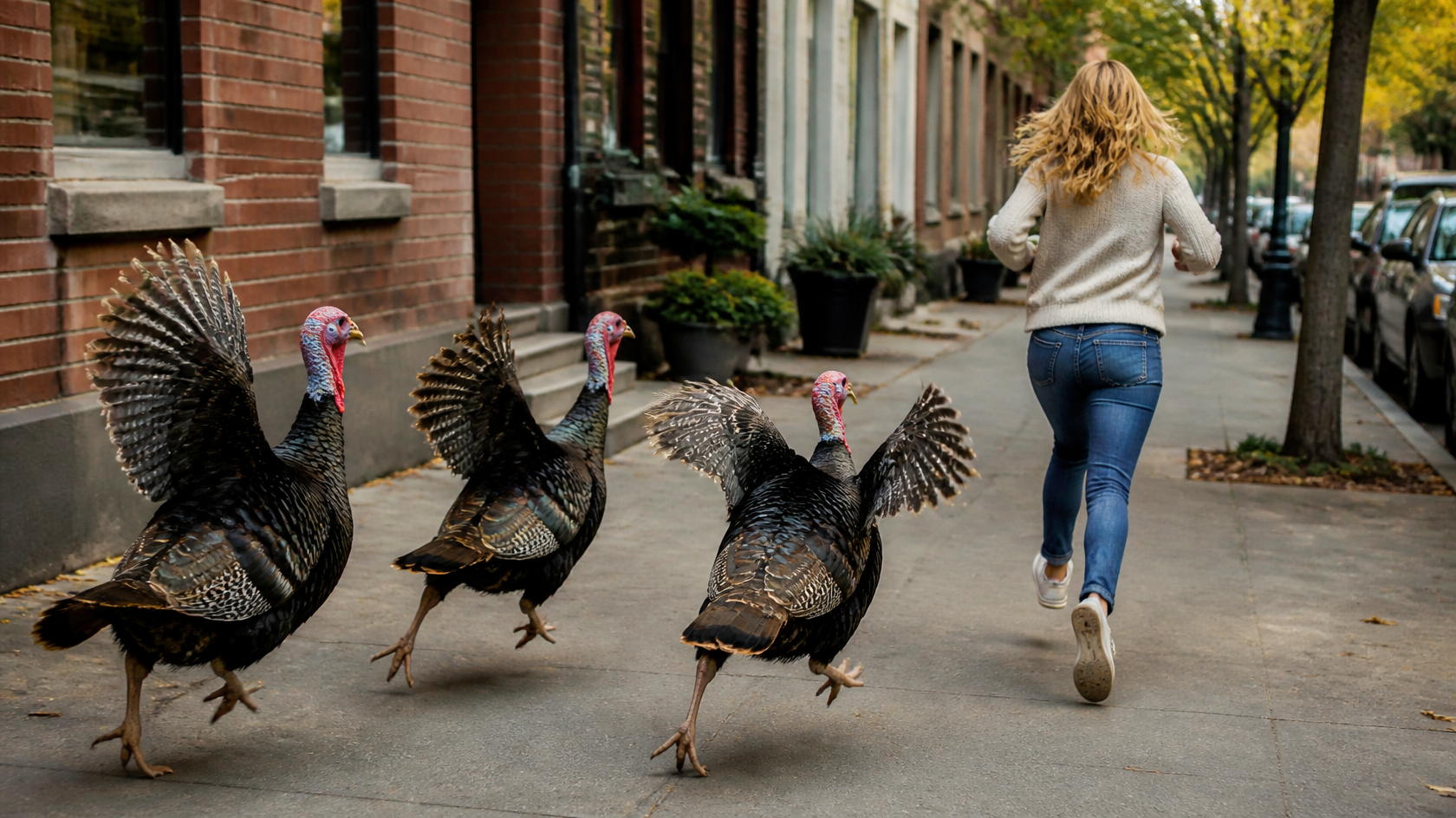
Picture this. You're just trying to take a normal walk down a quiet suburban street in Newton, Massachusetts, and suddenly three wild turkeys decide you're the main event.
That exact scene played out on Saturday, November 21, 2026, along Old Farm Road, just days before Thanksgiving. Taryn Laprade and her pastor were heading home from a volleyball game after taking a wrong turn when they spotted a woman on the sidewalk with aggressive wild turkeys closing in on her. Two birds were chasing her at first. Then a third joined in.
Laprade started recording from her vehicle and called out to the woman to get inside. As the turkeys followed right up to the car, her pastor stepped out to shoo the birds away so the woman could climb in safely. Nobody got hurt, though the woman told them afterward that they'd saved her life. As they drove off, Laprade noticed roughly 20 more turkeys gathered in a nearby yard.
It's hilarious on first watch. Honestly, a turkey chase right before Thanksgiving feels like a script from a comedy special. Yet laughing it off misses what's actually happening across eastern Massachusetts and other suburban pockets of New England. Wild turkeys aren't supposed to corner pedestrians on residential sidewalks. When they do, it's a symptom of broken boundaries between people and wildlife.
What Really Happened on Old Farm Road in Newton
Most viral animal clips strip away context within ten seconds. People see a bird puffing its feathers or jogging behind someone and assume it's a one-off fluke.
Here, timing and setting matter. November 21 fell on the same day Newton hosted its 13th annual Turkey Trot, which drew more than 1,800 runners according to local reports. While runners were sprinting through town for a holiday tradition, a walker on Old Farm Road was dealing with birds that didn't act scared at all.
Laprade told local outlets like WHDH and NBC Boston that she sees wild turkeys regularly, yet she'd never seen them behave that aggressively—and they seemed to get bolder as her car pulled closer. When she asked if the woman had been feeding them, the woman said no. Even without direct handouts in that moment, birds that grow accustomed to neighborhoods, yards, and people lose the caution that keeps wild animals safe and keeps pedestrians out of harm's way.
There's also a practical detail people overlook in the clip. Getting into a car while persistent birds press in isn't effortless. Having a second person step out to create space and keep the birds moving made the difference between a tense standoff and a clean exit.
Why Suburban Turkeys Act So Bold
If you grew up thinking of wild turkeys as skittish woodland birds that bolt at the snap of a twig, suburban flocks will surprise you. Wild turkeys nearly disappeared from Massachusetts in the 1800s before conservationists and wildlife agencies brought them back through restoration programs. Those efforts worked almost too well in some towns.
Suburbs offer everything a turkey likes. Lawns hold grubs and insects. Shrubs and dense hedges provide cover. Large trees give them roosting spots away from ground predators. And coyotes or foxes don't always deter a flock of large birds that have learned humans rarely fight back.
Food Is Usually Where the Trouble Starts
Wildlife biologists point to food as the primary driver of bold turkey behavior. Even when a specific pedestrian hasn't tossed bread or cracked corn to a flock, someone on the block often has—intentionally or by accident.
Spilled seed under bird feeders, open compost piles, pet food left on porches, or neighbors tossing scraps "just to watch them" teaches birds to associate humans and houses with easy calories. Once turkeys lose their wariness around people, pushing past a person holding a grocery bag or walking a dog feels normal to them.
As MassWildlife guidance on preventing turkey conflicts emphasizes, once bold behavior sets in, it's tough to undo. A flock that treats people like pushovers can start asserting dominance—which is why running away can actually backfire.
Reflections and Seasonal Triggers
Food isn't the only trigger. Turkeys react strongly to shiny surfaces like car doors, hubcaps, glass doors, and windows because they sometimes perceive their own reflection as a rival bird. That explains why a turkey might square up against a parked or slow-moving vehicle.
Seasonality plays a role too. Spring breeding season brings heightened territorial and courtship displays, while autumn and early winter see larger flocks grouping together and moving through residential neighborhoods in search of food. When you combine large flocks, familiar streets, and zero fear of humans, a sidewalk can turn into an awkward turf war fast.
A Growing Pattern Across Greater Boston
The Newton chase didn't happen in a vacuum. Residents across Greater Boston have been reporting plenty of close encounters with bold turkeys for years, and tracking efforts show just how frequent these run-ins are.
In neighboring Cambridge, Dr. Doug Robinson launched Cambridge Turkey Watch so locals could log sightings, upload photos, and document how birds behave—drawing more than 100 reports within about a month of launching. Tracking tools like that are useful because official complaints don't capture every mildly annoying or intimidating moment on a morning commute.
Here's the tension in towns like Newton, Cambridge, and nearby suburbs. Most people enjoy seeing wildlife in their neighborhood. Nobody wants harsh measures or lethal removal of animals that are simply responding to their environment. Yet when birds chase walkers, block driveways, or crowd school zones, tolerance wears thin quickly.
Common Mistakes People Make During a Turkey Encounter
I've watched plenty of people react to aggressive birds in ways that make things worse. It's totally natural to flinch or speed-walk away when a 15-to-20-pound bird steps toward you. Still, instinct isn't always your best guide here.
- Turning your back and running. Running triggers chase instincts and signals submission. If you bolt, a bold turkey is much more likely to pursue you down the block.
- Treating aggressive birds like pets. Laughing, leaning in for a closer video, or offering food tells the bird there's no real threat—or worse, that approaching people pays off.
- Cowering or shrinking down. Hunching over or trying to slip past quietly rarely works once a bird decides to press its luck.
- Assuming size means harmless. Turkeys aren't apex predators, and serious injuries are uncommon, yet sharp claws, strong wings, and persistent pecking can hurt or knock someone off balance—especially older adults or young children.
What Actually Works If a Turkey Charges You
If you ever find yourself in the middle of a sidewalk standoff like the woman on Old Farm Road, keep it simple and assertive. You don't need to attack the bird. You just need to change the dynamic so it sees you as bigger, louder, and dominant.
Stand tall and keep the turkey in front of you. Don't turn away. Raise your arms, open a jacket, or open and close an umbrella to look larger. Speak loudly, clap, or stomp—firm, decisive noise works far better than timid shooing.
If you're carrying a bag, backpack, or walking stick, put that barrier between you and the bird while backing slowly toward safety or a vehicle. A leashed dog can also deter turkeys in many situations, though you still want to stay aware so your pet doesn't get clipped or tangled up.
Practical Next Steps for Residents and Communities
If you live in a town with active turkey flocks—or walk through neighborhoods where birds hang out near streets—a few habits make a real difference right away.
- Cut off easy food sources today. Stop feeding turkeys directly, clean up fallen bird seed, bring pet bowls indoors, and secure trash or compost where birds can scavenge.
- Haze bold birds consistently. If a turkey lingers in your yard or approaches people without fear, use loud noises, a water hose, or visual deterrents to reinforce healthy distance before the behavior escalates.
- Talk to your neighbors. One person feeding a flock can undo an entire street's efforts. Mention the risk calmly so everyone stays on the same page.
- Log local sightings and check state rules. Report recurring aggressive behavior to local animal control or your state wildlife agency—such as MassWildlife in Massachusetts—and use community trackers if your area has one so officials see the real scope of the issue.
Keep wildlife wild, give flocks space, and never let a cute photo op turn a neighborhood sidewalk into a chase scene.