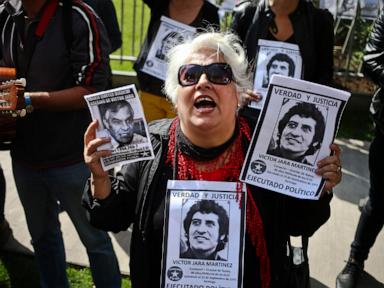
Half a century passed before Chilean authorities finally caught up with the last fugitive convicted in the murder of singer-songwriter Víctor Jara. Retired military colonel Nelson Haase Mazzei spent three years running from a 25-year prison sentence. Police arrested him over the weekend, closing a chapter on one of the most brutal political executions from General Augusto Pinochet's military dictatorship.
If you think a single arrest fifty years later heals an entire nation, think again. Amanda Jara, the musician's daughter and head of the Víctor Jara Foundation, made it clear that true accountability remains elusive. Catching an 80-year-old fugitive who evaded justice since 2023 brings relief, but it doesn't undo decades of systemic impunity.
Let's look at what actually happened, why this case still haunts Chile, and what this recent arrest means for historical memory.
The Brutal Murder That Shocked a Nation
Víctor Jara wasn't just a musician. He was a cultural icon and a core voice of the Nueva Canción Chilena movement. When the military coup overthrew President Salvador Allende on September 11, 1973, Jara was working as a professor at the State Technical University.
Soldiers detained him on campus alongside thousands of others. They hauled him to Chile Stadium—now renamed Estadio Víctor Jara. While thousands of prisoners crowded the stands, guards separated Jara and former Prison Director General Littré Quiroga Carvajal.
They tortured them both relentlessly. When investigators finally examined Jara's remains, they documented multiple fractures and 44 bullet wounds.
The military regime tried to erase his memory. They failed. His songs survived underground, traveling across borders as a testament to resistance.
The Long Road To Conviction and Flight
For decades, military protection shielded the perpetrators. It wasn't until 1991, after democracy returned, that the National Commission for Truth and Reconciliation officially classified Jara's death as a politically motivated human rights violation.
Legal battles dragged on for years. In 2018, courts convicted several military officers involved in the kidnapping and murder. Appeals stretched out until 2023, when judges increased Nelson Haase Mazzei's sentence to 25 years and two days in prison.
Instead of turning himself in, Haase chose to run. He vanished, slipping away from accountability while aging out of standard prison life. Judge Paola Plaza of the Santiago Court of Appeals finally ordered his immediate imprisonment after police tracked him down.
Haase's capture marks the end of the line for active fugitives in this specific case, but the broader wounds of the dictatorship remain wide open.
Why Families Say This Isn't Enough
An arrest after fifty years feels hollow to many victims' families. Amanda Jara released a public letter addressing the news. She acknowledged the capture but emphasized the bitter taste it leaves behind.
"It is difficult to consider this justice," she wrote.
Waiting half a lifetime for a court order means the legal system moves at a glacial pace. During the 17-year dictatorship, state documentation estimates roughly 40,000 victims suffered through execution, torture, or forced disappearance. Hundreds of state agents and civilians have faced conviction over the years, yet hundreds more cases lack closure.
Chile continues to push initiatives like the National Search Plan to track down the whereabouts of detained-disappeared victims. But much of the heavy lifting still falls on grieving families who refuse to let the state sweep atrocities under the rug.
What Happens Next
The arrest of Nelson Haase Mazzei proves that time doesn't grant total immunity for crimes against humanity, even if it took three decades of democratic rule and three years of fugitive hunting to lock him up.
If you want to track how transitional justice operates in South America, look closely at how grassroots organizations and victim foundations keep pressure on state institutions. History doesn't write itself. People demand the truth until the system has nowhere left to hide.