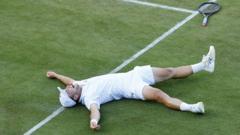
Forget the pristine, quiet lawns of Centre Court. The real drama of the first week of Wimbledon unfolded on Court 18, a tight, raucous bowl where fans stood crammed three-deep just to catch a glimpse of the last standing British hope in the singles draw.
Arthur Fery gave them a show that nobody who packed into those green stands will ever forget.
The 23-year-old wildcard didn't just beat Belgium's Zizou Bergs in a grueling four-hour, 38-minute marathon. He did it while staring down 4-1 deficits in both the fourth and fifth sets. He did it while trailing for nearly the entire afternoon. Most bizarrely, he did it while dealing with three separate, severe nosebleeds that stopped the match, irritated his opponent, and threatened to derail his physical momentum entirely.
When the dust settled, Fery walked away with a 2-6, 7-5, 2-6, 7-6 (7-3), 7-6 (10-5) victory. The win marks the first five-set triumph of his young professional career. It vaults him into the second week of a Grand Slam for the very first time. It pushes him into the world's top 100, locking his live ranking at world No. 91.
Most importantly, it gave British tennis fans a genuine, blue-collar hero to cheer for at a tournament that looked like an absolute disaster for the home nation just days ago.
The Court 18 Cauldron and the 4-1 Miracles
To understand why this victory feels so monumental, you have to look at how deep a hole Fery dug for himself.
Zizou Bergs arrived at Wimbledon playing the best tennis of his life. Named after the legendary French footballer Zinedine Zidane, the 27-year-old Belgian won his first ATP Tour title in Eastbourne just last week, soaring to a career-high ranking of world No. 37. In the opening set on Court 18, that gap in experience looked massive. Bergs dominated the baseline, moving Fery from side to side with ease and wrapping up the opener 6-2.
Fery fought back to grab the second set 7-5, aided by a handful of costly double faults from the Belgian. But the momentum didn't last long. Bergs reasserted his authority in the third, stringing together five consecutive games to take it 6-2.
When Bergs broke early in the fourth set to establish a commanding 4-1 lead, the match looked effectively over. Fery looked tired. His body was failing him. The home crowd was trying to lift him, but there's only so much shouting can do when a top-40 player is firing rockets from the baseline.
Somehow, Fery found another gear. He stopped trying to match Bergs for sheer power and started making the match ugly. He scrambled. He chipped low returns. He dragged Bergs into long, exhausting rallies. He clawed his way back to force a tie-break, then played flawless tennis on the dead run, flashing a brilliant forehand down the line and a full-stretch backhand volley to steal the fourth set.
The fifth set felt like a mirror image of the fourth, only with higher stakes. Bergs broke early again. Once more, the scoreboard read 4-1 in favor of the Belgian. Once more, Fery refused to blink.
Tennis matches at this level aren't always won by the player hitting the prettiest shots. They're won by the player who can handle the suffocating pressure of the scoreboard when everything goes wrong. Fery knew Bergs might tighten up with the finish line in sight. He trusted his fitness, trusted the raucous crowd, and broke back twice to force the ultimate match-tiebreak. By the time they reached that final race to ten points, Fery was the only one playing with absolute clarity.
The Blood and the Controversy on the Court
The tactical shifts were fascinating, but the strangest element of this match was the literal blood spilled on the grass.
Fery suffered three distinct nosebleeds during the contest. The first happened after just four games in the opening set. The second arrived just before the start of the deciding fifth set. The third, and most tense, occurred right in the middle of the tenth game of the final set, while Fery was leading 40-15 on his own serve at 4-5.
In modern tennis, medical timeouts are strictly regulated. A player can generally only receive one timeout per match for a specific physical condition. Blood is the major exception to the rule. Tournaments cannot have players dripping blood onto the court or tennis balls, so play must stop immediately for medical intervention until the bleeding is entirely contained.
Fery needed three full timeouts to plug the bleeding. The delays stretched out the match, cooled down the players' muscles, and clearly destroyed the rhythm of the contest.
Bergs grew visibly frustrated with the constant interruptions. He complained to the chair umpire during the final set, pointing out the awkward timing of the medical stops. It's easy to see his point. Sitting on a changeover chair for minutes at a time during the climax of a five-set match is a mental nightmare.
Fery was open about the awkwardness after the match, acknowledging that the bleeding wasn't an intentional strategy to disrupt the game. He noted that the issue broke his own momentum at times when he felt he had the upper hand, making it an annoying situation for both sides. He added that it's an issue he intends to address medically as soon as his Wimbledon run ends.
Local Roots and the Stanford Education
While Fery represents Great Britain, his background is delightfully cosmopolitan. He was born to French parents and his family heritage is deeply tied to France, but he grew up a mere ten minutes away from the All England Club in southwest London.
Sleeping in his own bed during a Grand Slam is a massive competitive advantage. Most tennis pros spend eleven months of the year living out of suitcases, adapting to unfamiliar hotel beds and relying on restaurant food. Fery has been able to maintain his exact morning routine, eat home-cooked meals, and commute to the tournament gates in minutes. That slice of normalcy provided a vital emotional anchor during a high-stress fortnight.
Before turning professional, Fery took a path that is becoming increasingly popular for elite young talent: American college tennis. He spent three years playing for Stanford University, competing in the highly intense NCAA circuit.
College tennis doesn't offer the prize money or glamour of the junior tour, but it teaches young players how to compete under intense team pressure. It forces them to solve tactical problems on court without a coach holding their hand. That collegiate background was visible in the way Fery managed the chaotic environment of Court 18. He didn't panic when the crowd went wild, and he didn't lose his temper when his body started bleeding. He stayed collected inside, knowing that wasting emotional energy would ruin his tennis.
Breaking a 33-Year Wildcard Curse
British men's tennis has struggled for decades to find consistent depth behind superstars like Andy Murray. When the big names fall early, the pressure on lesser-known home players becomes immense. Fery entered this year's tournament as a wildcard, a direct entry granted by the organizers rather than a spot earned through automatic ranking.
By reaching the fourth round, Fery accomplished something exceptionally rare. He became only the second British male wildcard in the Open era to reach the last 16 at Wimbledon. The last man to do it was Andrew Foster all the way back in 1993.
Think about the context of that achievement. For 33 years, dozens of highly touted British wildcards have stepped onto these lawns with the weight of home expectations on their shoulders. Almost all of them folded under the glare of the domestic media. Fery didn't just survive; he thrived in the messiest, most physically demanding match of the opening week.
The reward for his courage is massive. By securing those ranking points, Fery will break into the world's top 100 for the first time on Monday. He is projected to land at world No. 91.
That double-digit ranking changes everything for a rising tennis player. It means he will get direct entry into the main draw of the upcoming US Open, skipping the brutal, three-round qualifying tournament entirely. It means guaranteed prize money, easier scheduling, and regular entry into main-draw ATP Tour events for the rest of the calendar year. He has effectively secured his financial and professional future for the next twelve months in a single afternoon.
The Tactical Task Ahead Against Grigor Dimitrov
Fery won't have long to celebrate. His fourth-round matchup is a massive step up in class. He will face Bulgaria's Grigor Dimitrov, who survived his own five-set thriller against Italy's Matteo Berrettini on Saturday evening.
Dimitrov is a former Wimbledon semi-finalist and one of the most naturally gifted grass-court players of his generation. Unlike Bergs, who relies on heavy baseline hitting, Dimitrov uses a gorgeous low slice backhand that stays incredibly low on the grass. He possesses an elite first serve and moves with a fluid elegance that makes him incredibly tough to beat in a best-of-five format.
For Fery to stand a chance on Monday, he has to apply the exact same blue-collar mindset that got him past Bergs. He cannot expect to hit Dimitrov off the court. Instead, he needs to execute three specific tactical adjustments.
- Attack the Dimitrov Backhand with High Ball Clearance: Dimitrov's one-handed backhand is a work of art, but it can struggle against deep, heavy balls that bounce high out of his strike zone. Fery needs to use his heavy forehand to pin the Bulgarian into that corner.
- Shorten the Points on Second Serve: Fery won only 38% of his second-serve points against Bergs. That number will get him crushed against an elite returner like Dimitrov. He needs to vary his second-serve targets and occasionally look for serve-and-volley options to keep the Bulgarian guessing.
- Embrace a Bigger Show Court: Fery explicitly requested to play on Court 18 because he loved the tight, intense atmosphere. On Monday, he will almost certainly be moved to Centre Court or Court One. He must adapt his focus to a massive arena where the crowd noise echoes differently and the court dimensions feel vastly larger.
Arthur Fery has already proven he has the stomach for a fight. Win or lose on Monday, his performance on Court 18 showed that he belongs on the grandest stages in sport. Keep your eyes on the scheduling order of play for Monday morning; this young Brit is no longer a hidden wildcard option. He is a genuine contender ready to see how far his fighting spirit can take him.