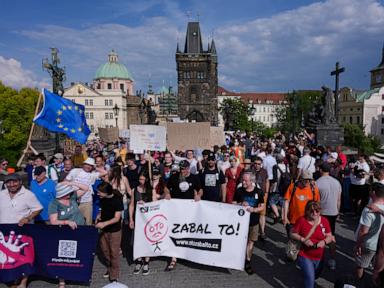
Thousands of protesters took to the streets of Prague this weekend because they smell a trap. On the surface, the Czech government's new plan sounds like a sweet deal for everyday citizens. The ruling coalition, led by populist Prime Minister Andrej Babiš, wants to entirely scrap the monthly public media license fees that households and businesses have paid for decades. Instead, the state will fund Czech Television and Czech Radio directly out of its central budget.
Who wouldn't want to save a little extra cash each month?
Plenty of Czechs, it turns out. They know exactly how this story ends. When a government holds the purse strings for public broadcasters, "independent journalism" usually becomes a fantasy.
The massive rallies across Prague aren't just about an administrative adjustment or a tax restructure. They represent a frantic effort to keep the Czech Republic from sliding down the same path as Hungary and Slovakia, where public media outlets have been effectively weaponized into state megaphones.
The Danger of Controlling the Purse Strings
For years, the Czech Republic used a public media funding model common across Europe. If you owned a TV or a radio, you paid a direct license fee. This fee went straight to the broadcasters. It bypassed the government entirely. This setup acted as a financial firewall. Politicians could scream about biased coverage all they wanted, but they couldn't easily starve the network into submission.
The new proposal tears that firewall down. Starting next year, the government intends to fund public media directly from the state budget.
This financial pivot comes with an immediate hit. The new plan cuts the combined budgets of Czech Television and Czech Radio by roughly 15%. That is an instant loss of about 1.4 billion CZK.
To cope with a sudden drop like that, you can't just cut back on office supplies. Czech Television's leadership already announced that the budget slash will trigger forced layoffs of 300 to 500 employees out of its 2,900-person staff. Programming will shrink. Regional bureaus, which cover stories outside the capital, will likely be the first to close.
When you defund regional journalism, you lose local accountability.
Politicians love to claim they are saving taxpayers money. Babiš repeatedly stated that the media simply needs to learn how to economize. But independent observers look at the timing and see something completely different. This budget overhaul contains absolutely zero legal guarantees for future funding levels. If a broadcaster runs an investigative report that exposes government corruption, what stops the ruling coalition from slashing the budget by another 20% the following year under the guise of fiscal responsibility?
Nothing. That is the point.
Echoes of Hungary and Slovakia
You cannot understand the rage on the streets of Prague without looking at what happened just across the border. Protesters aren't operating on theoretical fears. They have a front-row seat to the dismantling of free press in Central Europe.
In Hungary, Viktor Orbán's government mastered the art of media capture years ago. By restructuring public broadcasting and filling oversight boards with party loyalists, the state transformed the national news agency into a political tool. Independent reporting vanished from public airwaves.
More recently, Robert Fico's government in Slovakia pulled off a similar maneuver. They dissolved the public broadcaster RTVS and replaced it with a new state-controlled entity. Journalists who refused to parrot the government line were pushed out.
Czech protesters see the exact same playbook unfolding in Prague.
Central European Media Control Playbook:
Step 1: Criticize public networks as biased and out of touch.
Step 2: Eliminate independent funding streams (like direct license fees).
Step 3: Force networks to beg the finance ministry for their annual budget.
Step 4: Appoint loyalists to management during "restructuring."
Babiš and his allies have a long history of attacking independent journalists. They frequently label mainstream media as biased or corrupt when stories don't favor them. By removing the financial independence of Czech Television and Czech Radio, the government acquires a structural lever to control the narrative.
If a network depends on a politician's vote to pay its electricity bill, it will think twice before greenlighting an aggressive investigative piece on that politician's business dealings.
Workers Fight Back With Strikes
The resistance isn't just happening on the cobblestone streets of Old Town Square. Inside the broadcast studios, the people who actually produce the news are taking a stand.
Media labor unions announced a one-day warning strike. Hundreds of employees at Czech Television and Czech Radio plan to walk out. While core news coverage and essential public safety announcements will remain on the air, regular programming will face major disruptions.
Broadcasters are putting on black clothing during live segments to signal the potential death of media independence.
Financial Snapshot of the Proposed Reform:
- Total Funding Cut: 1.4 Billion CZK (~15% reduction)
- Project Staff Layoffs: 300 to 500 positions
- Baseline Funding Era: Reverts purchasing power to 2008-2024 levels
This collective action highlights how desperate the internal situation has become. Journalists know that once you cede financial autonomy to the state, you never get it back. International press watchdogs are screaming blue murder too. Both Reporters Without Borders and the International Press Institute released scathing statements warning that the bill directly violates the spirit of the European Media Freedom Act. The European act explicitly requires member states to provide public service media with predictable, stable, and sustainable funding that shields them from political pressure.
The Czech proposal does the exact opposite. It creates deliberate instability.
Why Public Media Matters in the Modern Era
A common counterargument from tech-savvy critics is that public broadcasting is a relic of the twentieth century. They argue that in an era of YouTube, podcasts, and substacks, we don't need a state-subsidized television network.
This argument misses the fundamental mechanics of modern information ecosystems.
Commercial networks and digital platforms run on algorithms designed to maximize engagement. Maximizing engagement usually means feeding people content that triggers outrage or confirms existing biases. Public broadcasters operate under a completely different mandate. They are legally required to provide balanced, verified, fact-checked reporting to the entire population, regardless of profitability.
When a crisis hits, people don't look to an influencer. They turn to public media.
Furthermore, commercial media companies rarely invest heavily in deep regional reporting because it doesn't generate high ad revenue. Czech Radio and Czech Television maintain bureaus in remote corners of the country. They report on local municipal corruption, regional school funding, and community infrastructure. If those bureaus disappear due to the 15% budget cut, those stories will simply go unwritten. Corruption thrives in the dark.
What Happens Next
The draft legislation has cleared the government cabinet, but it still faces a turbulent path through the Czech Parliament. Opponents of the bill are leveraging every tool they have to slow it down, modify it, or kill it entirely.
If you want to track this situation or support independent journalism, watch these specific pressure points over the coming weeks:
- The Parliamentary Debate: Look closely at whether opposition parties can successfully introduce amendments that legally lock in minimum funding percentages tied to inflation. If the government refuses to add inflation adjustments, it confirms that financial starvation is the ultimate goal.
- The Union Escalation: Pay attention to the outcome of the one-day warning strike. If the government ignores the warning, unions may escalate to open-ended strikes, which could disrupt major live broadcasts and sporting events.
- European Commission Intervention: Watch for statements from Brussels. Since the bill appears to directly conflict with the European Media Freedom Act, the EU has the authority to launch infringement procedures against the Czech Republic.
The battle in Prague isn't a minor local dispute over a household utility fee. It is a critical defense line for press freedom in Europe. Lose this line, and the regional march toward state-managed information takes another massive step forward.