"The very fact that you're aware of suffering is enough reason to be overjoyed that you're alive and can experience it."
Most people recoil when they hear that sentence. We live in a culture obsessed with optimizing away discomfort, popping pills for every minor ache, and treating emotional pain like a software bug that needs an immediate patch. Bob Ross wasn't trying to sell toxic positivity or tell you to smile through genuine trauma. He was pointing out a raw biological truth. Dead people don't hurt. Numb people don't hurt. Only the living feel the sting.
If you're dealing with a heavy heart, heartbreak, or chronic frustration right now, that pain is proof of your pulse. Let's look at why our modern aversion to pain is actually making us miserable, and how a soft-spoken painter on public television cracked the code of human resilience.
The Canvas Philosophy
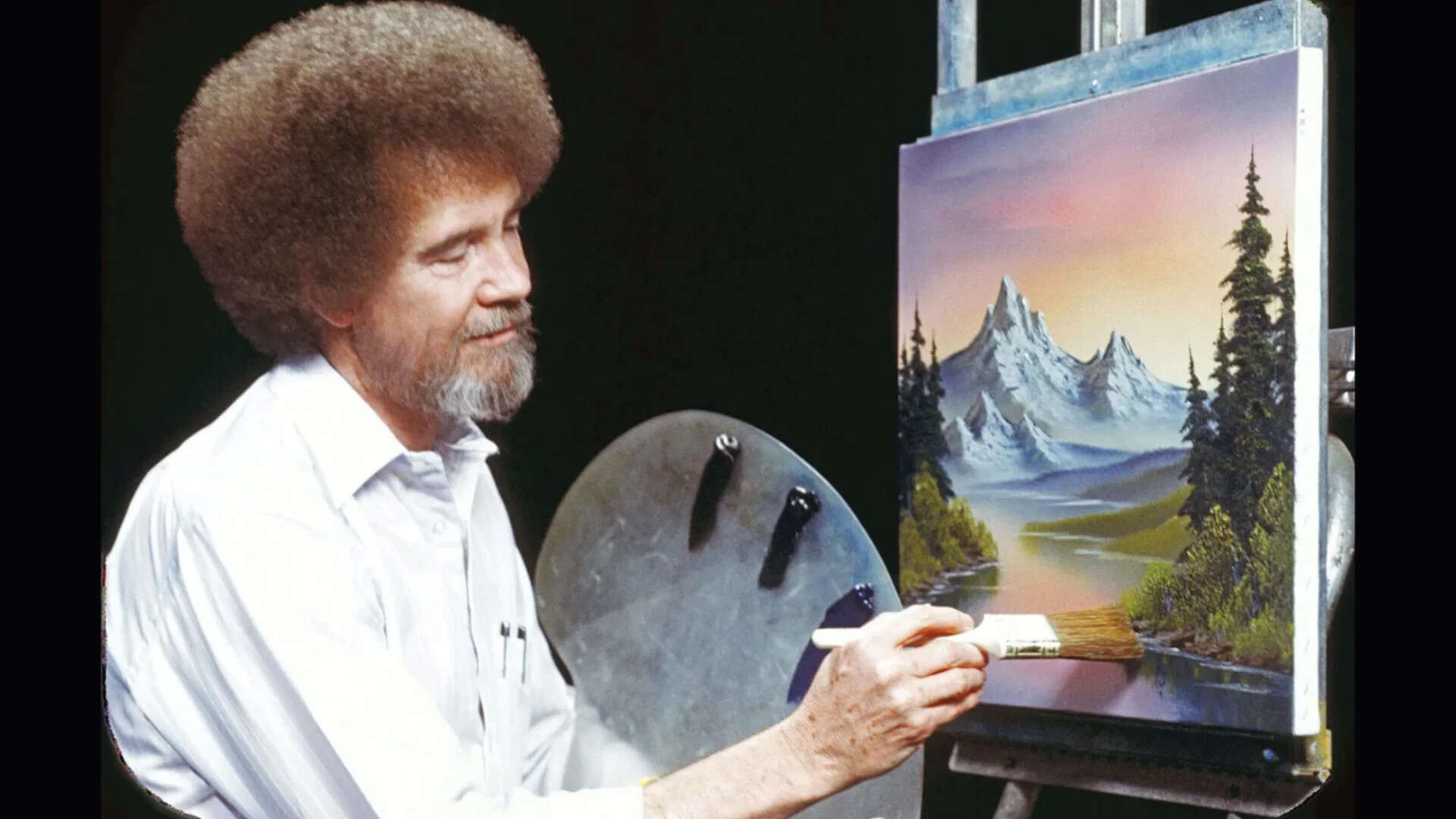
Bob Ross filmed The Joy of Painting out of a small television station in Muncie, Indiana, for over a decade. Millions tuned in to watch him blend titanium white and phthalo blue into mountainscapes, but his real art was teaching people how to handle mistakes. When a stroke of the knife went wrong, he called it a "happy little accident" and built a tree right over it.
Behind the calm demeanor, Ross knew about real grief. His second wife, Jane, died of cancer in 1992. He carried that loss while continuing to tape episodes that brought comfort to millions of insomniacs, stressed workers, and lonely viewers.
When he talked about dark colors on a canvas, he wasn't just talking about paint. He frequently noted that you need dark shades to make the light show up. Without contrast, a painting turns into a flat, washed-out mess. Human life operates on the exact same principle. If you shield yourself from every possible source of pain, you accidentally flatten your capacity for joy.
Why Modern Life Makes Us Intolerant to Discomfort
We've built an entire economy around frictionless convenience. Don't want to talk to a waiter? Use an app. Feeling bored for two seconds? Scroll an infinite feed. Feeling sad? Find a distraction.
This hyper-comfort has tanked our baseline resilience. Psychologists call it sensory adaptation. When your environment is dialed in to be constantly smooth and pleasant, your brain recalibrates. Minor inconveniences—a delayed flight, a rude text, a rejected proposal—feel like catastrophic emergencies because your nervous system has forgotten what actual friction feels like.
When you run away from suffering, you don't actually escape it. You just make yourself weaker. You shrink your world until a gentle breeze feels like a hurricane.
What Stoics and Psychiatrists Knew
Ross didn't invent this mindset. He just translated ancient wisdom into a denim shirt.
The ancient Greek philosopher Epictetus spent part of his life as a slave before teaching that human beings break down not from events, but from their judgments about events. Recognizing that pain is part of the package deal frees you from the exhausting job of trying to control the uncontrollable.
Decades later, psychiatrist Viktor Frankl survived Nazi concentration camps and wrote Man's Search for Meaning. Frankl argued that suffering is an unyielding layer of human existence, right alongside death. You cannot have a complete life without it. When you cannot change a brutal situation, Frankl noted, you are forced to change yourself.
Frankl and Ross arrived at the same conclusion from different directions. Awareness of suffering means your mind is awake. It means you care about outcomes, people, and dreams. Apathy is the real enemy. Indifference doesn't hurt, but it's a slow death of the soul.
How to Apply This Without Losing Your Mind
Accepting pain doesn't mean you have to enjoy it. Nobody likes getting dumped, getting laid off, or getting sick. Radical acceptance—a core concept in modern dialectical behavior therapy pioneered by Marsha Linehan—is about stopping the exhausting war against reality.
When bad things happen, our first instinct is usually rage and denial. Why me? This shouldn't be happening. That secondary resistance causes more agony than the actual event.
Try shifting your internal dialogue the next time life punches you in the gut.
- Stop asking for a guarantee of permanent comfort. It doesn't exist.
- Acknowledge what hurts without judging yourself for feeling broken.
- Treat your emotional scars like the dark paint on Ross's canvas. They give depth to your character.
Stop viewing every negative emotion as proof that your life is failing. Sometimes, it's just proof that you're paying attention. Embrace the contrast, pick up the brush, and deal with the landscape in front of you.