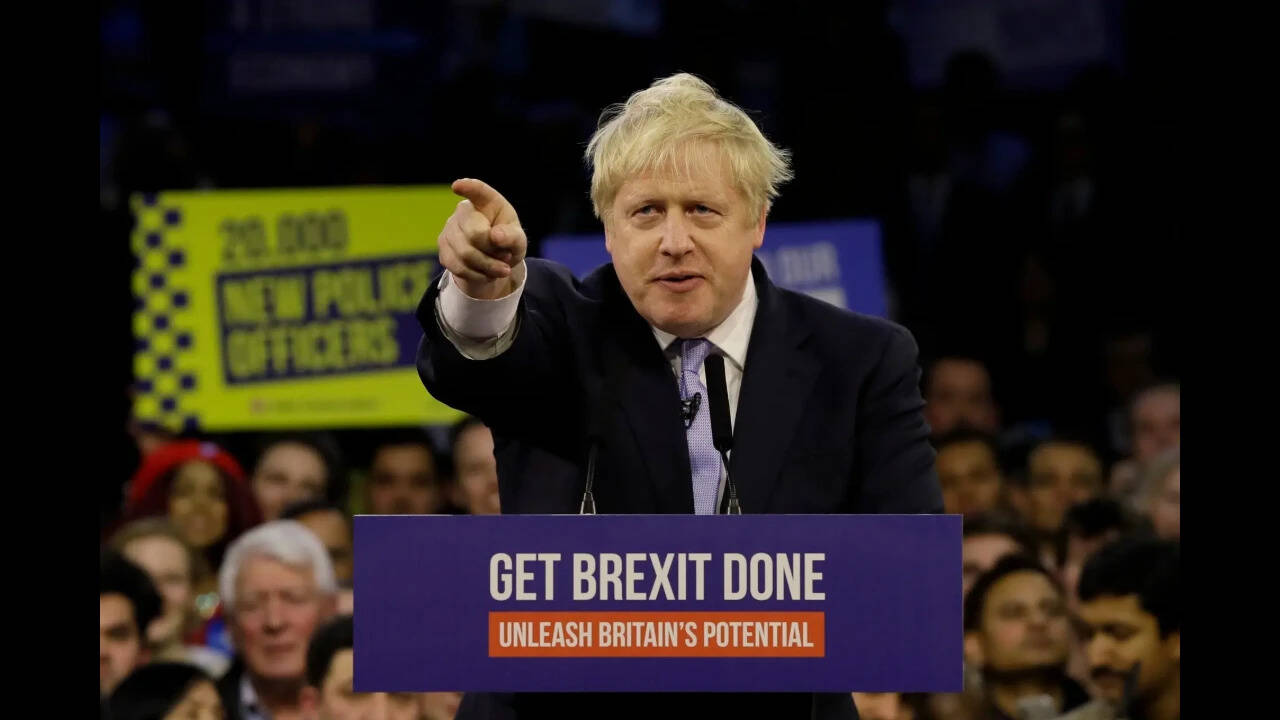
Political slogans usually die fast. They burn bright during an election, get plastered on billboards, and disappear the moment the ballots are counted. But one ridiculous phrase managed to outlive the political career of the man who said it, defining an entire era of British history. When Boris Johnson muttered the phrase, "My policy on cake is pro having it and pro eating it," it sounded like a classic piece of his trademark buffoonery. It was funny. It was eccentric. It was also the exact moment that British foreign policy abandoned reality.
The line wasn’t even originally about Brexit. Johnson had been tossing it around for years during his time as Mayor of London to shrug off questions about his competing personal and political ambitions. But when the 2016 referendum arrived, this throwaway quip transformed into a governing ideology. It gave birth to a new word in the political lexicon: cakeism. This wasn't just a funny joke over tea. It became the foundational myth of the Leave campaign, promising voters that the United Kingdom could ditch the burdens of European Union membership while keeping every single benefit.
Years after the UK officially cut ties with Brussels, the ghost of this phrase still haunts the economy. Understanding why this bizarre philosophy took hold tells us everything we need to know about the power of magical thinking in modern campaigns.
The Origin of the Boris Johnson Cake Quote and How It Defined Brexit
To understand how a pastry metaphor became geopolitical strategy, you have to look at the mechanics of the EU. The European single market relies on a strict trade-off. If you want seamless access to millions of customers across the continent, you must accept the four freedoms: the free movement of goods, capital, services, and people. You also have to pay into the central budget and accept the jurisdiction of European courts. It's a package deal. You can't pick and choose.
Boris Johnson decided that rules were for other people. As a leader of the Vote Leave campaign, he had a massive problem to solve. He needed to convince a worried electorate that walking away from Britain's biggest trading partner wouldn't tank the economy. His solution was simple. Just deny the trade-off exists.
He told voters that Britain could stop EU immigration completely. He promised the country would stop sending money to Brussels. At the same exact time, he claimed the UK would maintain full, frictionless access to the single market. When journalists and economists pointed out that the EU would never agree to let a non-member rewrite their rulebook, Johnson smiled, leaned on his charm, and pushed his cake theory. To his supporters, this wasn’t dishonesty. It was glorious British optimism. It was a refusal to bow to the dour, pessimistic experts who said things were impossible.
The phrase stuck because it made a incredibly dry, legalistic debate digestible. Most people don't want to read hundreds of pages on customs declarations or regulatory alignment. They want to hear that they can win without making sacrifices. Johnson gave them exactly that. He turned a complex international negotiation into a cheerful bakery visit.
How Cakeism Clashed With European Reality
The view from Brussels was completely different. European leaders didn't see a charming optimist. They saw a deeply unserious country trying to break a club's rules while keeping the clubhouse privileges. The phrase quickly morphed from a British slogan into a weapon used by EU negotiators to mock the UK's position.
Donald Tusk, who was serving as the President of the European Council at the time, decided to take the metaphor head-on. In a blistering speech, he mocked the idea that Britain could magically preserve its old advantages. He said there would be no cakes on the table for anyone, only salt and vinegar. Tusk even suggested a simple experiment for anyone buying into the rhetoric: buy a cake, eat it, and see if it remains on the plate.
Despite the public warnings from Europe, the British government couldn't shake the habit. The delusion wasn't just confined to Johnson’s public speeches. It infected the entire civil service and cabinet. In late 2016, a political aide was photographed walking into 10 Downing Street carrying a notepad filled with handwritten strategy notes. The press zoomed in on the document. Written clearly on the paper was the phrase: "What's the model? Have cake and eat it."
The leak exposed the truth. The government didn't actually have a backup plan. They genuinely believed they could bluster their way through the negotiations and force the EU to blink. They assumed Europe’s auto manufacturers and winemakers would panic at the prospect of losing British customers and force their political leaders to give the UK a special deal. It was a massive miscalculation. The EU prioritized the integrity of its single market over making life easy for a departing member.
The Concrete Costs of Magical Thinking
We now have years of data showing exactly what happens when cakeism meets the real world. Boris Johnson eventually secured a trade deal in late 2020, proudly claiming that it proved his original theory correct. He insisted the UK had achieved zero-tariff and zero-quota trade while regaining total sovereignty.
The reality on the ground told a different story. Zero tariffs do not mean zero paperwork. The moment the UK left the customs union, British businesses were hit by a mountain of new bureaucracy. Companies had to fill out complex rules-of-origin forms to prove their goods were actually made in Britain. Small exporters found themselves buried under customs declarations, health certificates for food products, and VAT complications. Many simply gave up selling to Europe altogether.
The economic fallout didn't arrive as a sudden, dramatic crash. Instead, it showed up as a slow, steady drain on growth. The Office for Budget Responsibility consistently estimated that Brexit would reduce the UK’s long-term productivity by around 4% compared to remaining in the EU. Labor shortages hit key sectors like agriculture, hospitality, and logistics because the supply of European workers dried up.
- Trade Barriers: British seafood exporters watched their fresh catch rot in trucks at the border due to shipping delays.
- Investment Stagnation: Business investment in the UK flattened out compared to other G7 nations after the 2016 vote.
- Regulatory Duplication: The UK had to build its own expensive regulatory bodies to replace EU agencies, creating extra red tape for domestic firms.
The cake had been eaten, and the plate was completely empty.
The Long Shadow Over Today's Politics
The legacy of this era extends far beyond trade statistics. It fundamentally altered how political communication works in the UK. By proving that a politician could win a historic vote by rejecting structural trade-offs, Johnson set a new standard for campaigns.
The strategy is simple. When faced with a complex problem that requires hard choices, you create a slogan that promises everything to everyone. If anyone calls you out on the math, you label them a project-fear alarmist or an enemy of progress. It created a culture where admitting that choices involve sacrifices is seen as a political weakness.
You can see the remnants of this thinking in current debates around taxation, public services, and green energy. Politicians on all sides remain terrified of telling voters the blunt truth: you cannot have American-style low taxes alongside Scandinavian-style public services. The spirit of cakeism lives on every time a politician promises to fix the National Health Service without raising taxes, or vows to hit net-zero targets without costing consumers a single penny.
How to Spot Cakeism in Daily Life
You don't have to be a British politician to fall into this trap. Cakeism is a human instinct. We all want the rewards without the sacrifice. Recognizing this pattern can help you make better decisions in your own career, investments, and daily planning. Here is how to audit your own goals for hidden cakeism.
Look closely at your current projects or financial plans. Are you projecting an outcome that relies on two mutually exclusive things happening simultaneously? If you're planning a business venture and assuming you can charge premium prices while spending absolutely nothing on marketing, you're practicing cakeism. If you're trying to scale a team but refuse to delegate any actual authority, you're caught in the same loop.
Stop looking for the magical third option that lets you avoid a difficult choice. Write down the true cost of your decisions. Accept that choosing one path means actively abandoning another. The moment you stop trying to hold onto the cake while devouring it, you can actually start building a strategy that works in the real world. Get comfortable with the trade-offs, make your choice, and stop pretending you can have it both ways.