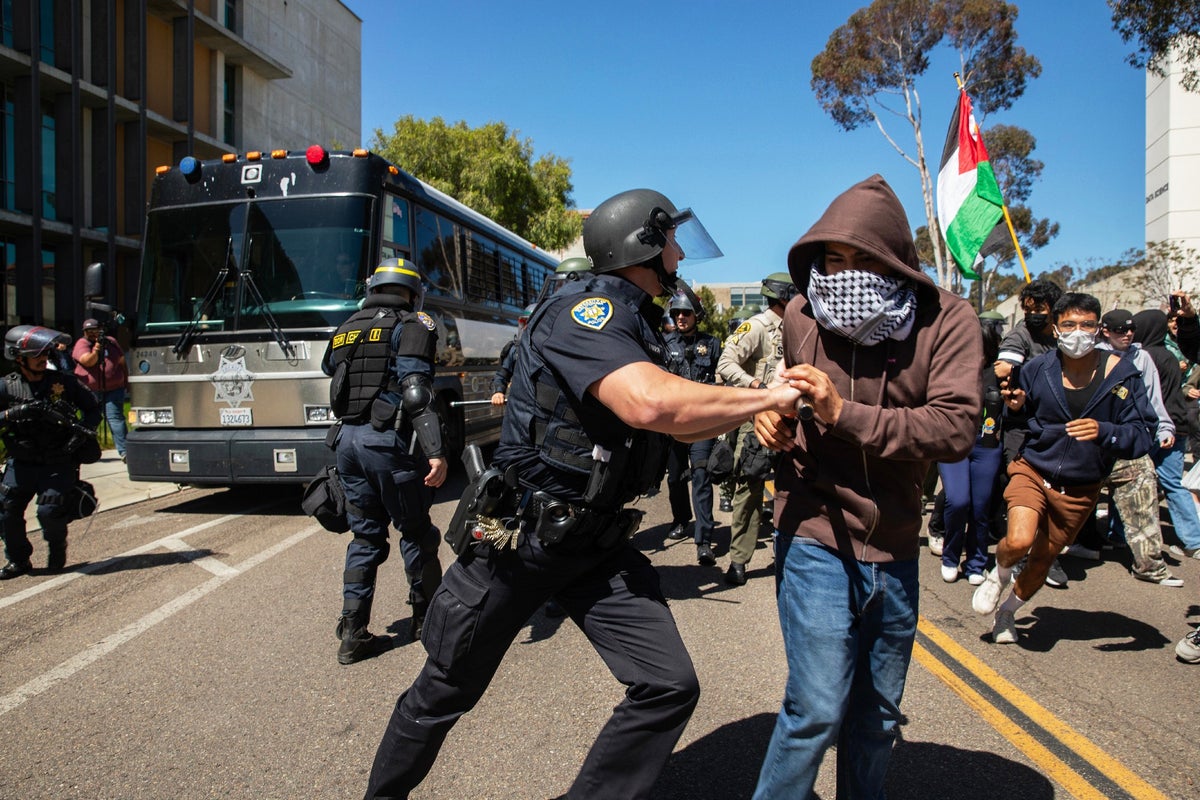
You expect to see textbooks, laptops, and coffee cups on a college campus. You don't expect to find semi-automatic AR-15 rifles, chemical tear gas grenades, and military-grade sonic weapons capable of causing permanent hearing damage. Yet, that is exactly what has been piling up in campus police armories across California.
A massive investigation into 148 public campuses across the California Community Colleges, California State University (CSU), and University of California (UC) systems exposed a startling truth. Many of these institutions have spent years quietly amassing military equipment. Worse, they routinely ignored state laws designed to force them into public transparency.
This isn't just about safety. It's about a total breakdown of accountability.
The Stockpiles Hiding in Plain Sight
When most people think of university security, they picture officers unlocking dorm doors or patrolling parking lots. The reality is far more militarized. Campus police departments across California have built up arsenals that look more like small-town SWAT teams than school safety units.
We are talking about hundreds of semi-automatic rifles. Hundreds of thousands of rounds of live ammunition. Stun grenades designed to induce temporary blindness. Long-Range Acoustic Devices (LRADs), which are specialized speakers used by the military to blast sound at 160 decibels. In the armed forces, these machines are literally nicknamed the "voice of God."
Why does a biology major sharing a campus with local commuter students need to be policed by weapons meant for a combat zone? The official line from university administrators is always the same. They claim these weapons are necessary to deal with extraordinary threats, like active shooters or massive civil unrest. But the scale of the hoarding tells a completely different story.
Look at the numbers. Police at UCLA deployed long-range acoustic devices 71 times during the 2024-25 academic year alone. They used them to manage protests, demonstrations, and student gatherings. UC Santa Cruz police deployed similar sonic weaponry during pro-Palestinian encampment protests. These aren't isolated incidents. This is standard operational procedure.
Inside the Black Box of Campus Armories
The sheer variety of tactical gear hidden in these universities is staggering. The investigation revealed that departments are tracking—and sometimes hiding—highly dangerous hardware.
- Semi-Automatic Rifles: Over 25 public colleges in California officially own high-powered rifles. These firearms shoot with vastly more precision, velocity, and distance than standard handguns.
- Chemical Agents and Launchers: Campus inventories contain thousands of riot munitions, including tear gas and projectiles packed with oleoresin capsicum, which is the chemical active in chili peppers.
- Flashbangs and Stun Grenades: These distraction devices emit blinding light and deafening noise to disorient targets during high-risk arrests.
- Projectile Launch Platforms: Heavy-duty 40mm launchers designed to fire rubber bullets, bean bags, and specialty impact munitions.
The hypocrisy is what really stings. While students face strict regulations regarding what they can bring onto campus, police are operating under an entirely separate set of rules.
How Higher Education Skirts State Laws
This brings us to Assembly Bill 481. Signed into law back in 2021, AB 481 was meant to put a leash on the militarization of local law enforcement, explicitly including campus police departments. Written by former Assemblymember David Chiu, the statute laid out clear rules. If a department owns military equipment, its governing board must approve a formal use policy every year. They must publish a precise inventory online. They must host well-publicized forums so the public can ask questions and give feedback.
It sounds simple. It turns out, colleges just didn't care to follow it.
The investigation proved that compliance with AB 481 is an absolute mess across the state. Some departments simply never bothered to write a policy. Others routinely left out crucial information, like manufacturers' product descriptions, exact munition counts, and up-to-date inventories.
Take UC Berkeley as an example. The University of California Board of Regents approved the school's annual equipment report in September. Yet, UC Berkeley police refused to actually publish their equipment list online until April of the following year, only doing so after being repeatedly cornered by reporters.
Then you have the outright rule-breaking. San Jose State University and San Francisco State University both own AR-15 rifles. Here's the catch. The broader California State University systemwide policy doesn't actually authorize those rifles. When caught, a CSU spokesperson tried to claim the rifles were "standard issue" and exempt from reporting laws. But San Jose State's own internal reports explicitly categorized those exact weapons as "specialized firearms."
Even worse, an October 2025 memo showed that San Jose State police had 33 unauthorized tear gas grenades sitting in their armory, along with an unapproved submachine gun. The department's defense? They claimed the grenades had "always been in our armory" and that they planned to destroy them eventually. That is an terrifying lack of oversight.
The Student Backlash and What Comes Next
Students are starting to realize their tuition dollars are funding heavy weaponry, and they are furious. When officials at Mt. San Antonio College tried to officially add AR-15 rifles to their department's arsenal, a massive student-led coalition organized demonstrations and packed board meetings.
Student activists pointed out that bringing high-powered rifles onto campus makes students of color and student veterans feel intensely unsafe. It turns an environment meant for learning into a hostile zone. Because of that aggressive student pushback, the college rolled back its plans and halted the rifle purchases. It was a rare victory for student accountability.
Other administrators are playing catch-up now that the spotlight is on them. Compton College President Keith Curry admitted he had no clue his campus police had been handing out semi-automatic rifles to officers for over seven years without any approved policy in place. He only found out after journalists started asking questions.
Since the reality came to light, several institutions are scrambling to fix their image. Chaffey College quickly passed an emergency policy. MiraCosta College pledged to responsibly reduce its weapon inventory to align with actual campus needs.
But shouldn't this oversight have happened years ago? Relying on investigative journalists and angry student protests to force public universities to obey state law is an embarrassing failure of leadership.
Actionable Steps for Campus Communities
If you want to ensure your local campus isn't secretly hoarding unauthorized military gear, you have to take direct action. Do not wait for administrative transparency.
- Demand the AB 481 Inventory: Search your university police website specifically for their "AB 481 Military Equipment Report." If it isn't prominently published or hasn't been updated within the last 12 months, file a formal public records request.
- Audit the Public Forums: State law requires a "well-publicized" public forum within 30 days of the report's release. Force your student government to track these dates and ensure the police department actually advertises these meetings to the entire student body, not just in obscure corners of the internet.
- Challenge the Inventory: Attend the governing board meetings. Ask direct questions about why specific weapons, like 40mm launchers or acoustic devices, are necessary for campus safety, and push for a hard cap on munition stockades.