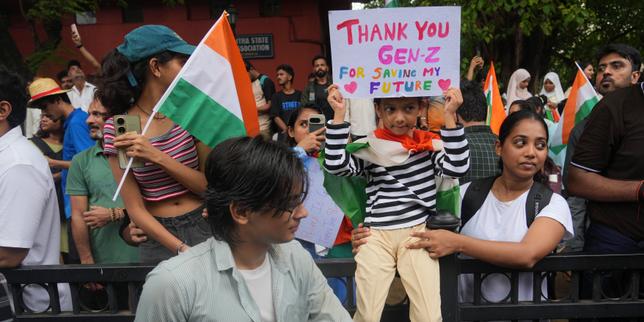
When a political movement adopts the name of an insect, people laugh. Until the streets fill with millions of angry citizens who refuse to go home.
In India right now, a youth-driven rebellion known as the Cockroach Janta Party, or CJP, is shaking the foundations of Prime Minister Narendra Modi's administration. Born online in May, this satirical acronym mocks the ruling Bharatiya Janata Party (BJP). But the anger driving it isn't a joke. Thousands of students and young professionals have taken over New Delhi's Jantar Mantar square, demanding structural changes and holding nothing back.
If you want to understand why this specific wave of protests poses a genuine threat to an otherwise dominant government, you have to look past the political slogans and examine the economic reality facing India's youngest generations.
The Breaking Point Behind the Exam Scandals
The immediate trigger for this mass mobilization isn't abstract ideology. It is systemic corruption.
For months, massive anger has boiled over regarding widespread irregularities and fraud in major university entrance and competitive exams, notably including the NEET medical entrance tests. Millions of students spend years studying day and night, sacrificing everything in hopes of securing a stable future. When exam papers leak or results are rigged, years of hard work evaporate overnight.
Founder Abhijeet Dipke and leaders like Ashutosh Ranka managed to capture a deep, latent fury. The CJP's core demand is blunt: they want Education Minister Dharmendra Pradhan fired immediately. When police moved in with tear water and batons during a massive march toward the federal parliament, injuring at least 180 people, they expected to crush the momentum. Instead, they poured gasoline on the fire.
Beyond the Economic Growth Statistics
Government officials love pointing to national gross domestic product numbers to prove the country is thriving. India boasts impressive macro-level statistics, often clocking economic growth rates above 7%.
Yet macroeconomics don't pay rent or buy groceries. Millions of young graduates face youth unemployment rates that can spike past 40% in various sectors and regions. You can have all the skyscrapers and technological hubs you want, but if an entire generation believes the system is rigged against them, stability vanishes.
The CJP movement works precisely because it addresses this disconnect. Young Indians feel invisible. They are told they live in an emerging global superpower while struggling to find entry-level jobs that pay a living wage. When dissent is treated as a threat to national security rather than a symptom of a broken administrative pipeline, frustration turns into defiance.
Political Fallout for Modi
Narendra Modi has faced political battles before, winning three consecutive mandates through sheer electoral dominance and nationalist appeal. Yet this crisis hits differently.
Opposition figures, including parliamentary leader Rahul Gandhi, quickly seized on the heavy-handed police response to amplify the pressure. Gandhi openly called for Modi's resignation, accusing the prime minister of actively destroying the future of the nation's youth. Sit-ins outside the prime minister's residence and spreading solidarity demonstrations in cities like Bombay, Bangalore, and Patna prove this isn't just a localized New Delhi riot.
Faced with mounting international scrutiny and sustained street occupation, the government has started softening its stance, hinting at possible reforms for the first time. But cosmetic changes won't satisfy a population that has lost its fear of state authority.
What Comes Next
Movements born from digital organizing and organic street anger are notoriously difficult to control or negotiate with through traditional political channels. The youth have made it clear they won't disperse simply because police show up with batons.
If the administration fails to address the root causes of educational fraud and structural joblessness, the "cafards" will remain a permanent thorn in the side of a government that thought it was untouchable.