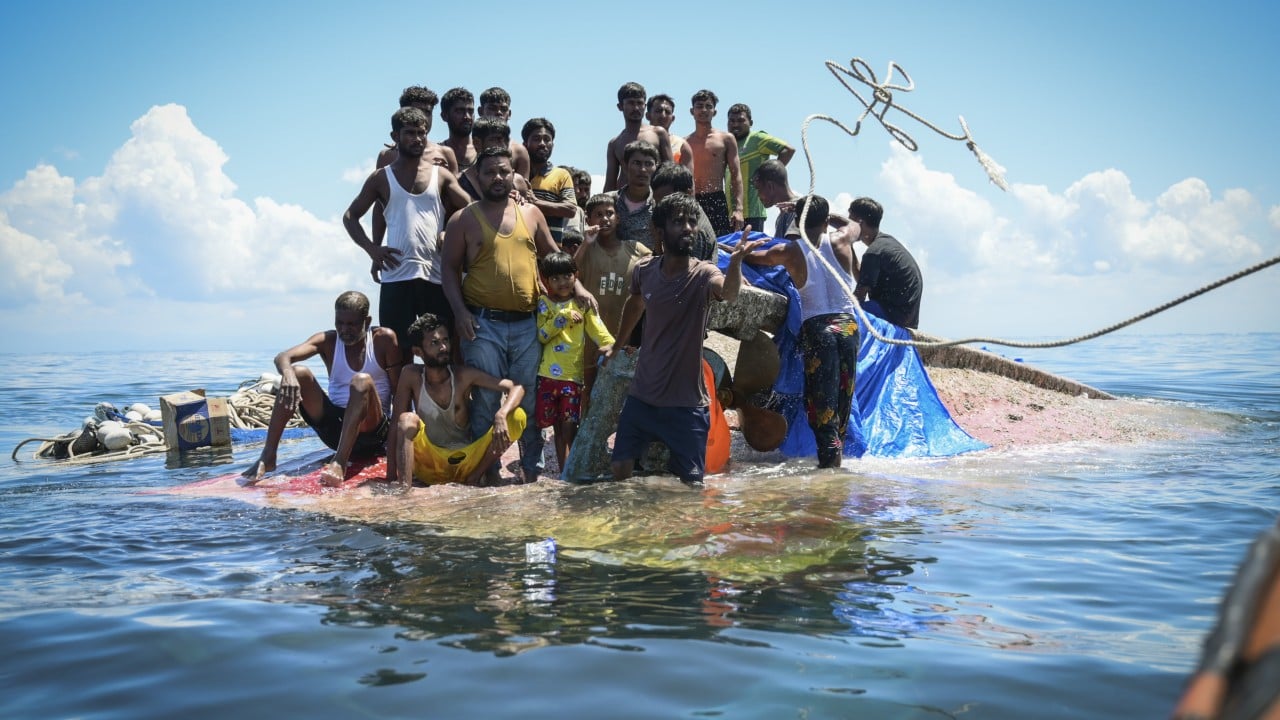
People don't board flimsy, overcrowded wooden boats in the middle of a raging monsoon because they want to. They do it because staying behind feels like a slow, guaranteed death sentence. On July 16, 2026, the UN Refugee Agency (UNHCR) and the International Organization for Migration (IOM) dropped a bombshell that barely registered on global news feeds. More than 500 Rohingya refugees are feared dead after two separate vessels capsized off the coast of Myanmar.
The sheer scale of this disaster is horrifying. Yet, the reaction from the international community has been a collective shrug.
It is time to look at why this keeps happening. The narrative we are fed often treats these ocean tragedies as unpredictable, seasonal accidents. That's a flat-out lie. These deaths are entirely predictable, systemic, and manufactured by a toxic combination of regional political apathy, aid cuts, and relentless military violence.
The July 2026 Double Tragedy
To understand the depth of this crisis, we have to look at the timeline of what just happened. In late June 2026, two vessels packed with hundreds of desperate people slipped away from the shores of Myanmar's conflict-torn Rakhine State.
They did not choose this time of year by accident. They chose it because they were desperate enough to ignore the worst sailing weather of the year.
- The first boat: Carrying roughly 250 people, this vessel lost all contact almost immediately after pushing off into the open ocean. It simply vanished.
- The second boat: Carrying an estimated 280 passengers, this craft is believed to have broken apart and sunk off Myanmar's Ayeyarwady coast on July 8, 2026.
That makes more than 500 human beings—including children, infants, and pregnant women—swallowed by the sea in a matter of weeks.
What makes this even more tragic is that many of these passengers had traveled from the overcrowded, squalid refugee camps across the border in Cox's Bazar, Bangladesh. They slipped back into Myanmar just to catch a boat operated by human traffickers, hoping to reach Malaysia or Indonesia.
If these numbers are fully confirmed, this single event will instantly dwarf the total recorded casualties of the region's sea routes for the first half of the year.
How the World Shrank the Rohingya Safety Net
We need to talk about why refugees are fleeing Bangladesh camps that are supposed to be safe havens. The truth is, the camps have become open-air prisons.
For years, over one million stateless Rohingya refugees have survived on the bare minimum in Cox's Bazar. But recently, that bare minimum got even smaller. Global humanitarian funding has cratered. In early 2026, the World Food Programme (WFP) was forced to make devastating cuts to food aid.
Before the cuts, refugees were trying to survive on a meager $12 per month for food. Think about that. Less than fifty cents a day to feed a human being. Then, the WFP slashed that to just $7 to $10 a month for the majority of the camp population.
Try feeding your family on $7 a month. It is impossible.
When you cut off food to a million people who are legally banned from working, you create a pressure cooker. Parents are left with a simple, brutal math problem. Do they watch their kids slowly starve in a muddy shelter, or do they hand their teenage sons and daughters over to human smugglers on the coast?
We are seeing the direct result of those choices. Desperation drives these families straight into the hands of trafficking syndicates.
The War at Home and the Rakhine Meat Grinder
The situation inside Myanmar itself is arguably even worse. Since the military coup in 2021, the country has been locked in a brutal civil war. In Rakhine State, the homeland of the Rohingya, the fighting between the ruling military junta and the Arakan Army—an ethnic Rakhine armed group—has reached a fever pitch.
The Rohingya are trapped in the middle of this clash. The military junta has lost massive ground and has resorted to forcibly conscripting Rohingya men—the very people they tried to wipe out in the 2017 genocide—to use as human shields on the front lines.
Meanwhile, those who remain in Rakhine are subjected to severe restrictions on movement, blocked from accessing medical care, and confined to displacement camps that resemble concentration camps. Since 2024, more than 150,000 new refugees have tried to pour into Bangladesh to escape this fresh wave of violence.
But Bangladesh has closed its borders. The country is exhausted, cash-strapped, and dealing with its own internal political and economic headaches.
With the land route blocked and the camps in Bangladesh starving, the sea is the only exit door left open. Even if that door leads to a watery grave.
The Deadliest Sea Route on the Planet
The Bay of Bengal and the Andaman Sea are now home to the highest mortality rate of any major refugee maritime route in the world.
In 2025, nearly 900 Rohingya refugees died or went missing along this route. That was out of about 6,500 who attempted the journey. That is a staggering 13% mortality rate. To put that in perspective, it is significantly more dangerous than the notorious Mediterranean crossing from North Africa to Europe.
Yet, you rarely see this on the front pages of Western newspapers.
Neighboring countries have behaved with astonishing cruelty. Rather than launching search-and-rescue operations when distress calls are received, regional navies and coastguards often engage in what is politely called "pushbacks." They tow the broken boats back out to international waters, hand over some bottles of water and packets of dry noodles, and leave them to drift.
It is a policy of organized abandonment.
Moving Beyond Useless Diplomatic Statements
Every time a Myanmar boat capsizes, we get the same copy-paste statements from regional bodies and international agencies. They call for "regional cooperation" and "enhanced search and rescue".
It does absolutely nothing. The words are hollow.
If we actually want to stop the drownings, we have to treat this as a geopolitical crisis, not just a humanitarian tragedy. Here are the immediate, practical steps that governments in the region must take.
Fund the Joint Response Plan
The UN has requested $710.5 million for the 2026 Joint Response Plan to support Rohingya refugees and host communities in Bangladesh. Right now, that plan is severely underfunded. Wealthy nations need to step up and fill the gap to restore food rations to livable levels. If people aren't starving, they won't feel forced to board death traps.
Establish a Regional Search and Rescue Protocol
ASEAN countries—specifically Thailand, Malaysia, and Indonesia—must establish a coordinated, active patrol system in the Andaman Sea. Finding a boat in distress should trigger a rescue mission, not a pushback.
Break Down the Trafficking Networks
These boat journeys are not organic. They are highly organized business ventures run by transnational smuggling networks operating with impunity across Myanmar, Bangladesh, Thailand, and Malaysia. Targeting the financial flows of these networks is much more effective than arresting the low-level boat captains.
The tragedy of over 500 feared dead in July 2026 is not a natural disaster. The monsoon rains and high seas may have sunk the boats, but it was political cowardice, aid cuts, and military brutality that pushed those people into the water. Every day the world chooses to look away, the body count in the Bay of Bengal will keep rising.