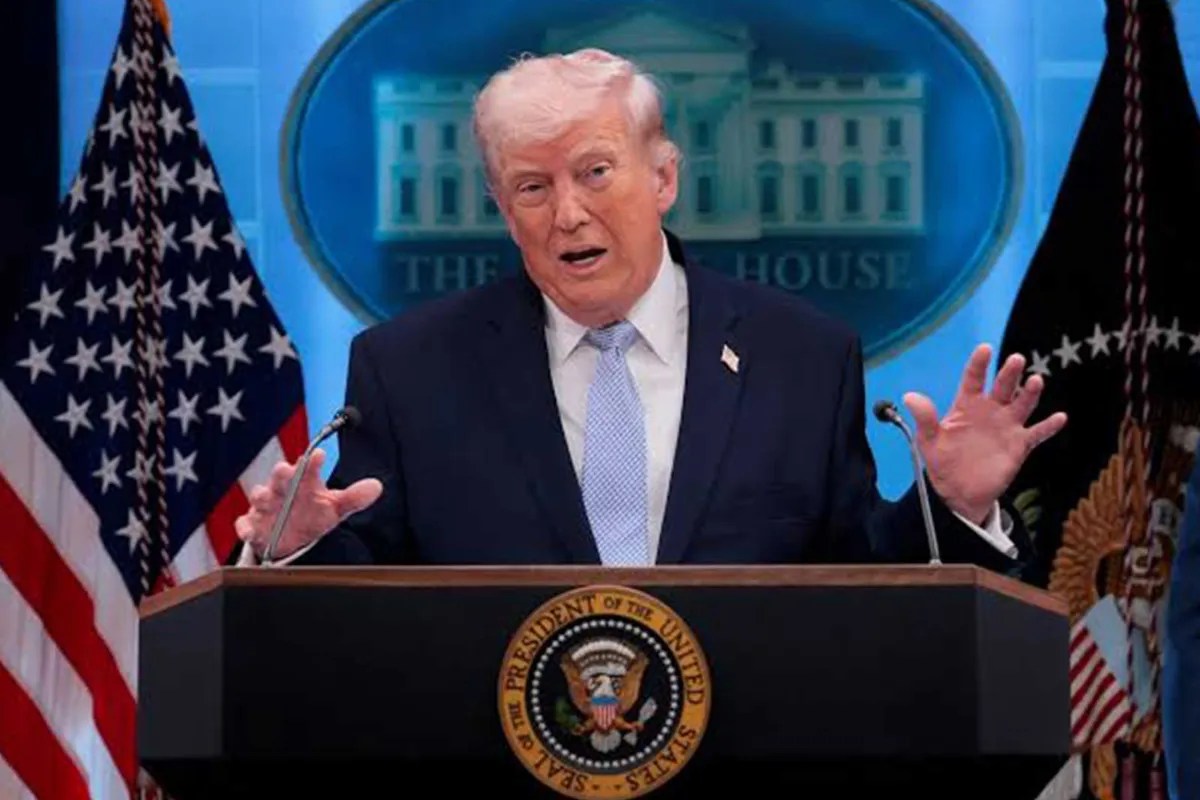
Donald Trump loves a massive number, especially when it helps him make a point on Truth Social. His recent broadside against NATO is a classic example. He claimed the United States is blowing $999 billion on NATO "to protect them, without getting any benefit from so doing." He contrasted this massive near-trillion-dollar figure with the much smaller defense budgets of the UK ($90.5 billion), France ($66.5 billion), and Italy ($48.8 billion), calling the gap "ridiculous."
If you just look at the raw numbers, it's easy to see why people get furious. Nobody wants to feel like they're the world's sugar daddy, paying for everyone else's security while getting nothing in return. But when you look under the hood of how military spending actually works, the picture changes completely. Trump's math is technically real, but his framing is totally misleading.
Let's break down what that $999 billion actually pays for, why the math doesn't mean what he says it means, and what the real state of trans-Atlantic security looks like today in 2026.
The Myth of the Trillion Dollar NATO Check
Here is the biggest misconception about American defense spending. The US does not write a check for $999 billion to NATO headquarters in Brussels. That astronomical figure is the cumulative, total annual budget for the entire US Department of Defense.
When Washington funds its military, that cash goes to global operations. The vast majority of that $999 billion goes to strategic priorities that have absolutely nothing to do with defending Europe. It funds the massive naval presence in the Indo-Pacific to counter China. It pays for homeland defense, the American nuclear modernization program, counter-terrorism operations in the Middle East, and global space and cyber commands.
Only a fraction of total US military capability is dedicated solely to the defense of Europe. Conflating America's entire global military apparatus with its specific NATO commitments is a classic accounting trick. It makes for a great headline, but it's bad math.
The Burdensharing Script Has Flipped
For years, critics complained that European nations were free-riding on the back of Uncle Sam. Robert Gates, the former US Secretary of Defense, warned about a "two-tiered alliance" all the way back in 2011. And honestly, for a long time, those critics were right. European nations treated defense spending like a rollercoaster that only went down.
But things look radically different now. Trump’s relentless political pressure—combined with Vladimir Putin’s brutal reality check in Ukraine—forced a massive reckoning.
The old metric established at the 2014 Wales Summit required member states to spend 2% of their GDP on defense. For years, major economies like Germany fell way short. Not anymore. Every single one of the 32 NATO allies has reached or passed that 2% mark.
In fact, the goalposts moved entirely at the 2025 NATO Summit in The Hague. Spurred on by the reality of a multi-polar world, allies signed a massive commitment to hit 5% of their GDP by 2035. This new target splits the load: 3.5% goes directly to hard core defense capabilities, while 1.5% covers broader security, like protecting critical infrastructure and building up the defense industrial base.
European allies and Canada stepped up massively, throwing an extra $139 billion into their defense budgets in nominal terms. They aren't sitting back waiting for a free ride. They're spending real cash to buy their own weight in security.
America is a Shareholder, Not a Donor
The idea that the US gets "no benefit" from NATO is the most flawed part of the argument. Washington doesn't support the alliance out of the goodness of its heart. It does it because stable European markets and security architectures serve direct American self-interest.
Consider the sheer scale of the economic connection. Trans-Atlantic investment sits at roughly $7.4 trillion, and annual trade hovers near $2 trillion. If Europe falls into chaos or war, American retirement accounts, corporate profits, and supply chains take a massive hit.
Then there is the defense industry itself. When European nations expand their militaries, guess where they shop? They buy American hardware. The European defense market is on track to be worth $1.14 trillion by 2035. US defense contractors are vacuuming up massive contracts for F-35 fighter jets, Patriot missile systems, and artillery.
On top of the economics, America's global power projection relies entirely on European infrastructure. The US military can't operate effectively in Africa, the Middle East, or the Mediterranean without its network of bases in Germany, Italy, and Spain. Those logistics hubs aren't charity gifts to Europe; they are the backbone of American global influence.
The Real Risk of Decoupling
If Washington continues to signal that it might walk away from its alliances, it won't just hurt Europe. It will accelerate a strategic decoupling that undermines American influence.
We're already seeing the early signs of this shift. Look at Canada’s push to build a 10-nation defense bank alongside European partners. They are trying to create a self-sustaining pool of capital for defense manufacturing specifically because they don't know if they can trust the long-term consistency of US leadership.
When America threatens to pack up its toys and go home over misleading math, it pushes its closest allies to build their own strategic autonomy. Over time, that means fewer buyers for US arms, less cooperative intelligence sharing, and a world where Washington has a lot less say in how global security is managed.
Instead of treating NATO like a bad business deal, it's better to recognize it for what it actually is. It's a high-yield investment in global stability where the other shareholders are finally picking up their fair share of the bill.
If you want to track how these shifting defense goals are actually playing out on the ground, your next move should be looking at the official NATO Secretary General's annual reports. They track hard spending metrics as a percentage of GDP, rather than the raw, misleading numbers thrown around on social media.