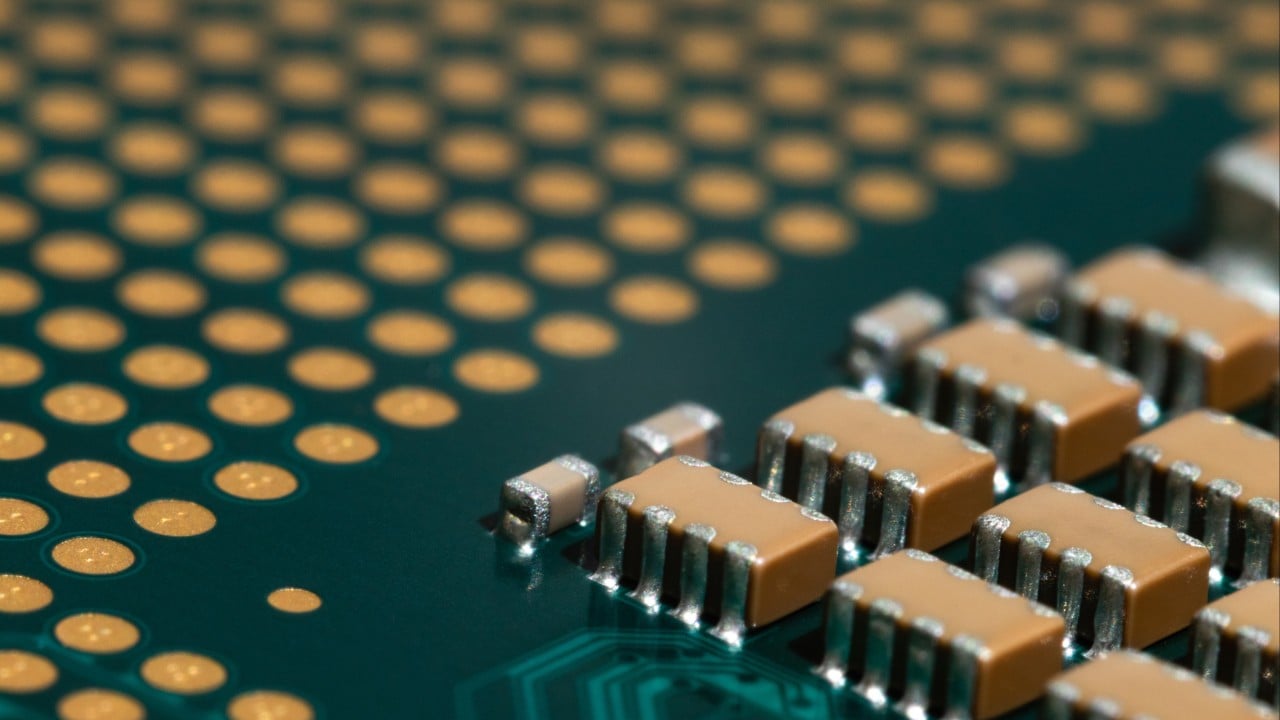
You probably don't think about multilayer ceramic capacitors. Most people don't. These tiny, rice-grained components, known as MLCCs, are the unsung workhorses of modern electronics. Every smartphone has about a thousand of them. An electric vehicle needs up to 10,000. They regulate the flow of electricity, preventing circuits from frying under intense power loads.
Right now, a silent migration is happening in this unglamorous corner of the hardware world. Japan and South Korea, the historical rulers of the MLCC universe, are packing their bags and moving upmarket. Industry titans like Murata, Taiyo Yuden, and Samsung Electro-Mechanics are frantically shifting their production capacity toward high-margin, ultra-high-end applications like artificial intelligence servers and automotive systems.
This has left a massive, yawning vacuum in the consumer electronics market. And Chinese manufacturers are rushing in to claim the territory.
The Secret AI Crowding Out Effect
The investment community recently caught wind of this shift. Analysts at Goldman Sachs even started calling MLCCs the next memory, hinting at an imminent cyclical supercycle driven by artificial intelligence. But the real story isn't just that AI needs more capacitors. It's what the AI boom is doing to the legacy supply chain.
When an AI data center goes online, it demands premium, high-capacitance MLCCs that can handle insane thermal and electrical loads. Only four companies globally—Murata, Samsung Electro-Mechanics, Taiyo Yuden, and Kyocera—effectively command 97% of this advanced market. Because AI demand is so intense and the margins are so incredibly high, these firms are reallocating their production lines away from standard, consumer-grade capacitors.
This has triggered a severe crowding-out effect. If you're building a standard smartphone, a laptop, or a home appliance, your traditional Japanese suppliers are suddenly turning down your orders or pushing out lead times. They simply don't have the bandwidth for low-margin parts anymore.
This is where China comes in. Mainland firms like Guangdong Fenghua Advanced Technology, Chaozhou Three-Circle Group, and Shandong Sinocera Functional Material have spent years hovering in the lower tiers of the market. Now, they've been handed a golden ticket.
Capturing the Middle Ground
For years, domestic Chinese tech brands relied on Japanese imports for peace of mind. Why risk a cheap local capacitor when Murata provides flawless reliability? The chip supply chain disruptions of the early 2020s changed that mindset, but this current AI-driven pivot by foreign giants has completely shattered the old status quo.
Chinese electronic assemblers are facing a blunt reality. They can't get standard parts from Japan, so they have to qualify domestic suppliers.
The financial markets have already noticed. Fenghua Advanced Technology saw its stock price skyrocket over 130% in a single month. Sinocera jumped over 60%, and Sanhuan Group shot up by more than 50%. This isn't empty speculation. Spot prices for high-capacitance consumer MLCCs have climbed more than 10% from their cyclical lows because production lines are genuinely running hot.
But don't mistake this for a total victory just yet. The domestic expansion follows a specific, calculated playbook:
- Saturating the Home Market: Chinese firms are locking down the massive domestic supply chain for mid-range smartphones, PCs, and home appliances.
- Chasing Automotive Qualification: Landing contracts for basic automotive infotainment systems, which serve as a stepping stone toward critical powertrain electronics.
- Upstream Material Control: Companies like Sinocera are dominating the supply of raw ceramic powders, ensuring that even if Japan makes the final component, China controls the base ingredients.
The Massive Quality Gap Nobody Admits
If you listen to optimistic mainland market reports, you'd think Chinese firms are about to put Murata out of business. Let's be real: they aren't. There's a massive, uncomfortable technical barrier that domestic players are struggling to cross.
Making a high-end MLCC requires stacking hundreds of microscopic ceramic and metal layers, each only a fraction of a micrometer thick, and baking them without a single microscopic flaw. If a capacitor fails in a smartphone, the screen goes black. If it fails in an autonomous driving system or an AI cluster drawing 1000 watts of power, the system catches fire.
[Japanese/Korean Giants] -> Focus on AI Servers & EV Powertrains (High Margin)
       │
       ▼ (Capacity Reallocation Creates Shortage)
       │
[Chinese Suppliers]      -> Capture Smartphones, Laptops & Home Appliances (Volume Growth)
Right now, the combined global market share for MLCCs is still ruthlessly dominated by the top five players, who command over 77% of the entire industry. Murata alone holds nearly 32%. Chinese manufacturers are brilliant at scaling up volume and slashing costs for standard commodities, but when it comes to the extreme precision needed for bleeding-edge computing architectures, they're still years behind.
They're winning the volume war in consumer electronics because the incumbents voluntarily walked away from the battlefield to chase AI riches.
What Happens Next for Hardware Buyers
If you run a procurement team or design hardware, you can't afford to ignore this restructuring. The era of cheap, infinitely available Japanese passive components for everyday electronics is drawing to a close.
First, audit your bill of materials immediately. Identify every non-critical, consumer-grade MLCC sourced from top-tier Japanese or South Korean vendors. These are the specific components most vulnerable to sudden lead-time extensions as capacity shifts toward enterprise AI infrastructure.
Second, begin the qualification process for tier-two domestic alternatives. Companies like Fenghua or Chaozhou Three-Circle are hungry for market share and have the capacity to deliver. It's no longer a matter of saving a fraction of a cent per board; it's a matter of supply chain continuity. Save your premium Japanese allocations for the parts of your circuit where failure isn't an option.