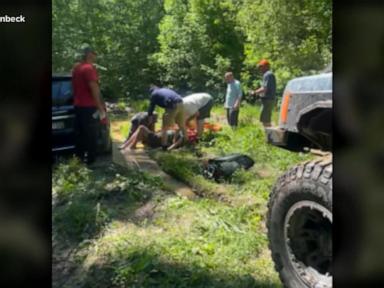
Imagine stepping out of your car on a quiet backcountry road, losing your footing, and suddenly finding yourself completely unable to stand up. You are on your back in two feet of thick, heavy mud. Every time you try to pull your legs free, the suction holds you tighter. Nobody knows where you are. Your phone isn't in your pocket.
This isn't a hypothetical horror movie setup. It is exactly what happened to 68-year-old Kathryn Woessner in early June 2026.
She went missing in rural Minnesota on June 3. By the time two trail riders stumbled across her three days later, she was severely sunburned, dangerously dehydrated, and pinned flat on her back. Her ordeal highlights a terrifying reality of the outdoors that most people completely underestimate. Mud can act exactly like quicksand, and surviving it requires knowing what to do before panic sets in.
Three Days in a Minnesota Mud Puddle
When we think of wilderness survival, we usually picture mountain peaks, deep snow, or desert heatwaves. We don't think of a two-foot-deep puddle on a dirt path.
According to the Douglas County Sheriff's Office, Woessner's vehicle became stuck on a remote trail. When she stepped outside to inspect the damage, she walked around to the other side of her car, slipped, and fell directly into a deep patch of mud.
She couldn't get back up. Without any personal belongings or a way to call for help, she was entirely at the mercy of the elements.
For three straight days, she lay on her back in the muck. The June sun beat down on her face, causing severe sunburns. Think about the physical and mental stamina required to survive that. You are exposed, immobile, and listening to the sounds of the woods night after night, wondering if anyone is even looking for you.
Her rescue was pure chance. On Saturday, June 6, Mike Gravalin and Adam Sandbeck were out exploring a bumpy, lesser-known trail in central Minnesota. Their original plans for an organized ride had fallen through, so they decided to check out this specific remote route instead.
As they rode along, they spotted Woessner. She was still trapped on her back, barely visible, and exhausted. They pulled her from the suction of the mud and called emergency services. Paramedics rushed her to Essentia Health-St. Joseph's Medical Center in Brainerd to treat her severe sunburns and underlying medical conditions.
She survived, but she was incredibly lucky. If those two riders hadn't changed their weekend plans, the outcome would have been tragic.
The Quicksand Physics of Heavy Mud
People laugh at old movies where characters get sucked into quicksand. They assume it's a Hollywood myth. But heavy, wet clay and deep mud puddles function under the exact same scientific principles.
When sand or dirt mixes with a high volume of water, it turns into a liquefied soil mass. When you step into it, your weight liquefies the mixture, and you sink. But once you stop moving, the sediment settles and packs tightly around your limbs.
This creates a powerful vacuum.
Trying to pull your foot straight up out of deep mud requires an immense amount of force. In fact, pulling a foot out of true quicksand at a normal walking speed requires enough energy to lift a small car. If you pull too hard and too fast, you'll literally pull your foot right out of your boot, or worse, tear ligaments in your knee or ankle.
When you panic, you thrash around. Thrashing forces more water out of the mud directly around your body, packing the dirt even tighter against your skin. You essentially seal yourself into a makeshift mold. This is why Woessner found herself pinned on her back. The mud held her down like solid concrete.
What to Do If You Get Trapped
If you ever find yourself slipping into deep muck or a marshy puddle, panic is your absolute worst enemy. You need to act deliberately.
- Ditch the extra weight. If you're wearing a heavy backpack or holding items, drop them immediately. Extra weight forces you deeper into the liquefaction zone.
- Stop trying to take a step. Do not try to lift your feet straight up. Instead, gently wiggle your ankles and toes. This allows water to flow back into the space around your feet, breaking the vacuum seal.
- Lean backward. Increase your surface area. If you spread your weight across a larger space, you won't sink as deep. Lean back onto your shoulders and upper back. It feels counterintuitive because you want to get out, but floating on top of the mud is your best defense.
- Use a slow, swimming motion. Once your weight is distributed and you've broken the initial suction around your legs, use your arms to slowly wiggle and "swim" backward toward solid ground.
How to Avoid Getting Stuck in Remote Areas
Vehicle rescues happen every single day, and most of them are entirely preventable. If your car gets stuck on an unmaintained dirt road or trail, your vehicle is actually your best survival shelter.
Never walk away from your car into unfamiliar terrain without a clear plan, a working communication device, and proper footwear. If you must step outside to inspect a tire or check the depth of a rut, use a stick or branch to poke the ground ahead of you first. Never assume a puddle is shallow or that the dirt beneath it is solid. Central Minnesota's landscape, much like many rural areas across the country, is full of low-lying wetlands that look dry on the surface but are completely saturated underneath.
Always let someone know exactly where you are going and when you expect to be back. If Woessner's vehicle location had been logged with a family member, search and rescue teams would have found her within hours instead of days.
Ultimately, nature doesn't care how close you are to a main road. A simple slip in a two-foot puddle can become a fight for your life in a matter of seconds. Stay in your vehicle if it is safe, test the ground before you step, and never underestimate the power of a little bit of wet dirt.
The incredible story of this rescue shows just how unpredictable outdoor emergencies can be. For a closer look at the actual trail conditions and the firsthand accounts from the two riders who spotted her just in time, watch this report on the Minnesota trail rescue. This video provides a direct look at the remote area where the incident occurred and why the terrain was so incredibly difficult to navigate.