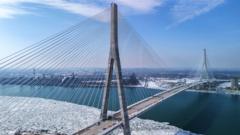
When engineers first broke ground on the Gordie Howe International Bridge, it was pitched as the ultimate physical symbol of North American partnership. Linking Detroit, Michigan with Windsor, Ontario, the six-lane cable-stayed span was designed to relieve the relentless bottleneck on the century-old Ambassador Bridge, flowing billions of dollars in automotive trade seamlessly across the border every single week.
Instead, the $6.4-billion infrastructure marvel has transformed into an arena for geopolitical leverage, trade skirmishes, and bitter political infighting.
If you've been following the headlines, you know the story was supposed to be simple: Canada pays for the vast majority of the bridge up front, collects tolls to recoup its massive investment, and both nations enjoy a modern trade corridor. But border politics in 2026 rarely stays simple. What was meant to be a triumph of international cooperation has turned into a masterclass in how economic infrastructure can be hijacked by political brinkmanship.
The Billion Dollar Chokepoint Everyone Ignored
To understand why this bridge matters so much—and why the political fight over it has gotten so ugly—you have to look at what was happening before it was built.
For decades, roughly 25% of all commercial trade between the U.S. and Canada funneled through a single crossing: the privately owned Ambassador Bridge. Every day, thousands of semi-trucks loaded with engine blocks, auto parts, and agriculture products crawled through city streets in Windsor just to reach the span.
It was a nightmare for supply chains. One accident or border delay could stall automotive assembly plants in Michigan and Ontario within hours.
The solution seemed obvious. Build a state-of-the-art public bridge directly connecting Ontario’s Highway 401 with Interstate 75 in Michigan. Name it after Gordie Howe, the iconic hockey legend adored on both sides of the Detroit River. Problem solved, right? Not quite.
                 TRADITIONAL ROUTE                   NEW CORRIDOR
           (Ambassador Bridge - 1929)     (Gordie Howe Bridge - 2026)
           --------------------------     ---------------------------
Highway:   Local City Streets             Direct Highway Connection
Access:    Stop-and-Go Signal Traffic     Uninterrupted Expressway
Span:      4-Lane Suspension              6-Lane Cable-Stayed
Ownership: Private Entity                 Public Partnership
How Economic Promises Turned Into Political Weapons
The original deal inked over a decade ago was straightforward. Ottawa agreed to front the capital costs for the bridge and its massive ports of entry. In return, Canada would collect toll revenues until it recovered its billions, after which net profits would be split with the state of Michigan.
Then political reality hit.
As completion drew near in early 2026, Washington stepped in with threats to block the bridge from opening altogether. The rhetoric focused on claims that the bridge treated the U.S. unfairly, alleging everything from steel sourcing disputes to imbalance in border concessions.
Behind the scenes, intense lobbying efforts by entrenched private interests—namely the owners of the competing Ambassador Bridge who stand to lose millions in toll revenue—fueled the hostility.
The result was an abrupt delay of scheduled opening ceremonies and months of tense, behind-closed-doors negotiations.
The Revenue Sharing Contradiction
When a "proposed agreement in principle" was finally revealed to open the span, it immediately sparked controversy in Ottawa. The newly revealed text outlined a deal where Canada would split half of the bridge's net revenue for the first 15 years into a U.S.-controlled economic development fund—before Canada fully recovered its capital expenditures.
This directly challenged initial claims by Canadian leadership that debt repayment would take priority over revenue sharing. For Canadian taxpayers who funded the $6.4-billion structure, it felt like moving the goalposts right at the finish line.
Scrapped Ribbon Cuttings and Fraying Ties
Nothing illustrates the deep rift over the project better than the fate of its opening celebration.
A joint ribbon-cutting event that was supposed to feature leaders from both nations shaking hands in the middle of the span was officially scrapped. Following a fresh round of trade tariffs targeting Canadian goods, Ottawa announced it would no longer participate in a joint celebration with U.S. federal officials.
Instead, Canadian officials opted to mark the opening in isolation "among Canadians".
"It's hard to celebrate a relationship when the president of the United States continues to lob insults and tariffs at Canada unnecessarily," noted Windsor Mayor Drew Dilkens, reflecting the local sentiment on the border.
✨ Don't miss: 3 7v 18650 li ion battery
Instead of a triumphant moment of international unity, the bridge opens under a cloud of trade anxiety, tariff threats, and political posturing.
What Truckers and Businesses Actually Care About
While politicians bicker over toll splits and tariff threats, the people who actually move the cross-border economy view the situation through a totally different lens.
For long-haul truckers, logistics firms, and border-town residents, the bridge isn't a political bargaining chip—it's survival.
- Eliminating Local Bottlenecks: The old route required commercial trucks to navigate up to 17 traffic lights through Windsor city streets before reaching the border. The new span connects highway-to-highway directly.
- Redundancy: When anti-mandate protests blockaded the Ambassador Bridge in 2022, billions in trade ground to a halt. A second major crossing provides essential supply chain redundancy.
- Customs Capacity: Modern custom plazas spanning hundreds of acres on both sides mean significantly shorter wait times for cargo inspections.
Politics might delay the fanfare, but market reality means trucks will start rolling the moment the lanes open. Economic gravity wins every time.
Practical Takeaways for Cross-Border Supply Chains
If your business relies on cross-border freight between Michigan and Ontario, here is what you need to do right now to navigate the transition:
- Audit Your Freight Routes: Work with your logistics providers to re-route primary freight lanes onto Highway 401 / I-75 through the new Gordie Howe inspection ports to bypass local street traffic.
- Prepare for Dual-Toll Dynamics: Monitor toll rate structures closely. The competitive pressure between the private Ambassador Bridge and the public Gordie Howe Bridge could create fluctuating promotional rates for fleet operators.
- Stay Agile on Customs Processing: Ensure your border documentation is fully digitized for the new, automated customs lanes at the expansive ports of entry to maximize speed.
The political noise surrounding the Gordie Howe International Bridge will eventually fade into news archives. But the asphalt, steel, and trade capacity will stay anchored in the Detroit River for the next century.