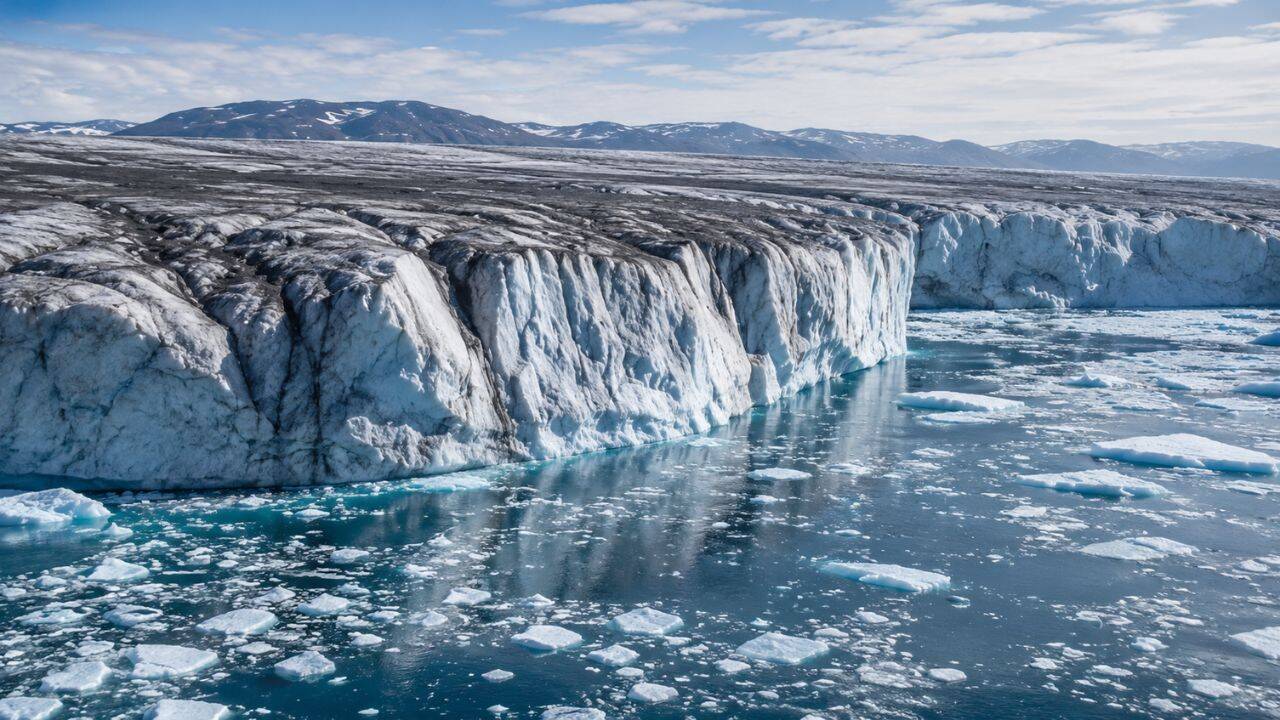
Greenland’s ice is disappearing. That is not a secret, nor is it new. But the sheer scale of the current loss should make you pause. During the 2024–2025 season, Greenland lost an estimated 105 billion tonnes of ice.
Think about that number. One billion tonnes is hard enough to picture. Multiply it by 105.
This marks the 29th consecutive year that the Greenland ice sheet has experienced a net loss of mass. The last time the ice sheet actually grew was back in 1996. But as staggering as 105 billion tonnes is, the real story here isn't just that the ice is melting. The real story is that the ice sheet is actively changing color.
It is getting darker.
A darkening surface means Greenland is losing its ability to reflect sunlight back into space. It is turning from a giant planetary mirror into a massive solar heat sink. This shift triggers a feedback loop that scientists are watching with growing alarm. Once this loop gets going, it becomes almost impossible to stop.
The Illusion of the Snowy Shield
If you only look at superficial weather reports, you might think Greenland is doing fine.
During the winter of 2024–2025, parts of Greenland actually saw heavy snowfall. The surface mass balance—which measures the difference between winter snow accumulation and summer surface melt—ended up higher than the historical average. Some voices in skeptical corners of the internet tried to use this to claim that the ice sheet was recovering.
They were dead wrong.
A high snow accumulation doesn't mean the ice sheet is growing. The surface mass balance is only half the equation. The other half is what happens at the coastlines, where massive glaciers break off into the ocean (known as calving) and warm ocean waters erode the ice from underneath.
Even with great winter snows, the rate of ice discharge into the sea was so high that Greenland still ended the year with a massive 105-billion-tonne deficit. The snow simply could not keep up with the losses.
The temporary white blanket of fresh snow is a fragile shield. When the summer heat hits, that fresh snow melts quickly, exposing what lies beneath. That is where the real trouble begins.
The Albedo Effect Explaining the Dirty Ice Problem
To understand why a darkening surface is so dangerous, you have to understand albedo. Albedo is basically a measure of how reflective a surface is.
Fresh, clean snow has an incredibly high albedo. It reflects up to 90% of the solar radiation that hits it. It is the ultimate natural shield, keeping the Arctic cool by bouncing solar energy back into space.
But as global temperatures climb, that clean top layer of snow melts away early in the summer. Underneath is not more pure white snow. Instead, what gets exposed is older, darker, "dirty" ice.
This older ice is dark for several reasons.
- Windblown Dust and Soot: Decades of dust, industrial pollution, and soot from increasingly severe wildfires across Canada and Siberia drift north and settle on the ice. When snow melts, these dark particles do not wash away. They get concentrated on the surface.
- Algae and Microbes: Warm summers encourage the growth of dark-colored ice algae. These microscopic organisms thrive in the meltwater, turning the ice shades of grey, purple, and brown.
- Clumping Ice Crystals: Even before the ice gets dirty, the warming process itself darkens the snow. Dr. Jason Box, a prominent glaciologist, noted that as snow warms up, the sharp, multi-faceted ice crystals melt at the edges and clump together into rounded grains. These rounded grains naturally absorb more light than fresh, sharp crystals.
The result is a drastic reduction in albedo. Instead of reflecting 90% of the sun's heat, the darkened ice might reflect only 50% or less. The rest of that heat is absorbed directly into the ice sheet, supercharging the melting process.
The Unstoppable Melt Albedo Feedback Loop
This is not a static problem. It is a classic self-reinforcing loop.
The cycle is simple but devastating. Rising global temperatures cause the surface snow to melt. This melting exposes the older, darker ice underneath. Because the ice is darker, it absorbs more solar energy. Absorbing more energy raises the temperature of the ice, causing even more rapid melting. This rapid melting exposes even more dark ice.
Once this loop starts rolling, atmospheric conditions don't even have to change for the melting to accelerate. Even during a summer that isn't record-hot, a pre-darkened ice sheet will melt much faster than a clean one would under the exact same weather conditions.
We saw a terrifying glimpse of this feedback in action during the summer of 2025.
In mid-July 2025, a massive heat dome settled over Greenland. For three consecutive days, satellite data showed that melting was happening across more than 80% of the entire ice sheet's surface area. It peaked at a record-breaking 81.2%.
Nearly the entire island was melting at once.
When 81% of an ice sheet melts simultaneously, millions of gallons of water pool on the surface. These meltwater pools are dark blue. They absorb vastly more solar radiation than solid ice, acting like hot water bottles resting on top of the glacier, drilling deep shafts (moulins) down to the bedrock.
Why You Should Care About a Frozen Island Thousands of Miles Away
It is easy to look at Greenland as a distant, abstract problem. It feels like a frozen wasteland that has no impact on daily life in Chicago, London, or Tokyo.
That is a dangerous misconception.
Greenland holds about 10% of the Earth’s total freshwater. If the entire ice sheet were to melt, global sea levels would rise by roughly 7 meters (about 23 feet).
You don't need all 7 meters to melt to cause global catastrophes. Right now, every centimeter of sea level rise exposes roughly six million people worldwide to coastal flooding and destructive storm surges. The 105 billion tonnes lost in 2024–2025 alone contributed directly to rising oceans, pushing high-tide flooding into coastal cities with increasing frequency.
There is also the threat to global ocean currents.
When billions of tonnes of cold, fresh water pour off Greenland, it flows into the North Atlantic. This fresh water is less dense than salty ocean water. It sits on the surface and threatens to disrupt the Atlantic Meridional Overturning Circulation (AMOC)—the massive ocean current system that pumps warm water from the tropics up to Europe. If that current collapses or slows significantly, it will radically alter weather patterns across North America and Europe, sparking severe winters and unpredictable droughts.
Concrete Action Steps We Must Take Now
We cannot simply fly to Greenland with giant white sheets and cover the ice. The scale is too vast. However, there are highly practical, targeted steps that can slow down this darkening process and buy the planet critical time.
1. Target Black Carbon Emissions
CO2 is the long-term driver of climate change, but black carbon (soot) is the immediate accelerator of Greenland's darkening. Black carbon comes from burning fossil fuels, diesel engines, residential wood burning, and forest fires. If nations, particularly in the Northern Hemisphere, strictly regulate diesel emissions and agricultural burning, we can dramatically reduce the amount of soot drifting onto the Arctic ice sheet.
2. Global Wildfire Management
The historic wildfire seasons of the past few years have choked Arctic skies with smoke, leaving dark ash deposits across Greenland's snowpack. Investing in aggressive forest management and global wildfire suppression isn't just about saving local communities; it is directly linked to preserving the reflectivity of polar ice.
3. Localize Infrastructure Adaptation
Coastal cities cannot wait for global emissions to hit net-zero. Knowing that Greenland is locked into a pattern of continuous mass loss means cities must immediately redesign storm runoff systems, construct living shorelines, and restrict new developments in low-lying coastal zones.
The ice sheet is telling us exactly what is coming. The dark, dirty surface of Greenland is a visual warning system. Ignoring it won't stop the feedback loop, but acting on what it reveals might just save our coastal cities.