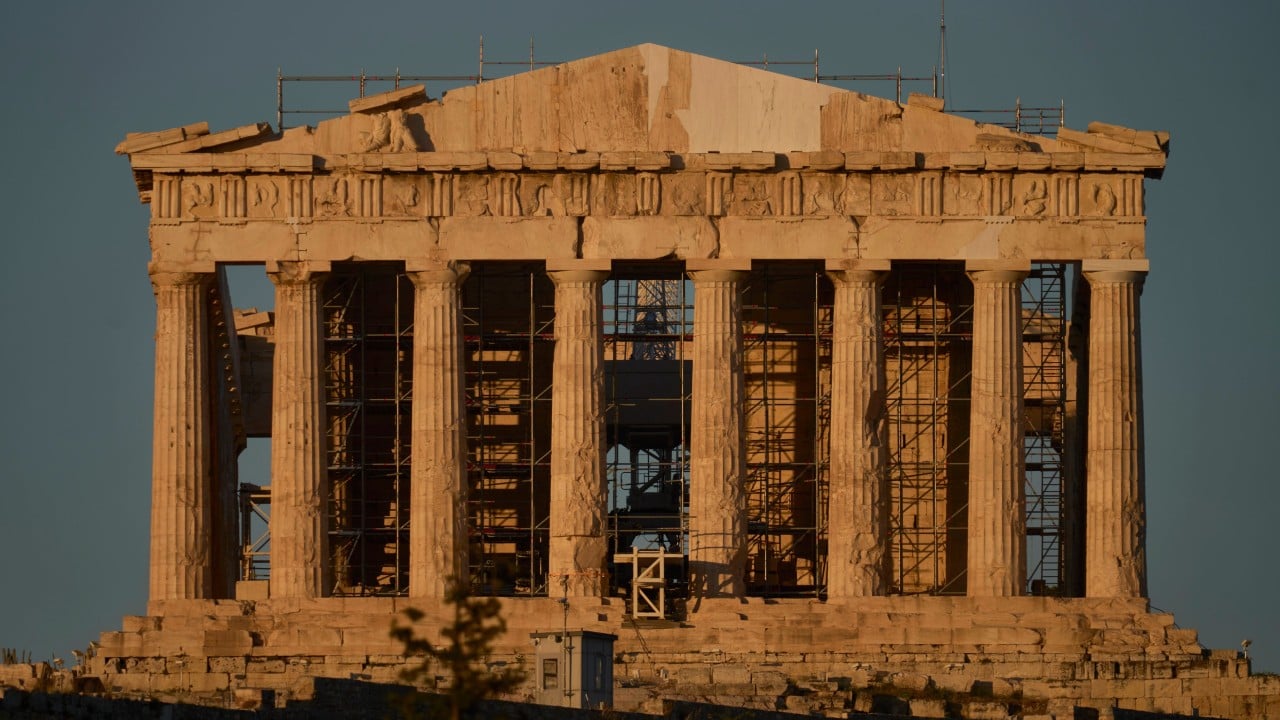
Walk up the Acropolis hill in Athens right now, and you'll notice something bizarre. The metal cage is gone. For decades, taking a photo of the western side of the Parthenon meant framing your shot around ugly, rusted industrial pipes.
That era just ended. Greece's Culture Ministry officially stripped away the external scaffolding from the temple's western facade, revealing the monument in its most complete, structurally whole form since the dawn of the 19th century.
For roughly 220 years, nobody had seen this view. Generations of travelers, archaeologists, and locals grew up assuming the Parthenon just naturally looked like an active construction zone. It didn't. What we've been looking at wasn't just ancient decay. It was a massive, slow-moving rescue operation trying to fix the historic blunders of past centuries.
The 220 Year Erasure
To understand why this matters, you've got to look back to the early 1800s. That's when Thomas Bruce, the 7th Earl of Elgin, systematically stripped the monument of its finest sculptures. He hacked away massive chunks of the western pediment and shipped them to Britain. He left behind a structurally compromised, jagged shell.
Shortly after, Greece won independence and started trying to put the pieces back together. But early efforts did more harm than good.
In the 1920s and 30s, an engineer named Nikolaos Balanos led a major restoration. He made a fatal error. He used raw iron clamps and bolts to join the fractured marble blocks. When iron gets exposed to the humid, salty air of Athens, it rusts. When iron rusts, it expands.
This process, known as rust jacking, literally cracked the ancient Pentelic marble from the inside out. The very fixes meant to save the building were tearing it apart. By the time the Committee for the Conservation of the Acropolis Monuments stepped in during the mid-1975 structural pivot, the western facade was a ticking time bomb.
The High Stakes Surgery on the West Pediment
Getting the scaffolding down wasn't just a matter of unbolting some pipes. It required highly technical, nerve-wracking architectural surgery. The Acropolis Restoration Service had to fix the geometric proportions of the western pediment, which had been warped and incomplete for centuries.
The team focused on two massive vertical wall stones, known as orthostates, which form the backing wall of the tympanum.
- The First Orthostat: Restorers gathered scattered, surviving ancient fragments. They puzzled them back together like a three-dimensional jigsaw, then used fresh Pentelic marble to fill the structural gaps.
- The Second Orthostat: The original was completely lost to time and looting. Master stonemasons had to hand-carve a brand-new replica from fresh marble, matching the exact dimensional tolerances of 5th-century BC builders.
Every single piece of corroded iron Balanos put in had to be extracted. Engineers replaced them with titanium rods. Titanium doesn't corrode, it doesn't expand, and it won't crack the stone.
Funding from the European Union Recovery and Resilience Facility kept the project moving through its final, tense stages. Culture Minister Lina Mendoni noted that the project finally restores the unique proportions and geometric perfection that the ancient architect Iktinos originally intended.
What This Means for Your Next Trip
If you visit Athens today, the visual impact is immediate. Last year, around 4.6 million people crowded onto the Sacred Rock, most of them squinting past steel poles to imagine what the ancient world looked like.
Now, the western side, which offers the most dramatic street-level view as you approach the site, stands totally unobstructed. The formal unity of the structure is back. You aren't looking at a chaotic modern building site anymore. You're looking at a cohesive piece of classical antiquity.
But don't expect it to look brand new. The restoration team purposely left a clear visual distinction between the weathered, golden ancient stones and the bright white patches of newly quarried Pentelic marble. It's a deliberate choice. It honors the monument’s complex history rather than faking a pristine past.
The Practical Next Steps for Visitors
If you're planning to see the restored facade yourself, you need to change how you approach the site.
First, skip the midday rush. With the scaffolding gone, the western facade catches the late afternoon sun beautifully. The golden hour light hits the mix of old and new marble perfectly around 6:00 PM.
Second, book your tickets well in advance through the official Hellenic Organization of Cultural Resources website. Greece uses a strict time-slot entry system to manage the millions of visitors walking up the hill. If you show up without a reserved slot, you'll likely be turned away at the slope.
Third, enter through the lesser-known southeastern gate near the Acropolis Museum rather than the main western entrance. It's a steeper climb, but you'll avoid the worst of the tour-bus bottlenecks and get a much cleaner, gradual view of the newly cleared monument as you crest the summit.