You probably think the hot dog is a simple, thoughtless backyard staple. You fire up the grill, throw some cheap meat on a bun, squirt yellow mustard over it, and call it a day. But you're missing the entire point of America's most misunderstood food. The hot dog isn't just a quick meal. It's a lens through which you can view the entire chaotic story of modern American immigration, urbanization, and international statecraft.
Most people assume the hot dog originated in New York or Chicago. They're wrong. To find the true dawn of this cultural phenomenon, you have to look at the deeply conservative midwestern landscape of the late nineteenth century.
The illegal street food that built an empire
In 1884, Indiana was locked in a bitter cultural war. The state had passed some of the tightest "blue laws" in the country. These statutes were designed to protect Sunday as a day of mandatory rest and religious worship. The authorities cracked down on everything. Saloons were shuttered. Theaters were closed. Even basic street commerce faced aggressive prosecution.
But people still needed to eat, and working-class immigrants were running a thriving underground economy on the street corners.
On September 14, 1884, the Evansville Courier & Press published a furious update on the local police crackdown. The reporter wrote a line that accidentally made history: “Even the innocent wienerworst man will be barred from dispensing hot dog on the street corners.”
This is the earliest known use of the term "hot dog" in print.
Think about that context. The American hot dog didn't debut as a celebrated national icon. It debuted as a contraband item, a regular target of midwestern police officers trying to enforce religious piety on a hungry working class. German immigrants were bringing their sausage-making traditions to the states, pushing carts loaded with weisswurst, bockwurst, and blutwurst. To the Anglo-Saxon establishment, these heavily seasoned tubed meats were suspicious, foreign, and potentially dangerous. The slang term itself was initially a derogatory joke, mocking the mysterious origin of the meat inside the casing.
The strategy backfired completely. Banning the carts only made them more popular among the urban working class who needed cheap, portable calories.
From immigrant carts to the ballpark
The transformation from an illicit immigrant snack to an undisputed national pastime took less than a decade. By the 1890s, sausages had moved from the street corners of Indiana to the major league ballparks of Chicago, St. Louis, and New York.
Historians like Bruce Kraig, author of Hot Dog: A Global History, point out that this shift was structural. The late nineteenth century saw a massive boom in industrial factory work. Workers had limited lunch breaks. They didn't have time for a sit-down meal. The hot dog was self-contained. It didn't require plates, forks, or tables. The bun acted as a natural heat barrier and a plate all at once.
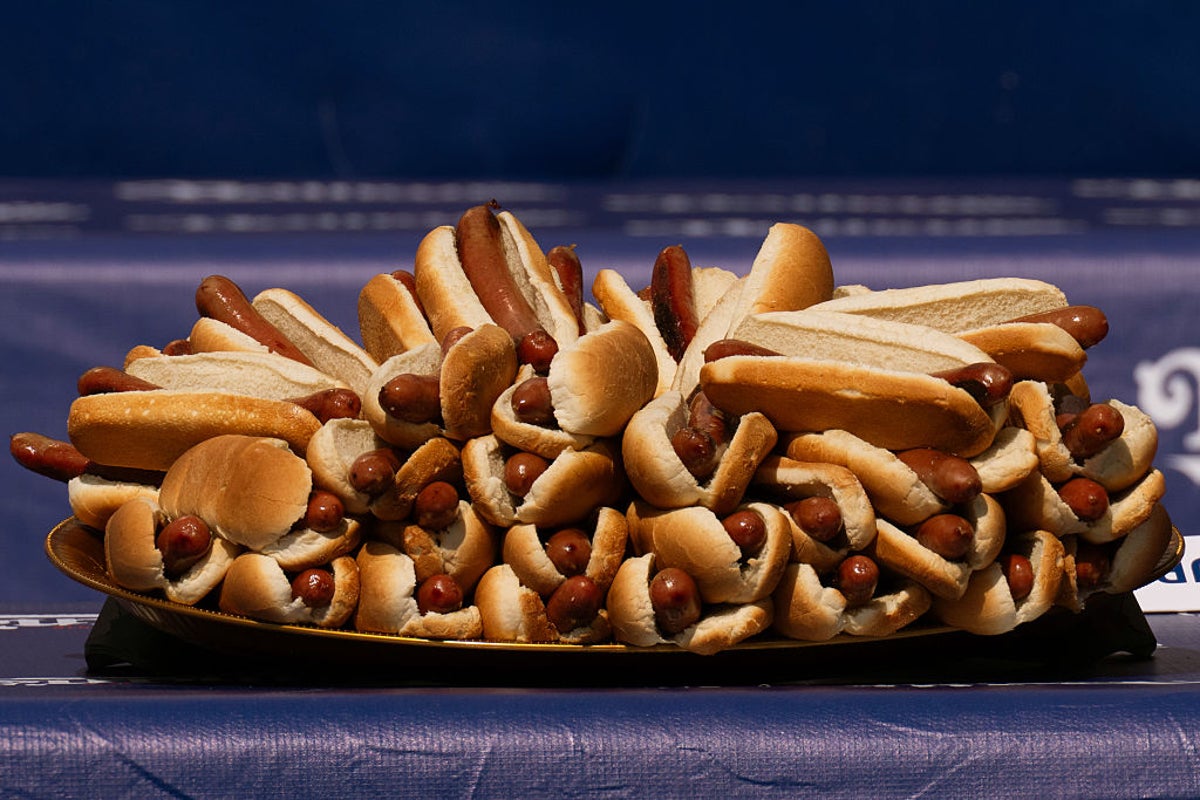
When baseball owners realized they could feed thousands of rowdy fans in minutes without washing a single dish, the deal was sealed. The food became fundamentally tied to the American weekend. The famous Fourth of July hot dog eating contests in New York solidified this connection, turning a fast-paced eating habit into a spectacle of national identity.
But it wasn't just about baseball. The hot dog was becoming a blank canvas for regional identity. As immigrant communities spread across the country, they adapted the basic sausage to local ingredients and cultural preferences.
Hot dog diplomacy at Hyde Park
By the time World War II was looming on the horizon, the hot dog had ascended to the highest levels of American political life. In June 1939, King George VI and Queen Elizabeth made history by becoming the first reigning British monarchs to ever set foot on American soil.
The geopolitical stakes were massive. Europe was on the absolute brink of annihilation. Franklin D. Roosevelt desperately wanted to convince a highly isolationist American public that the nation needed to support Great Britain against the rising Nazi regime. He needed a brilliant public relations move to humanize the British royals and prove they weren't out-of-touch aristocrats.
His solution was an informal Sunday picnic at his private estate, Top Cottage, in Hyde Park, New York.
The menu shocked Washington society. FDR’s mother, Sara Delano Roosevelt, a woman of rigid old-world aristocratic tastes, was completely horrified. The President was planning to serve the King and Queen of England plain American hot dogs on paper plates.
The day was incredibly hot. Guests sat at small informal tables scattered under the trees. When the silver platters arrived carrying rows of grilled franks, the royal guests faced a logistical crisis. They had never eaten a hot dog in their lives.
The Queen quietly whispered to Eleanor Roosevelt, asking how exactly one managed to get the sausage into one's mouth without a fork. Eleanor told her to use her hands. The Queen opted for a knife and fork to preserve royal decorum, but King George picked the hot dog up, jammed it into his mouth, and washed it down with local American beer.
He liked it so much he openly asked for seconds.
The next day, newspapers across the globe ran front-page stories about the British monarch eating street food with the American president. It was a masterpiece of political staging. By sharing a humble, working-class meal, the Roosevelts broke down centuries of anti-British sentiment among ordinary Americans. The hot dog helped build the psychological foundation for the wartime alliance that would eventually reshape the globe.
The Cold War sausage showdown
Twenty years later, the hot dog found itself at the center of another international standoff. This time, it was with the Soviet Union.
In September 1959, Soviet Premier Nikita Khrushchev arrived in the United States for a high-profile tour meant to ease tensions during the absolute peak of the Cold War. The world was terrified of nuclear war. Khrushchev was deeply suspicious of American capitalism, constantly looking for signs that the Soviet system was superior.
His tour eventually brought him to Des Moines, Iowa, where he visited a local meatpacking operation. Surrounded by reporters, security detail, and curious midwesterners, Khrushchev was handed a fresh American hot dog straight from the steamer.
He took a bite. He chewed thoughtfully. Then, he turned to the American officials and uttered a line that became legendary: “We have beaten you to the moon, but you have beaten us in sausage making.”
It was a stunning admission from the leader of the communist world. Even at a time when the Soviets were winning the early stages of the space race with the Sputnik launches, Khrushchev had to concede that American food production and industrial culinary culture had achieved something extraordinary. The humble hot dog had become an undeniable symbol of Western economic abundance.
The chaos of nineteen regional varieties
If you think a hot dog is just meat and mustard, you're missing out on a massive world of culinary history. The National Hot Dog and Sausage Council officially tracks nineteen distinct regional varieties across the United States. These aren't just minor differences in condiments. They're historical maps of how different cultures settled the country.
The Chicago-style dog is perhaps the most famous example of architectural eating. It's an all-beef frank tucked into a poppy seed bun, dragged completely through the garden. You need seven specific ingredients: neon green relish, sport peppers, a dill pickle spear, sliced tomatoes, chopped onions, yellow mustard, and a dash of celery salt.
Notice what's missing. Ketchup. Asking for ketchup on a hot dog in Chicago isn't just an etiquette mistake. It's viewed as an insult to the delicate balance of acid, salt, and crunch that working-class Jewish and Italian vendors perfected during the Great Depression.
Then you have the Cleveland Polish Boy, a massive mess of a sandwich featuring a smoked kielbasa link topped with french fries, a layer of sweet barbecue sauce, and a scoop of coleslaw. It's heavy, sweet, and smoky.
Down in the Southwest, the Sonoran dog tells the story of the Mexican-American borderland. You take a frank, wrap it tightly in thick bacon, and grill it until the pork fat renders completely. Then you stuff it into a bolillo roll and pile on pinto beans, chopped jalapeños, cotija cheese, and a heavy drizzle of Mexican crema.
Every single one of these variations represents a community making a foreign food item their own.
How to execute a perfect historical hot dog at home
Stop buying the cheapest plastic packs of mystery meat at the supermarket. If you want to honor the massive history of this food, you need to follow a precise set of rules for your next backyard gathering.
- Buy natural casing franks. This is non-negotiable. If your hot dog doesn't have a distinct "snap" when you bite into it, you're eating processed paste. Look for a blend of beef and pork wrapped in a natural sheep casing. Brands like Walter's or local artisanal butchers are your best bet.
- Steam the buns. Toasting a hot dog bun on the grill dries out the bread and makes it crumble. You want the bun to be pillowy soft, absorbing the juices of the meat without falling apart. Set a metal colander over your boiling water or grill steamer for thirty seconds to soften the bread.
- Layer with intention. Don't just slap ingredients on top randomly. If you're building a classic midwestern style, put the wet ingredients like mustard and relish on the bottom against the meat. Place your heavy ingredients like pickle spears or fresh tomatoes along the sides to hold the structure together.
- Skip the generic ketchup. Let the flavor of the meat stand on its own. Use high-quality stone-ground mustard, fermented kraut, or fresh onions to provide the necessary acidity to cut through the rich animal fat.
Get your ingredients together, grab a high-quality pack of natural casing franks, and experience a taste of history that helped win world wars and settle geopolitical standoffs.