The footage hits your social media feed before the police even arrive at the scene. It’s raw, incredibly violent, and completely unfiltered. On a north Belfast street, a man brutally stabs and slashes another man in the face and neck. The victim, Stephen Ogilvie, eventually loses an eye. Members of the public heroically step in to pin down the attacker, a 30-year-old Sudanese refugee named Hadi Alodid.
Within minutes, the video goes viral. Within hours, a spark hits a heavily loaded fuse.
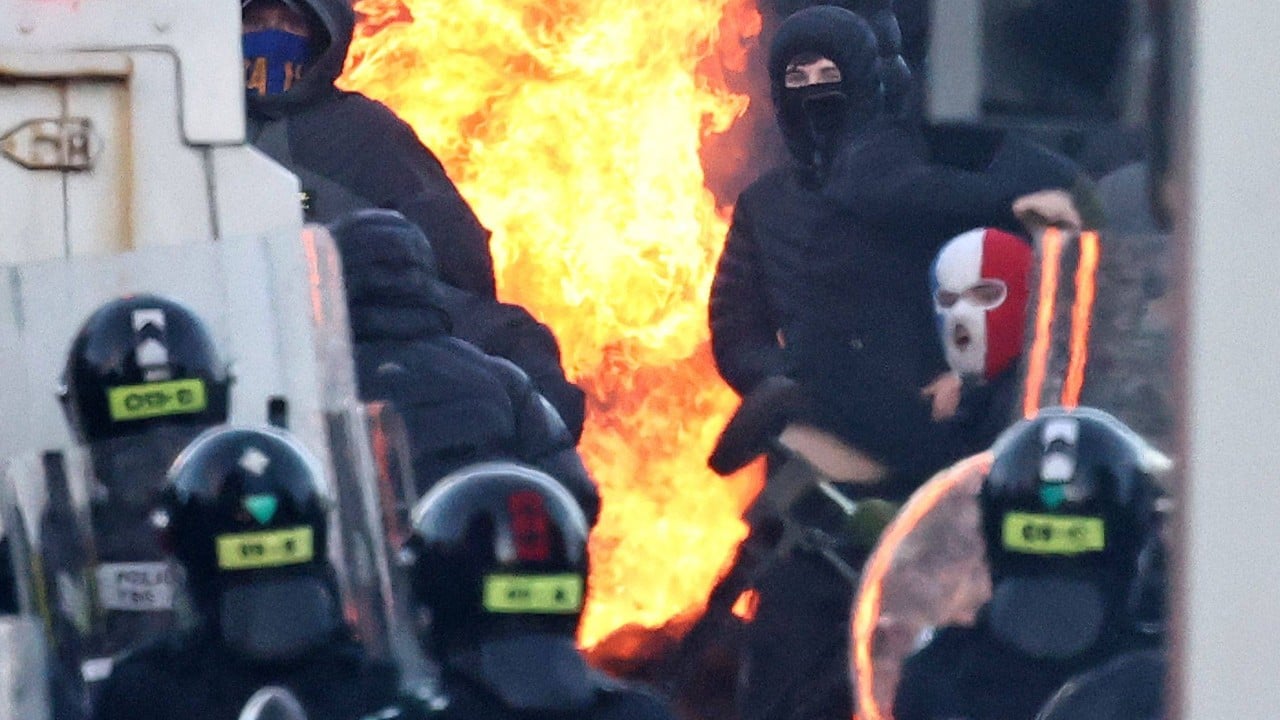
By the next evening, parts of Belfast are burning. Masked men roam the streets, cars are torched, and a bus is engulfed in flames in East Belfast. Families from ethnic minorities are forced out of their homes as mobs kick in doors. On walls, crosshairs are spray-painted alongside anti-Islamic slurs.
If you read mainstream international coverage, you’ll hear a simple narrative. They’ll tell you this is a sudden outburst of far-right anger fueled by Elon Musk's tweets or Tommy Robinson's Telegram channel. But that explanation completely misses the mark. It treats Belfast like any other British or European city experiencing anti-immigration friction.
Belfast isn't any other city. To understand why a horrific knife attack by one individual turned into a coordinated, multi-neighborhood assault on completely unrelated minorities, you have to look at the unique, dangerous intersection of Northern Ireland's unresolved past and modern digital radicalization.
The Myth of the Sudden Outbreak
This isn't a new or unexpected crisis. Northern Ireland is currently navigating its third consecutive summer of organized racist violence. Each wave has been more severe than the last.
Just last year, in June 2025, massive riots tore through Ballymena and parts of Belfast after two Romanian teenagers were charged with an offenses that sparked local outrage. The resulting violence led to a massive exodus of nearly two-thirds of the Roma population from Ballymena. Entire families hid in attics while mobs destroyed their downstairs living rooms.
The Police Service of Northern Ireland (PSNI) documented 2,048 racist incidents and 1,280 race hate crimes in a single recent annual timeframe. The reality on the ground contradicts any claim that this week's violence happened in a vacuum. The infrastructure for hate was already fully operational.
The underlying tension isn't just about immigration statistics. It's about how new demographics fit into a society that never fully healed from its own decades-long internal conflict.
When Old Paramilitary Tactics Meet Digital Agitation
During the Troubles, local communities relied on informal, often violent networks of men to "defend" their neighborhoods. Today, those same historical structures are being repurposed. The enemy has simply changed. Instead of targeting the rival community across the peace wall, the target is now anyone with dark skin.
Look closely at how the riots unfolded this week. By Tuesday morning, digital flyers circulated online with precise assembly points, times, and instructions. Local businesses were told to close by 5:30 PM with "no excuses." Rioters were told to wear dark clothes and prepare for arrest. This level of logistical coordination doesn’t happen organically through angry Twitter replies. It requires local operational capacity.
But while the boots on the ground are local, the command center is often global.
Local Grievance (Knife Attack)
       │
       ▼
Global Amplification (Far-Right Agitators on X/Telegram)
       │
       ▼
Local Paramilitary Infrastructure (Masked Mobs, Blockades)
       │
       ▼
Targeted Violence against Minorities
Figures like Tommy Robinson, posting from Moscow, and Elon Musk, commenting from the US, actively amplified the initial footage. When Robinson called for protests against "yet another invader attack," Musk replied to his millions of followers: "Only by protesting REPEATEDLY and LOUDLY will there be any change!!"
This creates a bizarre feedback loop. Bad faith actors who couldn't find Belfast on a map weaponize the genuine horror of a local knife attack. They use it to validate their own global anti-immigration narratives. Meanwhile, local youths, facing long-term economic deprivation and lack of opportunity, find a twisted sense of purpose in the chaos.
The Exploitation of Real Anxieties
It's easy to dismiss the rioters as uneducated thugs, but that ignores the systemic failures feeding this anger. Belfast's political institutions, namely the Stormont Executive, have failed to address severe structural issues for years.
There's a chronic housing shortage across Northern Ireland. Working-class loyalist and nationalist areas suffer from generational neglect, high unemployment, and zero economic mobility. When people are desperate for public services and housing, it takes very little effort for extremist recruiters to point at a newly arrived refugee family and say, "They are taking what belongs to you."
Kashif Akram, a board member of the Belfast Islamic Centre, points out that politicians regularly look for scapegoats to cover up their failure to build homes. The blame naturally shifts downward to the most vulnerable people available.
Additionally, the Republic of Ireland’s open-border arrangement means asylum seekers who cross from Dublin into Northern Ireland become a flashpoint for identity politics. For unionist communities, this open border feels like a violation of their British identity. For the anti-immigration movement, it's framed as an uncontrolled pipeline of danger.
The Policing Crisis Left Exposed
The violence has exposed a massive vulnerability in Northern Ireland's security apparatus. The PSNI is in the middle of a severe staffing crisis.
The police force has dwindled to roughly 6,200 officers, down from its original target of 9,000. On any given day, up to 1,500 of those officers are on sickness absence or restricted duties. When hundreds of masked men set up simultaneous blockades across East Belfast, North Belfast, and surrounding towns like Larne, the police simply don't have the numbers to control the perimeter and protect individual homes at the same time.
The UK government's response has been slow and bureaucratic. Prime Minister Keir Starmer promised to crack down on those fueling division, and ministers plan to amend the Online Safety Act to force social media companies to quickly take down inflammatory content during crises.
The catch? Those amendments won't take effect for weeks. In the meantime, platforms like X face zero immediate consequences for hosting content that directly incites racial violence on the streets of Belfast.
What Needs to Happen Right Now
Condemnation from political leaders isn't working anymore. Saying the violence is "disgusting cowardice" makes for a good press release, but it doesn't protect a minority family sitting in a dark terraced house waiting for their front window to shatter.
If authorities want to stop the cycle of summer riots, they need a strategy that goes beyond riot shields and water cannons.
First, the PSNI requires immediate emergency reinforcement from mainland UK police forces to restore visible, static security in vulnerable neighborhoods. You can't police a volatile city with a depleted workforce.
Second, local communities must stop treating social media platforms as neutral bystanders. Local community leaders need to establish direct, rapid-response communication channels to debunk viral misinformation before it turns into an evening assembly point.
Finally, Stormont has to address the material conditions of these neighborhoods. If you leave working-class areas to rot economically, you create the perfect breeding ground for paramilitary recruitment and racial scapegoating.
The violence on Belfast's streets isn't a random blip. It's the predictable result of a society that has left its past unresolved, its public services underfunded, and its digital borders completely unguarded.
To gain a deeper perspective on how history and geography intertwine to fuel these recurring tensions, watch Why Belfast’s troubled past made violence inevitable. This analysis explains how the city's historical divisions created the perfect environment for modern unrest to ignite.