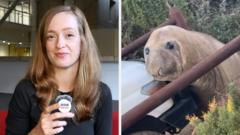
A one-tonne mammal is currently flattening fences, crushing traffic cones, and trapping Australian residents in their own homes. His name is Neil, and social media absolutely loves him. On TikTok and Instagram, a viral seal called Neil looks like the ultimate urban prankster. He plays with bollards. He takes naps in the middle of highways. He blocks people from driving to work by sleeping right behind their cars. It looks like harmless fun.
It isn't.
Behind the millions of views and the adorable videos lies a massive wildlife problem brewing in Tasmania. We're laughing at a wild predator that is actively trying to grow up in the wrong environment, and our collective obsession might eventually get him killed.
The Wild Biology Behind the Internet Fame
The viral seal called Neil is a southern elephant seal born in October 2020. Right from the start, his life was weird. Most southern elephant seals are born thousands of kilometers south in icy subantarctic regions like Macquarie Island or Heard Island. Neil was born on mainland Tasmania, in Salem Bay. He's an anomaly. Between 1985 and 2022, researchers only recorded nine elephant seal pups born in Tasmania. Only five survived weaning. Neil is one of those rare survivors.
Because he was born on Tasmanian shores, he exhibits site fidelity. That means he thinks Tasmania is his actual home. Every year, he returns to the beaches and towns around Hobart and Dunalley to do what elephant seals naturally do. He comes ashore to rest and undergo what biologists call a catastrophic moult.
Most animals shed their fur slowly. Elephant seals don't have time for that. They dump their entire layer of fur and the outer layer of their skin all at once. It takes weeks. It's painful, exhausting, and leaves them highly vulnerable. To survive it, they have to stay out of the freezing ocean while their new skin grows.
Neil chooses populated town roads instead of quiet, isolated beaches.
Why Neil is Acting Like an Unruly Teenager
If you see a video of Neil slamming his massive body against a parked LandCruiser or biting a yellow plastic bollard, he isn't trying to destroy town property. He's just lonely.
On subantarctic islands, young male elephant seals live in massive colonies. They spend their time on land sparring with each other. They push, shove, chest-bump, and bite. It's essential practice for adulthood, when they'll have to fight massive beachmasters to win mating rights.
Neil doesn't have any peers. He's the only resident elephant seal in the area.
Without other young males to fight, Neil uses human infrastructure as a stand-in. He picks fights with traffic cones. He tries to wrestle with fences. He squishes his massive bulk against suburban boundary lines because he craves the physical feedback of another body. When he sleeps right against a fence, he's likely trying to simulate the feeling of being packed into a tight colony with his own kind.
It looks like hilarious chaos to a viewer scrolling on a smartphone in London or New York. For local Tasmanian councils, it's a structural nightmare. Flimsy electric fences don't work against a creature that relies on inches of thick blubber to protect itself from freezing depths. When Neil wants to move somewhere, he simply flattens whatever is in his path.
The Looming Threat of the Freya Scenario
Right now, Neil is roughly five years old. He weighs about 1,000 kilograms and stretches around three meters in length. That's a massive animal, but he's actually still just a kid.
When a male southern elephant seal reaches full maturity around age 12, the numbers get terrifying. They can grow up to five meters long. They can easily weigh up to 4,000 kilograms. That is four tonnes of aggressive, territorial, hormone-fueled marine apex predator.
If Neil is causing traffic disruptions and breaking concrete posts at one tonne, imagine what happens when he triples his weight. He won't just block cars; he will crush them. He won't just nudge people; he could kill them instantly without even trying.
Wildlife authorities are terrified of a repeat of the Freya scenario. In 2022, a friendly walrus named Freya captivated crowds in Norway. People refused to keep their distance. They crowded her for selfies, brought their children close, and ignored every single safety warning. Eventually, Norwegian officials decided the public risk was too high and euthanized Freya.
Nobody wants that for Neil. Tasmanians genuinely love him. Senator Jacqui Lambie famously called him the only bloke in Tasmania who can stop traffic, ignore everyone, and still be loved for it. But love can be incredibly dangerous for wild animals.
How Humans are Getting it Wrong
The biggest mistake people make is treating Neil like a domestic pet. There are videos online of locals spraying him with garden hoses or trying to get close enough to snap a picture.
Every single time a human approaches Neil, it alters his behavior. He becomes habituated to human presence. If he stops fearing humans, he will continue to seek out urban spaces as he grows into a massive four-tonne adult. If someone feeds him, the situation worsens instantly. He will start associating humans with an easy meal, leading to intense aggression when food isn't provided.
Tasmania currently lacks strict, enforceable laws to penalize tourists and locals who get too close to the seal. Wildlife officials from the Department of Natural Resources and Environment have issued clear guidelines, but they can't police every single beach or roadside where Neil decides to take a nap.
If you ever find yourself in southern Tasmania when Neil is in town, you need to know the actual boundaries.
- Keep a minimum distance of 20 meters from Neil at all times, even if he looks completely fast asleep.
- If you're walking a dog, double that distance to at least 50 meters. Dogs stress him out, and he will lash out defensively.
- Never block his path back to the water. An cornered elephant seal is an incredibly dangerous animal.
- Do not post his live, exact location on local social media groups. The surge of looky-loos creates immediate crowd control issues for local councils.
Neil recently returned to the sea after his latest shedding period, but he will be back. He returns multiple times a year to rest. The only way to ensure he survives to see his twelfth birthday is to give him space. Stop treating him like an internet meme and start treating him like the wild ocean predator he actually is.