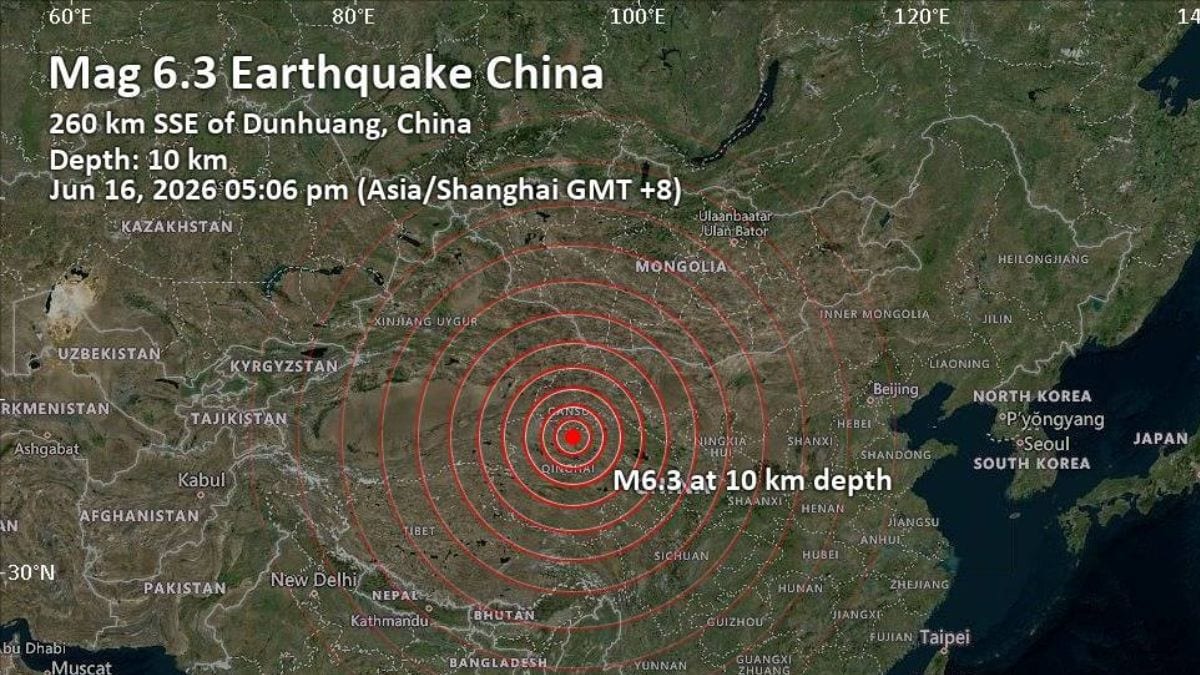
A powerful magnitude 6.3 earthquake just ripped through the high-altitude terrain of northwest China's Qinghai province. The ground shook violently at 5:06 p.m. Beijing Time on Tuesday, June 16, 2026. Early state media reports confirm that at least one person has died and four others suffer from injuries.
When you see a headline about a remote earthquake, it's easy to brush it off as another minor blip on the global news radar. That's a mistake. This specific tremor struck the Haixi Mongolian and Tibetan Autonomous Prefecture, an area sitting at a brutal average altitude of 4,302 meters. Up there, the thin air makes every single rescue operation a logistical nightmare.
The China Earthquake Networks Center pinned the epicenter at 37.80 degrees north latitude and 95.56 degrees east longitude. It was shallow, hitting at a depth of just 10 kilometers. Shallow quakes always pack a more dangerous punch because the seismic energy doesn't have time to dissipate before reaching the surface.
Chaos Near the Emerald Lake
If you've ever looked at travel guides for northwest China, you probably know Da Qaidam. It's famous for Emerald Lake, a stunning, mineral-rich tourist hotspot that sits right along the popular Qinghai-Gansu travel route. The epicenter of this quake hit uncomfortably close to that exact region.
Local authorities shifted into high gear immediately. Nearby coal mining operations faced the most immediate threat. Mining underground during a shallow 6.3 magnitude tremor is a recipe for catastrophic cave-ins. Officials managed to fully evacuate all operating staff from the local coal enterprises shortly after the shaking stopped.
Right now, over 320 emergency responders are on the ground. The Qinghai provincial seismological bureau dispatched specialized field teams directly into the zone to spearhead the search for anyone trapped under rubble. The Ministry of Emergency Management also bumped its response up, coordinating with local charities to rush emergency tents, folding beds, and heavy blankets to the high-altitude zone where night temperatures plummet fast.
The Tectonic Reality of Western China
This isn't an isolated stroke of bad luck. If you look at a tectonic map, western China is essentially a giant collision zone.
The Indian plate is constantly shoving its way northward into the Eurasian plate. This relentless geological sparring match created the Himalayas, and it keeps provinces like Qinghai, Sichuan, and Tibet under permanent seismic threat. The earth here is laced with active fault lines that build up massive strain over decades before snapping.
We saw a series of aftershocks ripple through the region right after the main event, including a notable magnitude 4.9 tremor. These secondary shocks aren't just terrifying for survivors; they threaten to bring down structures that were cracked or weakened by the first big jolt.
Current Status of Critical Infrastructure
The good news is that the initial damage reports look better than expected for a tremor of this size. According to local reports from the Qinghai Daily, key infrastructure within a 50-kilometer radius of the epicenter is holding up.
- Power grids remain stable and electricity is flowing.
- Water lines didn't suffer immediate major ruptures.
- Communication networks are up, allowing rescue teams to coordinate effectively.
- Transportation routes are mostly open, though teams are watching for landslides.
Government agencies triggered a Level II provincial emergency response and a federal Level IV response to keep resources moving. While the low population density of this specific high-altitude region likely prevented a massive death toll, the situation remains fluid as remote mountain villages are checked one by one.
Immediate Next Steps for Travelers and Residents
If you happen to be traveling the Qinghai-Gansu route or have family in the Haixi prefecture, stop waiting for standard news updates and take active precautions.
First, avoid the immediate vicinity of Da Qaidam and Emerald Lake until emergency teams officially clear the local roads. Landslides are incredibly common in these high-altitude terrains during aftershocks.
Second, if you're in the region, secure your immediate surroundings against secondary tremors. Stay out of older, unreinforced brick structures. Keep an emergency bag packed with warm clothing, water, and essential documents. The high altitude means exposure to the elements is just as dangerous as falling debris. Monitor local channels like Xinhua and the China Earthquake Administration for real-time updates on active fault behavior.