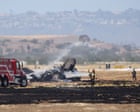
Plumes of thick black smoke filled the sky over Marine Corps Air Station Miramar on Friday morning. Another expensive stealth fighter went down. A pilot cheated death.
When a $109 million F-35B Lightning II crashes right on a major military installation, people panic. The internet lights up with speculation. Let's look at the facts of what went down in San Diego instead of relying on wild rumors.
The Miramar Crash Details
The incident struck at roughly 10 a.m. local time on July 31, 2026. An F-35B assigned to Marine Aircraft Group 11, part of the 3rd Marine Aircraft Wing, crashed on the flight line east of the base runways near Kearny Villa Road.
Eyewitnesses on the scene reported watching two jets come in together. The first aircraft landed normally. The second jet, the ill-fated F-35B, began acting strangely. Witnesses noted the aircraft slowed down abruptly as if attempting to hover before losing altitude rapidly.
With the aircraft roughly 100 feet above the ground, the ejection seat fired. The pilot cleared the canopy just as the multi-million dollar stealth fighter slammed into the dirt and erupted into flames.
The parachute deployed successfully, carrying the aviator roughly 200 feet into the air before a safe descent nearby. First responders and San Diego fire crews rushed to the site to douse a resulting vegetation fire and coat the burning wreckage in white fire retardant.
Understanding the Class A Mishap Designation
Military officials classified the incident immediately as a "Class A mishap". For civilians outside the defense sector, that administrative label sounds confusing.
In military aviation, a Class A mishap is the most severe tier of accident. It triggers automatically whenever an accident results in a fatality, a permanent total disability, or total destruction of hardware, or when the property damage exceeds $2.5 million. Since an individual F-35B costs upwards of $109 million and the airframe was completely destroyed, it easily met the threshold.
Military investigators from the Navy and Marine Corps are now combing through the wreckage at Miramar. These investigations rarely wrap up quickly. Piecing together flight data recorders, maintenance logs, and telemetry streams takes months.
Why the F-35B is Different
You can't talk about this crash without understanding what makes the "B" variant unique. The F-35 comes in three primary versions. The Air Force flies the conventional takeoff and landing A-model. The Navy operates the carrier-capable C-model with reinforced landing gear and larger wings.
The Marine Corps relies on the F-35B. This variant features a specialized lift fan and a swiveling engine nozzle that allows for short takeoffs and vertical landings (STOVL). That capability allows Marines to operate advanced stealth fighters from amphibious assault ships and austere dirt strips close to front lines.
However, that mechanical complexity introduces unique engineering challenges. The lift fan system, driveshaft, and vectoring exhaust duct require intricate synchronized computer controls. Investigators will look closely at whether any mechanical or software issue affected the flight control system during the final approach.
The Human Element and Local Impact
Miramar holds a legendary status in aviation history. Long before it became a Marine base, it was the Navy fighter weapon school made famous by the original Top Gun film. Locals still refer to the surrounding airspace with deep familiarity, and military aircraft noise is simply part of daily life in Southern California.
Yet, crashes close to civilian populations always spark anxiety. Fortunately, this accident occurred entirely on government property within the confines of the air station. No civilians on the ground were harmed, and structural damage was confined to the impact zone.
The unnamed pilot was transported quickly to a local medical facility for evaluation. Officials confirmed the aviator sustained non-life-threatening injuries and is currently listed in stable condition. Given the violent forces involved in ejecting from a fighter jet at low altitude, walking away with minor injuries is a massive testament to modern aerospace engineering and life-support systems.
What Happens Next
The military will ground the specific squadron's flight operations temporarily while initial safety inspections occur across the fleet. Maintenance teams will check similar airframes for any systemic vulnerabilities related to Friday's failure.
Expect a preliminary safety report in a few weeks, followed by a formal mishap investigation board finding months down the road. Until then, the focus remains on recovery, safety checks, and ensuring the injured pilot makes a full recovery.