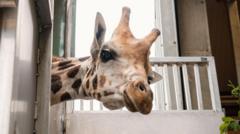
A four-year-old male giraffe named Stanley just arrived at Longleat Safari Park in Wiltshire. On the surface, it sounds like standard zoo logistics. A big animal gets loaded onto a specialized truck, rumbles down the highway, and steps into a new paddock. But if you think this is just another nice photo opportunity for families on summer holiday, you are missing the entire point.
Stanley is a Nubian giraffe. You might know them by their older name, Rothschild's giraffes, before recent genetic research lumped them into the broader Nubian category. Names aside, the reality is bleak. There are only about 455 mature Nubian giraffes left in the wild. Let that number sink in. That is not a typo. Fewer than 500 adult individuals are currently walking the African savannahs.
When you look at those numbers, Stanley isn't just an addition to a safari park. He is a multi-meter-tall insurance policy against total extinction.
The Pressure on a Four Year Old Bull
Longleat has a massive reputation in conservation circles. Their "tower"—the biological term for a group of giraffes—currently features nine females. Every single one of them was born at Longleat under the watchful eye of the European Endangered Species Programme (EEP).
The park used to have a legendary breeding bull named Thorn. He was incredibly productive, fathering 29 calves during his lifetime. But Thorn died in 2024, leaving a massive genetic void in the herd. For nearly two years, the breeding program at the park has been on pause.
That is where Stanley comes in.
Right now, Stanley is standing between 3.5 and 4 meters tall. He looks huge to us, but for a male Nubian, he is practically a teenager. Adult males can tower up to six meters high, making them the literal giants of the mammal world. Because he is only four, he hasn't quite hit full sexual maturity yet—that usually happens between ages four and five.
The keepers aren't rushing him. He spent his first few days in an isolated paddock right next to the giraffe house. It gave him a chance to check out the girls, sniff the air, and get used to the sounds of Wiltshire without getting overwhelmed. The goal is simple: let him acclimate, merge the tower back into the main reserve, and wait for nature to take its course once he hits his stride.
Why Wild Giraffes Are Silently Vanishing
Everyone notices when elephants or rhinos get poached. It makes global headlines. But giraffes are victims of what conservationists call a "silent extinction." Because you see them all over pop culture—on baby blankets, toy store logos, and animated movies—we assume they're doing fine. They aren't. Across the entire African continent, giraffe populations have plummeted by roughly 40% over the last three decades.
The Nubian giraffe has had it worst of all. Habitat loss is the primary driver. As human populations expand, farming, roads, and civil unrest chop up the continuous canopy lands these animals need to survive. A giraffe needs space. It eats up to 34 kilograms of leaves a day, mostly from acacia trees. When you fragment their habitat, you starve them out.
Illegal poaching for bushmeat and hides strips away the remaining wild populations. In areas torn apart by military conflict, a single giraffe represents hundreds of pounds of meat for desperate people. Conservation infrastructure falls apart during wars, leaving these animals completely unprotected.
The Genetic Math of Saving a Subspecies
You can't just throw any two giraffes together and hope for the best. That is a common mistake amateur wildlife enthusiasts make. If you mix different subspecies, you muddy the genetic waters, making future reintroduction efforts pointless.
The EEP tracks the lineage of every captive giraffe with intense scrutiny. They use complex studbooks to calculate exactly which male should breed with which female to maximize genetic diversity. Stanley wasn't picked at random. His DNA profile makes him the perfect match for the Longleat females without risking inbreeding depression.
"Longleat has been one of the most successful hubs for the breeding programmes of Nubian giraffes, so to start that journey again is a privilege." — Darren Beasley, Head of Animal Operations at Longleat.
If Stanley succeeds, his offspring won't just live out their days in European parks. The long-term goal of the EEP and organizations like the Giraffe Conservation Foundation (GCF) is to maintain a healthy, genetically diverse backup population. If wild numbers drop past the point of no return, these captive-born animals provide the genetic material needed for wild translocations and rewilding projects in safe African reserves.
Moving a Giant Is a Nightmare
Have you ever wondered how you actually transport an animal that stands as tall as a house? It is an absolute logistical nightmare. You can't just tranquilize a giraffe, let it flop onto the ground, and hoist it into a truck.
Because of their unique cardiovascular systems—their hearts have to pump blood all the way up that massive neck to the brain—letting a giraffe fall can cause fatal trauma or permanent brain damage. Their blood pressure is double that of a human to fight gravity, controlled by a complex web of valves and vessels. If they drop too fast, the sudden pressure shift can kill them instantly.
Instead, transport teams use positive reinforcement and months of crate training. They entice the animal into custom-built, open-top trailers using high-value treats like fresh willow branch leaves. The trailers have adjustable roofs that can be lowered to clear low-hanging power lines and bridges during the drive, then raised back up when the truck stops. It takes a massive team of veterinarians, police escorts, and keepers just to move one animal across counties, let alone countries.
What You Can Do Right Now
Sitting back and reading about Stanley is great, but awareness doesn't fund anti-poaching patrols or build secure transport trailers. If you want to actually move the needle for these animals, you need to support the boots-on-the-ground operations.
- Support Target Charities: The Giraffe Conservation Foundation (GCF) is the only organization explicitly dedicated to saving wild giraffes. They fund the tracking collars and community education programs that keep wild herds safe.
- Visit Accredited Facilities: When you buy a ticket to an EAZA or BIAZA accredited facility like Longleat, a direct percentage of that revenue funds international breeding programs and field conservation.
- Spread the Real Numbers: Stop letting people believe giraffes are doing fine. Talk about the silent extinction. The fact that under 500 mature Nubians remain in the wild should be common knowledge.
Stanley's journey is just beginning. Over the next year, he will grow taller, find his place in the Longleat tower, and hopefully step into the massive shoes left behind by Thorn. Keep your eyes on Wiltshire. The future of the tallest mammal on earth is playing out in a quiet English paddock.

.png/revision/latest/scale-to-width-down/268?cb=20250824043100)