South Korea doesn't have enough people to fight its wars. The country is staring down the barrel of a demographic collapse so severe that its military is literally running out of draft-age men. When your neighbor is a nuclear-armed state with over a million active soldiers and your own birth rate is hitting historic lows, you can't just recruit your way out of the problem.
You build a machine army instead.
The South Korean government just designated South Chungcheong Province and the city of Nonsan as the official hub for its new AI defense robotics innovation cluster. Backed by an initial $32 million in public funding, this project isn't just a standard military upgrade. It's a frantic pivot toward survival.
The Nonsan Project and the Reality of Automated Warfare
Nonsan is already famous within South Korea as the home of the military's primary boot camp, where hundreds of thousands of young men undergo basic training. Transforming this specific region into an advanced research and manufacturing center for physical artificial intelligence is deeply symbolic. The barracks of yesterday are turning into the automation testing grounds of tomorrow.
The $32 million investment handles the foundation. The real money and execution will come from a tight collaboration between the Ministry of National Defense, local tech conglomerates, and research hubs like the Korea Advanced Institute of Science and Technology (KAIST). The goal is clear: build a centralized ecosystem where engineers can design, simulate, and mass-produce autonomous weapons without bureaucratic delay.
This strategy relies heavily on physical AI—software that interacts directly with the messy, unpredictable real world rather than staying confined to data centers. Think less about chatbots and more about heavy hardware that can navigate mud, recognize targets in torrential rain, and operate when the GPS goes dark.
The Tech Behind the Defensive Shield
The military isn't waiting around for the Nonsan hub to finish construction before testing these concepts. Major defense contractors like Hyundai Rotem are already picking up state-funded projects to build the actual hardware that will populate this new cluster.
Two specific technological pillars are driving the current development.
Spoken Command Systems for Swarms
Right now, controlling an unmanned ground vehicle (UGV) or a drone requires a dedicated operator staring at a screen, punching in fixed commands via a remote control. It's tedious, and it takes a human out of the actual fight. Hyundai Rotem is currently building control software that allows a single soldier to command multiple autonomous platforms simultaneously using natural language text or voice. You tell a squad of four-legged robot dogs to "scout the ridge ahead," and the software handles the individual routing, obstacle avoidance, and coordination automatically.
Digital Twin Simulation
Hardware is expensive to break during testing. To speed up development, the Agency for Defense Development (ADD) is funding digital twin simulators. These systems create exact virtual replicas of real-world combat environments, complete with accurate physics, weather patterns, and terrain. Engineers can run a new autonomous navigation algorithm through thousands of simulated night missions in minutes, iron out the bugs, and deploy the software to physical hardware with minimal risk.
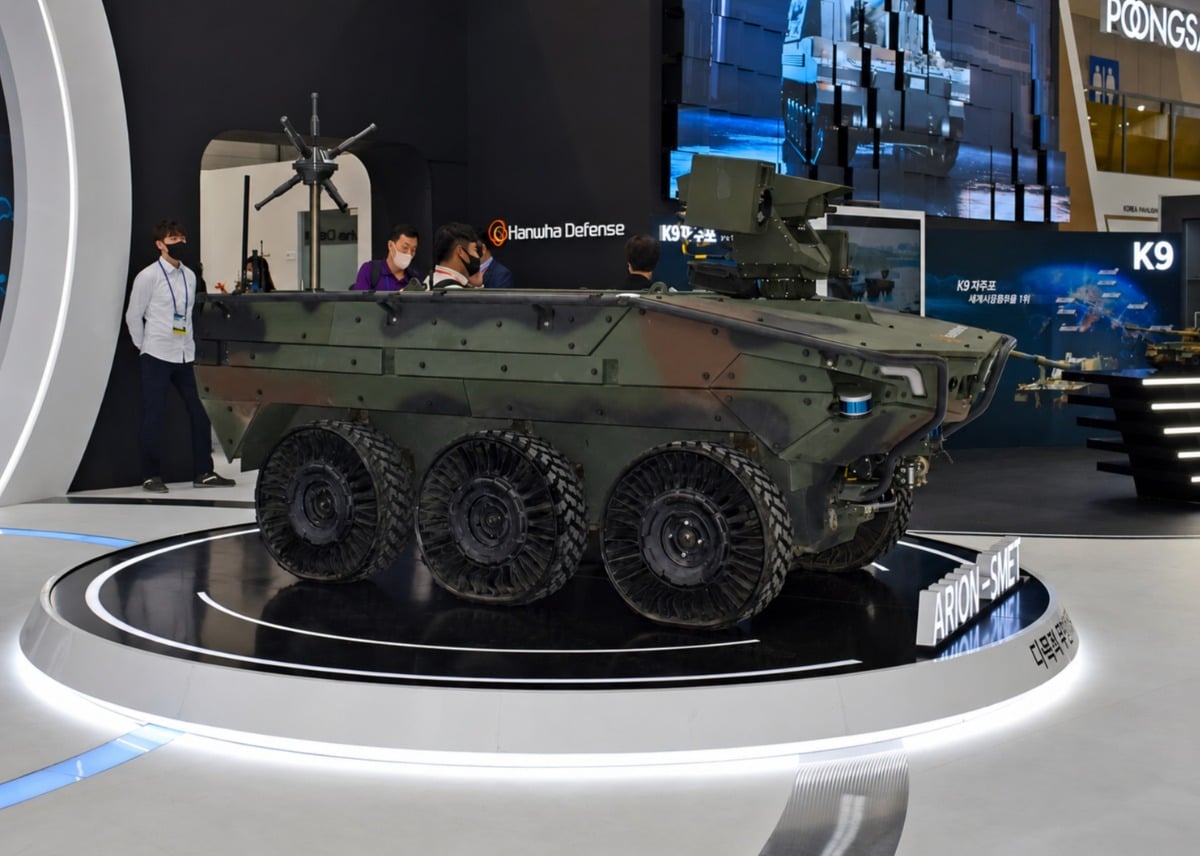
Beyond software, the physical platforms are shifting toward modular designs. Instead of building five different types of robots for five different missions, the military is focusing on standard bases—like the HR-Sherpa UGV—featuring detachable wheels, legs, and payloads. A single chassis can carry a robotic arm for bomb disposal in the morning, haul heavy supply packs across mountain passes in the afternoon, and mount a remote weapon station for perimeter security at night.
The Grim Mathematics of South Korea's Draft
To understand why Seoul is moving so fast, you have to look at the demographic numbers. South Korea's fertility rate dropped to an abysmal 0.72 children per woman, with some quarterly estimates dipping even lower.
A military built on conscription requires a steady influx of 20-year-old males. That pool is evaporating.
South Korean Active Duty Personnel Trajectory (Approximate)
2018: 600,000 troops
2022: 500,000 troops
2026: ~450,000 troops (and dropping)
The military can't maintain its current defensive lines along the 160-mile-long Demilitarized Zone (DMZ) with these numbers. Robots don't need a basic income, they don't age out of the draft, and they don't care about the brutal winter winds blowing across the mountains of Gangwon Province.
South Korea has actually been playing with this idea for years. Way back in 2006, they deployed the Samsung Techwin SGR-A1 along the DMZ. It was a stationary sentinel robot equipped with optical sensors, tracking software, and a machine gun. While it technically required a human operator to confirm a lethal shot, the system was fully capable of autonomous targeting. The new Nonsan hub takes that isolated experiment and scales it into a mobile, interconnected web of autonomous systems.
The Allied Supply Chain Factor
This shift isn't happening in a vacuum. South Korea is quickly becoming the primary arms manufacturing hub for Western-aligned nations. While the United States excels at designing incredibly complex, high-end defense systems, American shipyards and factories struggle with capacity, high labor costs, and severe production bottlenecks.
South Korea knows how to build heavy stuff quickly. They possess the highest robot density in the world, with over 1,000 industrial robots per 10,000 human employees. By embedding AI into their manufacturing lines—using automated quality inspection, predictive maintenance, and robotic welding—they can pump out artillery shells, tanks, and autonomous vehicles at a speed that Western nations can't match.
Integrating AI into the production line creates high-fidelity operational data. If a component fails during a field test, the manufacturer can trace the exact parameters of the automated weld or the specific batch of raw materials used in the factory. This data loop trains better production tools, minimizes defects, and ensures that when the Nonsan hub designs a new defense robot, the country's industrial base can actually mass-produce it next week.
Your Next Steps for Tracking the Defense Tech Shift
If you're tracking the defense sector, the automation of East Asia's borders is the most practical case study of physical AI in existence today. Watch these specific indicators over the next twelve months.
- Monitor Hyundai Rotem and Hanwha Aerospace announcements: Look specifically for updates regarding their multi-robot coordination software trials. The jump from controlling one robot to commanding a swarm via voice is the real technological milestone.
- Track ROK Army deployment updates along the DMZ: The gradual retirement of manned guard posts in favor of autonomous UGVs will give you the truest timeline of how fast this technology is maturing.
- Watch the implementation of the AI Basic Act: Pay attention to how Seoul balances strict safety standards with the military's urgent need for rapid, unconstrained autonomous weapon testing.