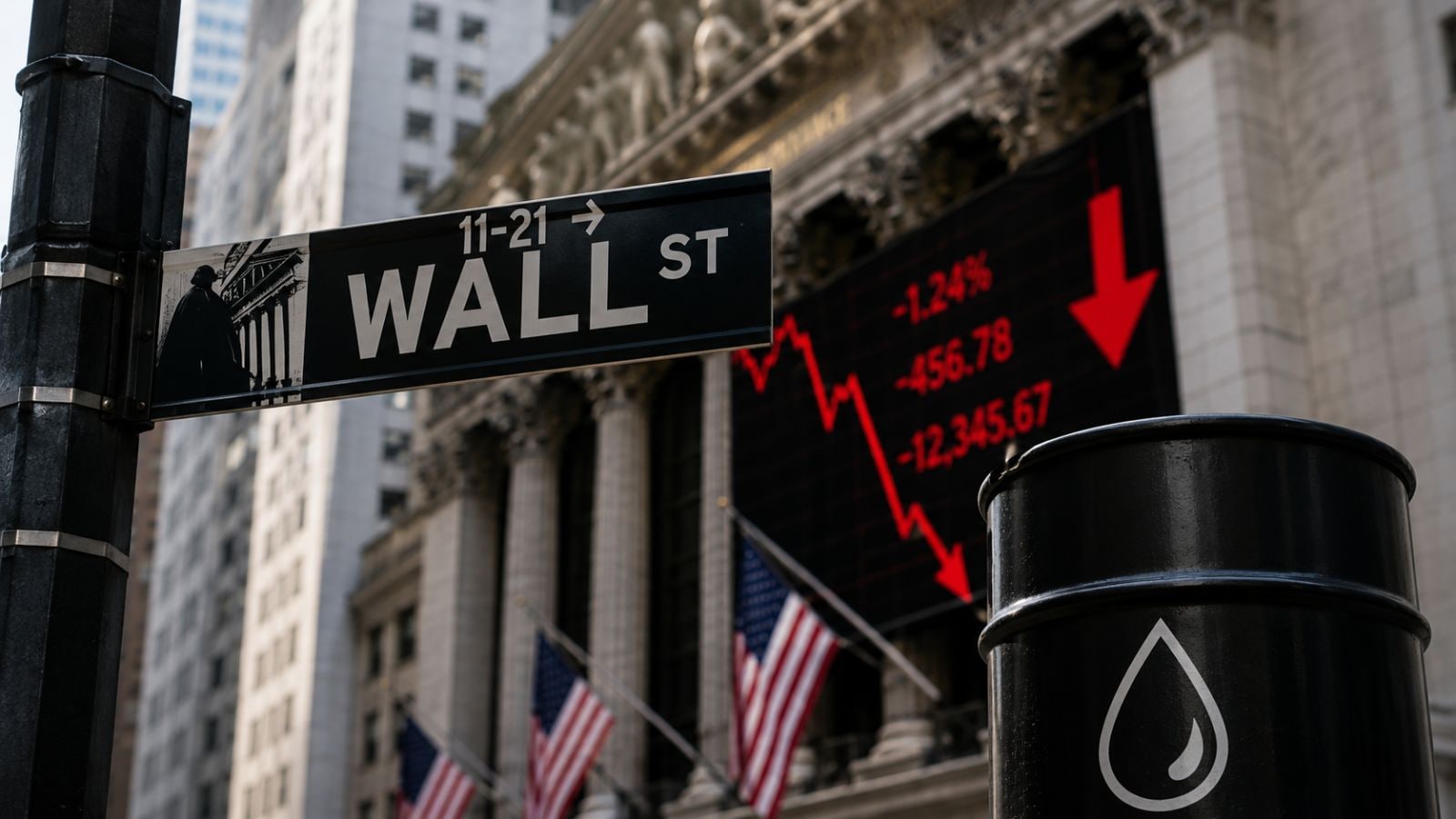
At 9:29 a.m. in Lower Manhattan, the trading floor of the New York Stock Exchange does not sound like the roaring coliseum of old cinema, yet the tension remains physical. A floor broker adjusts his earpiece beneath the harsh glare of overhead tickers while, two thousand miles away in an Ohio kitchen, a retired schoolteacher refreshes a brokerage app beside a cooling mug of coffee. Both are watching the same flashing number climb and dip in real time. That figure—the Dow Jones Industrial Average—has served for more than a century as the shorthand pulse of American capitalism, a single five-digit reading onto which millions of people project their fears about retirement, inflation, and the worth of their labor.
Numbers rarely earn that kind of emotional authority by accident. Most market gauges are built for institutional mathematicians who speak in basis points and market-capitalization weights. This index was born from a newspaperman's instinct for clarity.
When Charles Henry Dow, a high school dropout from rural Connecticut turned financial reporter, sat down with his partner Edward Jones in the spring of 1896, Wall Street was an opaque club. Rumors moved faster than verified prices, and small merchants had no reliable way to tell whether the broader economy was expanding or quietly rotting beneath speculative schemes. Dow wanted a weather vane that any reader of The Wall Street Journal could grasp over breakfast. On May 26, 1896, he published a simple arithmetic mean of twelve industrial companies—businesses rooted in sugar, cotton oil, tobacco, leather, rubber, and gas. The starting figure was 40.94.
It was a radical act of translation. Before that Tuesday morning, investors treated stocks as isolated wagers on individual railroads or mines. Dow suggested that twelve smokestack enterprises, added together and divided by twelve, could tell a collective story about the nation's appetite for goods and credit. The first summer tested that premise immediately; during the Panic of 1896, the fledgling gauge sank to an all-time low of 28.48. Still, the habit stuck. People began asking how the market was doing as though asking after a neighbor's health.
How a Pencil-and-Paper Formula Outlived the Smokestacks
To understand why the benchmark still commands the evening news, you have to look at the strange, stubborn mathematics ticking beneath its hood. While modern institutional benchmarks like the S&P 500 weigh companies by their total market value, Dow's creation remains price-weighted. In plain terms, a company's influence over the daily score depends entirely on the dollar price of a single share rather than the sheer size of the corporation.
Consider what that quirk produces in the modern market. A stock trading above seven hundred dollars—such as Goldman Sachs—exerts far more pull on a single trading session than a trillion-dollar technology titan whose share price sits near one hundred and fifty dollars following a stock split. A ten-dollar swing in the highest-priced constituent moves the headline number dramatically, even if the broader economy barely blinked.
Economists have spent decades pointing out the flaws in this design. A stock split—an accounting gesture that divides existing shares into smaller slices without changing a company's real value—would abruptly crash the average if left uncorrected. To prevent artificial drops whenever a corporation splits its stock or a committee swaps one business for another, custodians rely on a constantly recalibrated figure known as the Dow Divisor. Instead of dividing the sum of the thirty share prices by thirty, the formula divides by a decimal smaller than one. Every dollar change in any member company now translates into several points on the ticker.
Purists call the methodology archaic. Yet that very simplicity explains its survival. You do not need a quantitative finance degree to picture thirty iconic American companies standing shoulder to shoulder on a single ledger. The math carries the fingerprints of a nineteenth-century journalist working with a ledger book and a sharpened pencil, refusing to let complexity obscure the headline.
The Quiet Drama Inside the Dow Jones Industrial Average
Behind every update to the Dow Jones Industrial Average sits a small selection committee at S&P Dow Jones Indices, tasked with deciding which thirty corporations best mirror the living economy. Getting added to the roster is a corporate coronation; getting dropped feels like a public verdict on obsolescence.
Look across the timeline of departures and arrivals, and you can trace the entire arc of American work. Of the original twelve companies from 1896, eleven vanished long ago through mergers, antitrust breakups, or quiet liquidation. Only General Electric endured into the twenty-first century, standing as a living relic of Thomas Edison's workshops until its removal in 2018. One by one, the furnaces and telegraph wires yielded their seats to software, semiconductors, healthcare, and consumer finance.
Today, the thirty names read like a portrait of how ordinary families spend their paychecks and their afternoons. Morning coffee and groceries pass through Walmart, McDonald's, and Coca-Cola. Home renovations run through Home Depot and Sherwin-Williams. Smartphones, cloud servers, and artificial intelligence chips run through Apple, Microsoft, Nvidia, and Alphabet. Medical bills and prescriptions pass through UnitedHealth Group, Johnson & Johnson, Amgen, and Merck. Even the heavy machinery of Caterpillar and Boeing still shares the room with Visa, JPMorgan Chase, and Amazon.
The index survives because it refuses to stay loyal to the past. Whenever an industry fades from the center of American life, the committee quietly edits the mirror so the reflection stays recognizable. For an executive in a corporate boardroom, inclusion validates decades of strategy. For a worker on a factory floor or in a logistics warehouse, seeing their employer's ticker symbol among the thirty brings a complicated pride—the sense that their daily shift is woven into the country's primary economic barometer.
When a Number Becomes a Mirror of Household Anxiety
Step away from Wall Street, though, and the meaning of those thirty stocks changes shape entirely. In a living room in Phoenix or a union hall in Pittsburgh, nobody debates divisors or price-weighting formulas. They look at the green or red arrow on the corner of the television screen and ask a much simpler question: Am I going to be okay?
Since the late twentieth century, the rise of 401(k) accounts and index funds has tied the quiet dignity of ordinary retirements directly to equity markets. When the benchmark plunges—whether during the bleak autumn of 1929, the sudden shock of October 1987, the banking panic of 2008, or the pandemic freeze of March 2020—the panic is never purely abstract. A sharp drop means postponing a kitchen repair, rethinking a college tuition plan, or working two extra years before handing in a badge.
At the same time, a surging market can create its own quiet alienation. Roughly half of American households own little or no stock directly, watching record highs celebrated on cable news while grocery receipts and rent renewals keep climbing. For a nurse working double shifts or a delivery driver watching fuel prices rise, a triumphant banner announcing another thousand-point milestone can feel less like shared prosperity and more like a dispatch from a parallel country.
That tension lies at the heart of our obsession with the ticker. The figure measures corporate earnings, global supply chains, and investor expectations with remarkable sensitivity, yet we routinely ask it to measure human well-being. When the gauge rises, politicians claim credit for national vitality; when it falls, households brace for layoffs that may or may not arrive. We have turned a thirty-company thermometer into a referendum on the American dream.
The Lasting Pulse of an Imperfect Barometer
Every second during trading hours, computers recalculate the tally and beam it across fiber-optic cables to phones, airport lounges, and trading desks around the globe. In an era when algorithmic funds track thousands of global securities simultaneously, a nineteenth-century average of thirty blue-chip names ought to be an antique.
Instead, it remains our shared campfire. People gather around it because human beings do not think in sprawling statistical distributions; we think in stories, benchmarks, and familiar names. Knowing that thirty companies—builders of airplanes, brewers of coffee, writers of code, insurers of health—are navigating the same economic weather gives shape to an otherwise invisible storm.
Late in the afternoon, as the closing bell echoes across the floor at Broad and Wall and the final tally locks into place for the night, the retired teacher in Ohio closes her app and walks out to water her porch plants, knowing that tomorrow morning, at 9:30 sharp, the pulse will begin again.