We treat the final frontier like an orbital garbage dump.
A four-tonne chunk of a SpaceX Falcon 9 rocket just slammed into the lunar surface near the Einstein crater at roughly 8,700 kilometres per hour. This school-bus-sized piece of debris spent more than a year drifting through space after launching lunar landers back in January 2025. Astronomy software creator Bill Gray noted that the uncontrolled impact highlights a recurring carelessness in how we dispose of leftover space hardware.
The collision is far from an isolated incident. It forces a hard look at what we've actually accumulated off-planet and whether our current trajectory threatens future exploration.
What is Actually Sitting Out There Right Now
Most people assume space is empty. It isn't. Decades of exploration have left behind an astonishing array of equipment, ranging from functional satellites to bizarre garbage.
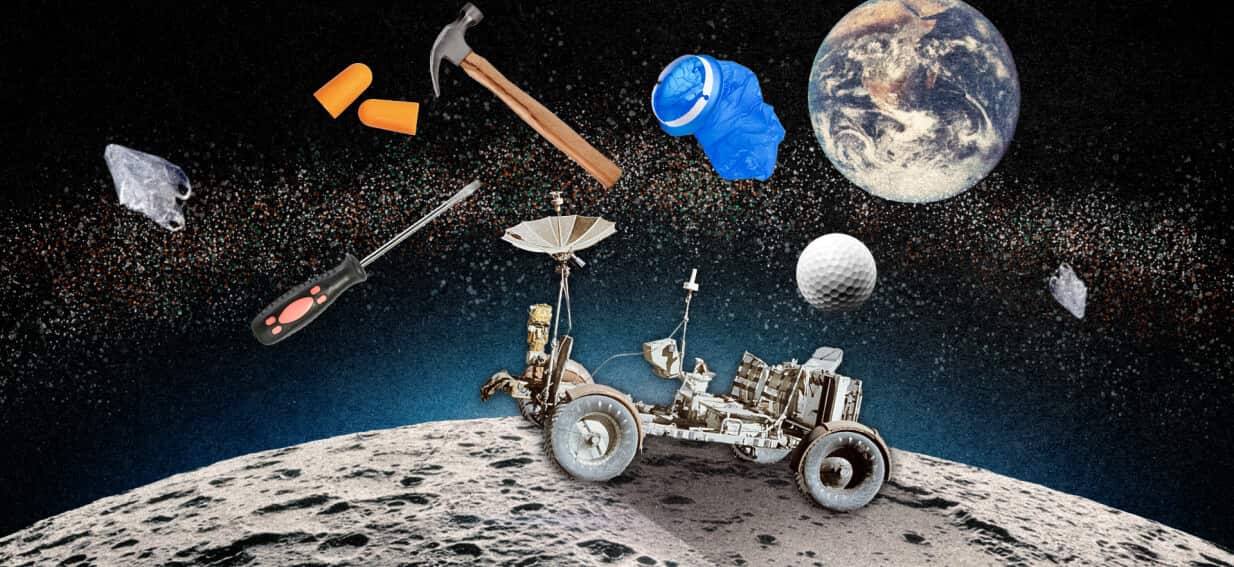
The lunar surface alone holds nearly 200 tonnes of human-made material spread across roughly 3,000 separate objects. Since the Soviet Union’s Luna 2 probe first reached the Moon in 1959, space agencies and private companies have deposited a fascinating timeline of human history—and a lot of clutter.
According to NASA tracking records, the lunar inventory features items like:
- Neil Armstrong's gold olive branch left behind in 1969
- Two golf balls hit by Alan Shepard
- Multiple lunar roving vehicles and crashed descent stages
- Abandoned cameras, scientific tools, hammers, and moon boots
- Bags of human waste and urine collection devices
Earth's orbit is in an even worse state. More than 13,000 tonnes of debris currently circle our planet. This includes defunct satellites, spent rocket upper stages, and millions of tiny paint flecks and metal shards travelling at bullet speeds.
The Approaching Tipping Point
Space agencies are rushing back to the Moon. NASA's Artemis program aims to establish a permanent human base on the lunar surface, while China and various private commercial entities ramp up their own lunar missions.
This crowded environment changes the math completely. When space was mostly empty, a stray 4,000-kilogram rocket booster hitting the Moon was little more than a scientific curiosity or an interesting plume of debris for telescopes in Chile to track. Researchers even plan to study the resulting crater to learn more about lunar geology.
As traffic increases, the margin for error shrinks to zero. Undetected debris running into future lunar bases, orbiting satellites, or historic Apollo landing sites transitions from a low-probability risk to a statistical certainty.
How We Fix Orbital Negligence
Governments and aerospace corporations can no longer treat empty space as a free disposal site. Solving this crisis requires structural changes to how missions are planned and executed.
- Mandatory De-orbiting Protocols: Rocket upper stages must be deliberately guided back into Earth's atmosphere to burn up or pushed into a safe graveyard solar orbit rather than left to wander blindly.
- Active Debris Removal: Engineers are currently testing technologies like Australian laser systems designed to track and eventually slow down orbital junk. Others are developing harpoons and mechanical nets to capture large defunct hardware.
- International Regulation: Space law currently lacks strict enforcement mechanisms for post-mission cleanup. Policymakers must draft binding international agreements holding private operators and state agencies accountable for their spent hardware.
Space exploration unlocks incredible scientific progress, but we are repeating environmental mistakes on a cosmic scale. If we fail to manage our footprint now, the orbital congestion overhead will lock us out of the stars entirely.