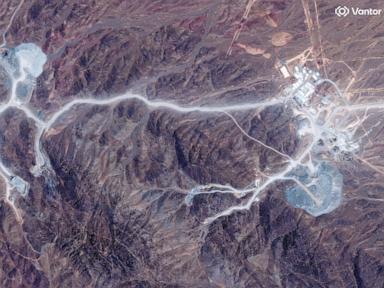
Donald Trump isn't holding back on Iran. During a recent Oval Office meeting, he bluntly promised that American forces would be hitting Pickaxe Mountain "pretty soon, and very heavily."
If you're wondering why a site buried deep under granite in central Iran is suddenly dominating international news, you aren't alone. Last year, military strikes hammered key nuclear targets across Iran, including Natanz and Fordow. At the time, official statements claimed the country's nuclear capacity had been effectively neutralized.
Yet Pickaxe Mountain sits untouched. It remains a major point of friction between Washington and Tehran.
Understanding what's happening at this underground complex requires looking past the political rhetoric. It means examining military realities, satellite surveillance, and the engineering limits of modern bunker buster bombs.
What Iran Has Actually Built Under the Granite
Pickaxe Mountain is the common nickname for the Shahid Alimohammadi facility. The site sits in Isfahan province, roughly two kilometers south of the main Natanz uranium enrichment complex. Located in the Zagros mountain range, the peak rises about 1,600 meters above sea level.
Iran didn't start digging here on a whim.
Construction began in late 2020. The project kicked off right after a devastating explosion destroyed an above-ground centrifuge assembly hall at Natanz. Iranian officials labeled that explosion an act of foreign sabotage. Soon after, Iran's nuclear chief announced the country would construct a far more secure facility inside the nearby mountain.
Satellite images tracked the heavy excavation work over the following years. Engineers carved out two pairs of main tunnel entrances, connected by paved access roads climbing up the steep slope. Security forces built multi-kilometer fencing that directly links the mountain perimeter to the main Natanz base.
Western intelligence agencies and non-proliferation think tanks, like the Institute for Science and International Security, have analyzed the imagery extensively. They estimate the primary underground halls sit at least 100 meters beneath solid rock—with some structural assessments placing sections deep beneath granite overhangs.
Iran maintains that Pickaxe Mountain is strictly a manufacturing hub meant to assemble advanced centrifuges. But independent analysts and foreign intelligence agencies suspect something else. They worry Tehran intends to set up an undeclared uranium enrichment plant inside the mountain.
Why Conventional Bunker Busters Might Fail
Destroying a nuclear site buried inside a mountain is notoriously difficult. Airpower has clear physical limits.
During previous air campaigns, American B-2 stealth bombers dropped GBU-57 Massive Ordnance Penetrator bombs on Iranian targets. These 30,000-pound munitions represent the absolute peak of conventional bunker-busting technology. They are engineered specifically to punch through heavily reinforced concrete and deep soil.
However, even a GBU-57 has hard physical constraints.
- The GBU-57 can penetrate up to 60 meters of reinforced earth or moderate rock.
- Pickaxe Mountain's subterranean chambers sit anywhere from 100 to nearly 600 meters beneath solid granite.
- Multiple heavy strikes on the exact same impact point can deepen a crater, but mountain granite disperses kinetic energy far better than soil.
That simple geological fact changes the military math entirely.
An air attack using conventional heavy bombs might collapse tunnel entrances or destroy surface infrastructure. It could knock out power lines, seal off transport roads, and crush ventilation shafts. But it might leave the actual equipment sitting in the central cavern completely intact.
If the centrifuges deep inside survive the shockwaves, the site remains functional. That leaves military planners with a difficult problem. Ground operations or specialized subterranean sabotage might be the only way to permanently disable what sits inside that mountain.
The Strategy Behind Moving Facilities Underground
Tehran learned hard lessons from decades of covert operations, air strikes, and cyberattacks against its nuclear program.
Building facility halls on the surface left them exposed. Remote missile strikes, drone attacks, and direct physical sabotage constantly disrupted production. By moving their most critical development work under hundreds of meters of solid rock, Iranian leadership created a physical shield that standard airstrikes cannot easily break.
This isn't an isolated project. It reflects a systematic policy across Iran's entire defense infrastructure:
- Deep Tunnel Networks: Moving military assets, missile silos, and nuclear hardware into mountain complexes.
- Redundant Facilities: Spreading equipment across multiple regions so no single attack can eliminate their technical capabilities.
- Backfilled Entrances: Reinforcing access points with dirt, rock, and thick concrete caps to withstand direct blast pressure.
Satellite photos taken over recent months show heavy equipment backfilling portions of the eastern tunnel entrances at Pickaxe Mountain. That indicates ongoing work to reinforce the site against potential blast damage.
These defensive steps show that Iranian engineers expect an attack. They are taking direct steps to ensure the underlying hardware survives whatever hits the exterior doors.
What Trump Wants to Accomplish Next
When Trump says the US will strike Pickaxe Mountain "pretty soon," the goal extends beyond hitting a physical building on a map.
The immediate tactical goal is preventing Iran from establishing operational uranium enrichment capabilities deep underground. Once centrifuges are installed and active inside a site that bunker busters cannot reach, stopping weapons-grade material production becomes significantly harder without full-scale ground intervention.
Beyond the physical structure, there's a broader political calculation at play. A heavy strike on surface access points sends a clear message to Tehran and regional neighbors. It signals that Washington will use military force to interrupt development, even if the target is buried deep underground.
Whether a strike completely destroys the subterranean complex or merely seals the doors for months, it forces Iran to divert resources toward repairs and defensive measures.
How to Track Developments as Tensions Rise
The situation around central Iran's nuclear infrastructure moves fast. If you want to follow what actually happens at Pickaxe Mountain without getting caught in political spin, focus on reliable monitoring sources:
- Satellite Imagery Providers: Keep an eye on reports from commercial satellite operators like Planet Labs and Maxar, which regularly publish high-resolution photos of Natanz and surrounding terrain.
- Nuclear Watchdog Analysis: Read updates directly from the International Atomic Energy Agency and non-partisan non-proliferation groups like the Institute for Science and International Security.
- Official Military Statements: Watch Central Command press briefings for confirmed operational details rather than preliminary media speculation.
Watch for changes in site activity over the coming weeks, especially fresh earthworks, heavy transport vehicle movements near tunnel access roads, or structural changes around the perimeter fencing. Those physical indicators will tell you far more about the site's status than any political speech.