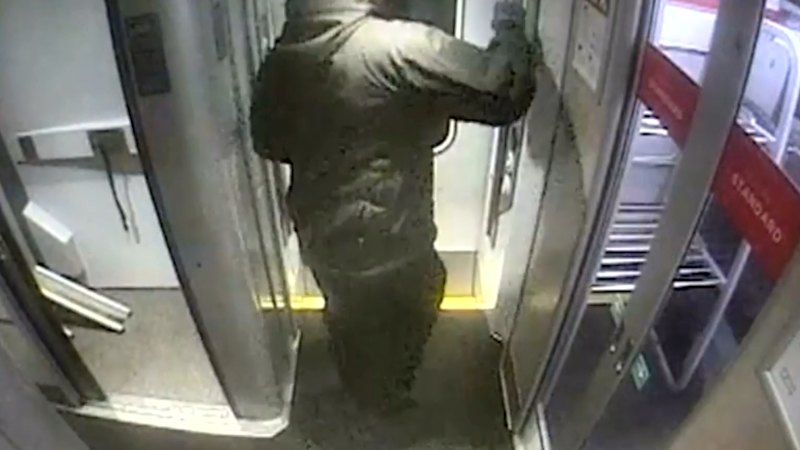
Twelve jurors spent nearly seventeen hours weighing a single legal question: did a man in the grip of acute psychosis still intend to kill?
On Thursday, November 26, 2026, a jury at Cambridge Crown Court convicted 33-year-old Anthony Williams on all 14 counts of attempted murder following a spree across Peterborough, London, and Cambridgeshire in late October and early November 2025. Ten of those counts stemmed from a terrifying attack aboard a London-bound LNER train between Peterborough and Huntingdon. Meanwhile, you can explore other developments here: Why Meloni Pushed Back On Ukraine Mediterranean Strikes.
Standard wire rewrites treat this verdict like a simple closed-book crime story. They shouldn't. If you look closely at what unfolded in court, the case exposes three messy realities that most headlines gloss over: how English courts separate psychosis from specific intent to kill, how emergency rail response played out in real time, and why rail security remains a constant balancing act rather than a quick fix.
How the UK Train Stabbing Case Became a Test of Intent
Williams never denied carrying out the stabbings. Earlier in the legal process, he pleaded guilty to serious offenses including wounding with intent, while contesting the 14 attempted murder charges at trial. His defense leaned heavily on mental illness, with the court hearing that he was experiencing acute psychosis linked to schizophrenia at the time and did not intend to kill his victims. To explore the full picture, we recommend the excellent analysis by NBC News.
That distinction matters enormously under English law. Attempted murder requires proving an intent to kill, not merely an intent to cause severe harm.
Prosecutor Christopher Paxton KC argued that Williams posed an ongoing danger across streets and trains over Halloween weekend in 2025, moving from incidents in Peterborough and a DLR service near Pontoon Dock in east London before boarding the LNER train from Doncaster toward London. Crucially, psychiatric evidence presented at trial confirmed that despite his mental health condition, Williams was still capable of forming intent in his mind.
Jurors also heard stark medical and eyewitness details from the LNER attack. One passenger, Stephen Crean, suffered a scalp wound measured within 0.79 centimeters of his brain after allegedly being asked if he wanted to die. Another passenger, Sachin Balakrishnan, had the tip of the blade come perilously close to his heart. Rail worker Samir Zitouni, who tried to intervene using a frying pan, suffered catastrophic blood loss, three stab wounds to the back, and required four blood transfusions in intensive care.
Honestly, that kind of forensic precision is usually what tips the scales in contested intent trials. Words and medical proximity tell a story that abstract legal arguments can't match. After 16 hours and 52 minutes of deliberation, the jury returned unanimous verdicts on several counts and majority verdicts on others, convicting Williams across all 14 charges. He appeared via video link from Rampton Hospital rather than sitting in the dock, with sentencing scheduled for February 4 and 5, 2027.
What People Usually Get Wrong About Psychosis and Criminal Liability
A common misconception after high-profile trials like this is that a diagnosis of schizophrenia or psychosis automatically cancels out criminal intent. It doesn't.
In practice, courts look at evidence of targeted action, awareness of surroundings, and specific conduct during the offense. When psychiatrists testify that a defendant can still form intent despite severe mental illness, juries are asked to weigh clinical symptoms against concrete behavior.
Another myth is that these cases are neatly black-and-white. Notice that the jury reached majority verdicts on several charges alongside unanimous verdicts on others. That tells you real people in that deliberation room wrestled hard with the evidence before landing on guilt across the board.
At the same time, we should be transparent about limits in public reporting. While trial coverage and official statements from the Crown Prosecution Service and British Transport Police lay out the core facts of the convictions and timeline, full psychiatric transcripts and sentencing submissions aren't always public in real time. You shouldn't treat courtroom summaries as a complete clinical history of mental health care gaps or systemic failures before the attack.
Inside the Emergency Response and Investigation
When violence breaks out on a moving train, seconds feel like minutes. According to accounts of the LNER attack, the train made an unscheduled stop at Huntingdon railway station within 14 minutes of leaving Peterborough and within five minutes of the first emergency call, thanks to coordination between the driver and a signaller. Officers then tasered and arrested Williams in the station car park.
British Transport Police described the probe as one of the most significant and complex investigations in the force's history. Yet even complex police operations face scrutiny. A July 2026 report from the Independent Office for Police Conduct concluded that two police constables should face gross misconduct proceedings over false claims regarding CCTV availability and, for one officer, inadequate inquiries.
That detail is worth paying attention to. Good outcomes in the courtroom don't erase procedural missteps during an investigation. Accountability works on two tracks: convicting the offender and holding public bodies to basic investigative standards.
Why High-Speed Rail Security Stays Complicated
Whenever a major incident hits intercity rail, people immediately ask why stations and trains don't have airport-style security.
Anyone who rides commuter or long-distance trains regularly knows why that's tough. High-frequency rail networks move hundreds of thousands of passengers through open platforms, dozens of regional stops, and tight boarding windows. Airport screening assumes a single controlled entry point and hours of lead time. Put airport gates on every regional station and you'd paralyze daily commuting.
Instead, rail safety relies on layered measures: fast signaller and driver coordination, emergency stopping protocols, on-board staff training, CCTV, rapid armed response at scheduled or unscheduled stops, and public alertness. You can see that layered approach in action at Huntingdon, where stopping the train ahead of Stevenage brought armed response into play quickly once emergency calls came in.
Still, real-world bravery doesn't replace systemic prevention. Rail staff like Samir Zitouni stepped into harm's way under extreme pressure, and passengers hid in toilets or whatever cover they could find while a walking frame was reportedly placed in the attacker's path. Everyday people shouldn't have to improvise defenses with kitchenware just to survive a train ride.
Practical Steps If You Follow the Case or Travel by Rail
If you're tracking this case ahead of the February 2027 sentencing or simply want practical habits for rail travel, focus on concrete actions rather than doomscrolling:
- Rely on primary justice and policing releases: Check updates directly from the Crown Prosecution Service and British Transport Police rather than second-hand social media threads when sentencing dates and court reporting restrictions matter.
- Know how to contact rail police fast: On UK trains, save or program the British Transport Police text code 61016 before you travel, and call 999 immediately if there's an active threat to life.
- Pick seats near emergency tools and exits: When boarding long-distance services, glance at where the nearest carriage door, emergency brake/release, and crew call point sit so you aren't guessing under stress.
- Keep your awareness up without panicking: Taking out one earbud in quiet or late-evening carriages helps you hear announcements and crew instructions early, which is usually far more useful than staring anxiously at strangers.