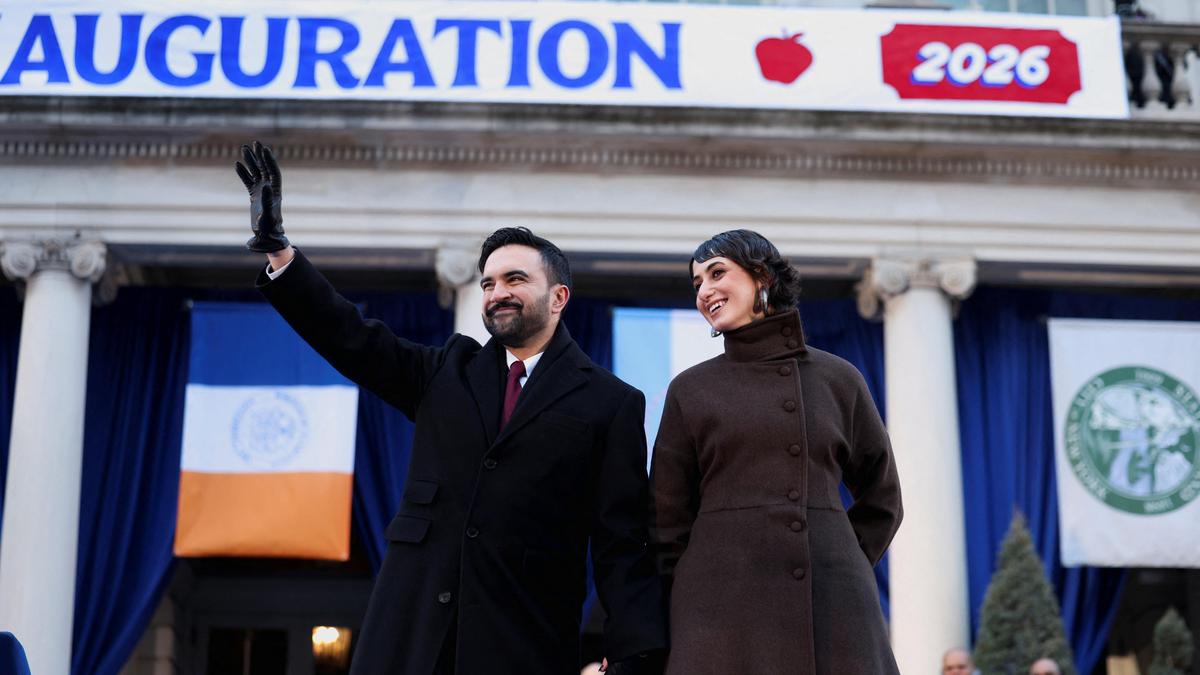
You can't make this up. Just past midnight on New Year's Day, a 34-year-old former foreclosure prevention counselor stood in a dark, decommissioned subway station beneath City Hall. He placed his hand on a Quran and took the oath as the 112th Mayor of New York City.
His name is Zohran Mamdani. He isn't your typical New York politician. He's a Ugandan-born, democratic socialist hip-hop fan who just pulled off one of the biggest political upsets in modern American history, defeating both political heavyweights like independent Andrew Cuomo and institutional mainstays like Republican Curtis Sliwa.
By midday on January 1, Mamdani left his new desk, jumped into a yellow cab, and headed above ground to the City Hall steps. In front of tens of thousands of freezing New Yorkers, his political idol, Senator Bernie Sanders, administered the public oath of office for a second time.
What followed wasn't the usual, sanitised political speech filled with generic promises of unity. Mamdani threw down a gauntlet. He explicitly rejected the traditional "grammar of civility" that politicians use to hide corporate agendas, promising instead to use the raw power of City Hall to restructure the economics of America’s largest metropolis.
From Kampala to Delhi to Lower Manhattan
Mamdani’s speech didn't just target the local crowds in Queens, Brooklyn, or the Bronx. He explicitly highlighted his sprawling global roots, thanking his family "from Kampala to Delhi."
That lineage matters because it fundamentally shapes his worldview. Born in Kampala, Uganda, in 1991, Mamdani is the only child of Academy Award-nominated filmmaker Mira Nair and renowned Columbia University professor Mahmood Mamdani. His family split time across continents before moving to New York when he was seven years old. Growing up as a South Asian Muslim in a post-9/11 New York, Mamdani experienced a city that was hostile to his identity.
He didn't even become a naturalised U.S. citizen until 2018. Fast forward just eight years later, and he's running the entire city. It's an unprecedented trajectory that breaks every conventional rule of political climbs.
"To those who insist that the era of big government is over, hear me when I say this: No longer will City Hall hesitate to use its power to improve New Yorkers' lives." — Mayor Zohran Mamdani
The Radical Agenda Meeting Mundane Reality
Mamdani ran on a platform that his opponents called completely delusional. He didn't blink then, and he isn't blinking now. His administration is promising structural changes that would fundamentally alter daily life in the five boroughs.
- A total rent freeze for roughly one million rent-stabilized households across the city.
- Completely free city buses to convert public transit into a true public utility.
- Universal free childcare to ease the crushing financial burden on working-class parents.
- A municipal pilot program for city-run grocery stores to combat corporate price gouging in food deserts.
It sounds incredible to his base. But here's where theory hits a brick wall: New York City's bureaucracy is notoriously brutal.
While Mamdani wants to pilot state-backed grocery stores and eliminate bus fares, he's also inherited a massive municipal machine that requires constant, unglamorous maintenance. He's now personally responsible for managing trash collection, clearing heavy snow, lowering the rat population, handling severe subway delays, and repairing thousands of winter potholes. If the garbage piles up on the sidewalks of Staten Island or the Upper East Side, voters won't care about his rhetoric on corporate greed—they'll just see a broken city.
Furthermore, his grand economic vision requires immense capital. Taxing the wealthy to fund free public services works as a campaign slogan, but implementing it requires navigating a hostile state legislature in Albany and a volatile economic landscape.
Governing Expansively and Audaciously
During the public ceremony, Representative Alexandria Ocasio-Cortez took the stage to frame Mamdani’s victory as a choice of "courage over fear." The atmosphere felt more like a political revival than a stuffy bureaucratic handoff. The event ended with a performance by Toronto artist Babu Singh, who closed out the ceremony by blasting the track "Gandhi Red Challenger" over the loudspeakers.
Mamdani used his 25-minute address to reframe what success looks like in municipal politics. He openly mocked the political consultants who told him to manage expectations and tell New Yorkers to ask for less.
Instead, he explicitly channeled Nelson Mandela and the South African Freedom Charter, declaring that New York "belongs to all who live in it." He rejected the classic "Tale of Two Cities" trope, stating he doesn't want to govern a city defined purely by the rich versus the poor, but rather a collective of 8.5 million distinct individuals.
What Happens Next
The honeymoon is officially over. Mamdani and his wife, Rama Duwaji, are packing up their one-bedroom, rent-stabilized apartment in Queens to move into Gracie Mansion. The transition team is packed with a mix of seasoned progressive field organizers, housing activists, and policy experts who are trying to convert progressive ideas into legal executive orders.
If you want to track whether Mamdani’s bold experiment actually works or collapses under its own weight, look closely at these three immediate friction points.
1. Watch the Metropolitan Transportation Authority (MTA)
Mamdani wants free buses, but the state controls the MTA, not City Hall. Watch how he uses his bully pulpit to force the state's hand, or if he tries to fund fare-free routes using city-subsidized pilots.
2. The Rent Guidelines Board Vote
This will be the first massive test for his rent freeze promise. The board is appointed by the mayor. If Mamdani packs the board with pro-tenant advocates and secures a 0% increase for rent-stabilized apartments, it will be an immediate win for his base—and will trigger instant lawsuits from the city's powerful real estate lobby.
3. The First Budget Battle
The city budget must be balanced by law. Look at his first major fiscal proposal to see exactly how he intends to fund universal childcare and city-run grocery stores without triggering capital flight from Wall Street.