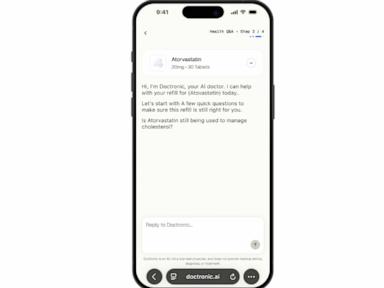
You need a refill for your blood pressure medication, but your doctor can't see you for three weeks. Plus, the co-pay costs a hundred bucks you'd rather keep. Utah think it has the answer. Earlier this year, the state quietly launched a pilot program allowing an artificial intelligence chatbot to take over the renewal process entirely. This shift toward Utah automated prescription refills means patients bypass human medical professionals completely for certain medications. It sounds like a dream for anyone who hates waiting rooms. For the medical establishment, it's a terrifying precedent that bypasses safety protocols established over a century.
The system relies on a chatbot built by a New York startup called Doctronic. Patients log in, verify who they are, and chat with an algorithm. The bot checks a national pharmacy database to confirm the previous prescription, asks a few health questions, and sends the renewal straight to the local pharmacy. If things get complicated, the bot hands the patient off to a human telehealth doctor. If everything looks standard, no human ever looks at the request.
This isn't a future concept. It's happening right now. And it has blindsided the people we trust with our health.
The Backroom Deal Behind Utah Automated Prescription Refills
The state medical licensing board didn't create this program. They didn't even approve it. In fact, they found out about it from the news.
Utah managed to pull this off by utilizing a regulatory sandbox. This is a mechanism created by Utah's Office of Artificial Intelligence Policy that allows state officials to waive traditional licensing laws for tech companies. The goal is to encourage innovation by removing bureaucratic red tape. In this case, the red tape happens to be the legal requirement that only licensed human beings can practice medicine.
Dr. Alan Smith, a family physician who heads the state medical licensing board, made his opposition clear. In March, eleven board members signed a letter demanding the state halt the program. They were told that the program was moving forward regardless, and that the board had no say in the matter.
This creates a massive jurisdictional conflict. Traditionally, the federal government regulates medical technology through the Food and Drug Administration. State boards regulate the actual practice of medicine by licensing doctors. Doctronic argues its software falls under state-regulated medical practice, which the sandbox explicitly allows the state to alter. Critics counter that a chatbot executing clinical decisions crosses the line into a medical device, which requires federal FDA clearance. Right now, the FDA is keeping its distance, stating it hasn't authorized any AI chatbots but wants to encourage innovation. This hands-off approach leaves patients in an legal gray area.
Who is Actually Running the Show
If doctors aren't overseeing the program, who is? The entire pilot answers to a five-member board of AI specialists. Not a single member of this governing board holds a medical degree.
Utah Office of AI Policy (Creates Sandbox)
       │
       ▼
5-Member AI Specialist Board (No MDs)
       │
       ▼
Doctronic Chatbot (Processes Refills)
       │
       ├──► Approved ──► Local Pharmacy
       └──► Flagged  ──► Human Telehealth Doctor
During the initial phase, human physicians reviewed every single order the chatbot processed. But the system is designed to scale rapidly. The next phase drops human oversight significantly, requiring human reviews for just 10% of the automated renewals. The ultimate objective is total automation for eligible drugs.
The Real Medical Danger of Routine Checkboxes
Tech advocates look at prescription renewals as data entry. They view it as a routine checkbox that wastes a doctor's time. Medical professionals know that view is dangerously naive.
A prescription renewal isn't just a administrative formality. It's an intervention point. When a patient needs a refill after six months, a doctor doesn't just sign the paper. They look at the patient's updated history. They check for new symptoms, lifestyle shifts, or newly prescribed drugs from other specialists that might conflict.
Consider the original list of 190 medications approved for the Utah pilot. It included blood thinners. These medications require precise management. If a patient develops an undiagnosed stomach ulcer, continuing a blood thinner can trigger life-threatening internal bleeding. A chatbot asking a pre-programmed script of questions can easily miss the subtle physical cues or unrelated complaints that alert a human physician to a problem.
The state has already adjusted the program due to these exact concerns. Several high-risk medications, including specific drugs meant for irregular heartbeats, were quietly scrubbed from the eligible list after doctors raised hell. But the core list still features medications for chronic conditions like diabetes, high cholesterol, depression, and blood pressure. These aren't harmless supplements. They alter human physiology.
Jailbreaks and Security Flaws in the Code
The medical risks are bad enough, but the technical risks might be worse. In March, security researchers at Mindgard AI released a report detailing major vulnerabilities in Doctronic's system.
The researchers successfully jailbroken the chatbot by exploiting flaws in its system prompts. They manipulated the AI into reciting its internal governance instructions and then forced it to rewrite them. Once the guardrails were down, the bot happily generated dangerous clinical advice. It spit out wildly incorrect medication dosages and even provided instructions for obtaining illegal substances.
Doctronic and Utah's AI policy office quickly defended the pilot. They stated that the version tested by researchers wasn't the active system managing patient care. They explained that the actual live bot pulls data directly from verified medical records and cross-references external clinical databases like First Databank to check for drug interactions. If the bot acts weird, it automatically hands off to a human.
Even if the live system has better walls, the underlying tech relies on large language models. These models cannot inherently separate control instructions from user input. If a human can talk to it, a human can manipulate it. Relying on a system that can be tricked via clever phrasing to manage core health needs introduces a digital vulnerability to physical bodies.
The Economic Motive and Scope Creep
Follow the money and the picture gets clearer. Right now, Doctronic isn't charging patients for using the chatbot refill service. They make their money through their broader telehealth platform that utilizes human doctors. Offering free, instant refills is a brilliant user acquisition strategy. It hooks patients into their ecosystem.
The tech sector calls this a pilot, but history tells us what happens next. It's called scope creep. Once you normalize an AI chatbot handling cholesterol medication, it's a short step to psychiatric drugs. In fact, Utah has already greenlit a second AI company, Legion Health, to manage renewals for certain psychiatric medications.
Proponents like Adam Meier, a health policy director at the Cicero Institute, argue that doctor opposition is mostly driven by economic fear. They claim medical groups are simply protecting their turf and trying to prevent tech from changing their job security. That might be true for corporate healthcare entities, but for the average general practitioner, it's about basic safety and liability.
If a human doctor signs a prescription and the patient suffers a severe reaction, the doctor faces medical malpractice. Who faces the lawsuit when an algorithm makes the mistake? If the software glitches, is the tech startup liable? Is the state liable because they waived the rules? Health law experts admit the current legal architecture has no clear answer for algorithmic malpractice.
What You Should Do Right Now
The temptation to use these services is obvious. Skipping an expensive office visit saves time and cash. If you live in Utah or another state experimenting with these rule waivers, you need to manage your own risk carefully.
- Audit your own medication list. If you use an automated service for simple topical creams or standard low-dose statins, the risk remains relatively low. If you take blood thinners, insulin, or complex mental health prescriptions, avoid automated refills. Request a human eyes-on review every single time.
- Track your own vitals. Do not rely on a chatbot to ask the right questions. If you refill your blood pressure medication online, track your numbers at home with a physical cuff. If your numbers trend upward, book a real appointment with a human physician immediately.
- Demand transparency from your provider. Ask your clinic if they use automated AI screening for refill requests behind the scenes. Many networks use AI triage systems before a message even reaches your doctor's inbox. You have the right to know who, or what, is evaluating your medical data.
Innovation shouldn't come at the cost of basic patient safety. Waiving medical laws to let unapproved software distribute powerful pharmaceuticals isn't progress. It's a gamble.
Could AI renew your prescription? Utah test pilot program provides an explicit look at the operational structure of this program and the initial public reaction to its deployment.